

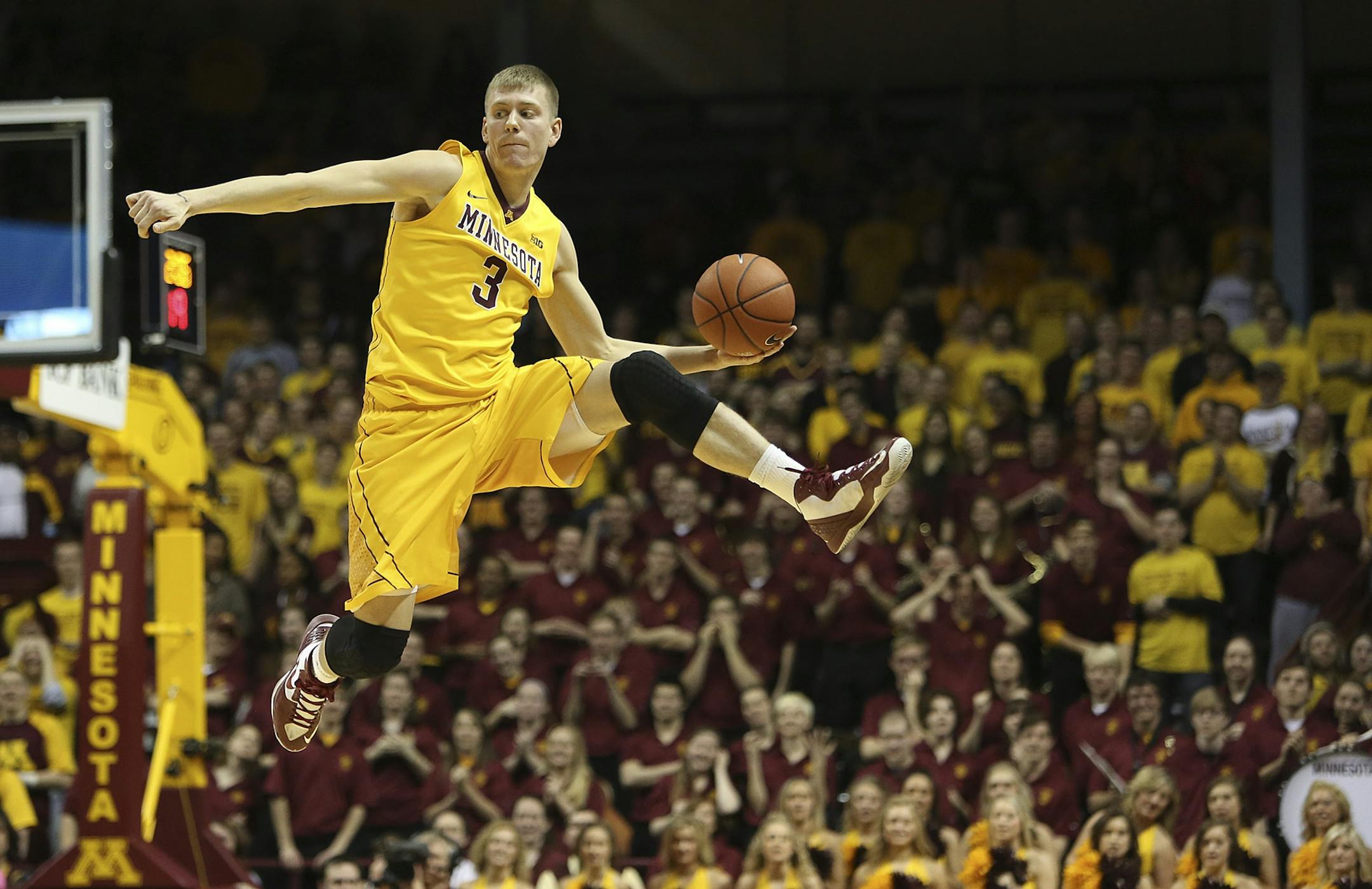
One thing is as clear now as it was when the Gophers were losing eight of 11 games: The half-court offense will never be Minnesota's bread and butter.
But when they find themselves needing half-court baskets — an inevitable scenario in the Big Ten and NCAA tournaments — Gophers coach Tubby Smith has decided to make things as simple as possible.
"I think we went back to the fundamentals, No. 1," Smith said. "We sort of narrowed what we're doing offensively as well. We limited what they could do with the ball."
That experiment has been beneficial — so much so that Smith hinted at starting guard Julian Welch and forward Andre Ingram at Nebraska on Wednesday. Those two started on senior day Saturday against Penn State, when the Gophers simply got the ball inside and overwhelmed the Nittany Lions.
Even so, the Gophers have been succeeding mainly in spite of its half-court problems: Against Indiana, Minnesota scored nearly half of its points by way of offensive rebounds and off the fast break.
But a team can't get away without some sort of functional half-court offense in this league. So in the victory over the then-No. 1 Hoosiers, Smith also relied heavily on the flex offense — basically a stripped-down offense that emphasizes constant movement by everyone and lots of back and down screens — a system the Gophers used effectively late last season when they went on a run in the NIT.
The flex can be successful because the cuts and screens are easy to remember and the philosophy essentially makes everyone's role the same. And because movement can be more easily anticipated, it can help to cut down on poor ballhandling, perhaps the Gophers' biggest weakness.
The fewer the turnovers, the more opportunities the Gophers have to work the ball into the paint, and the better chances for Minnesota to slow down the opponent and more effectively utilize their own transition game.


