

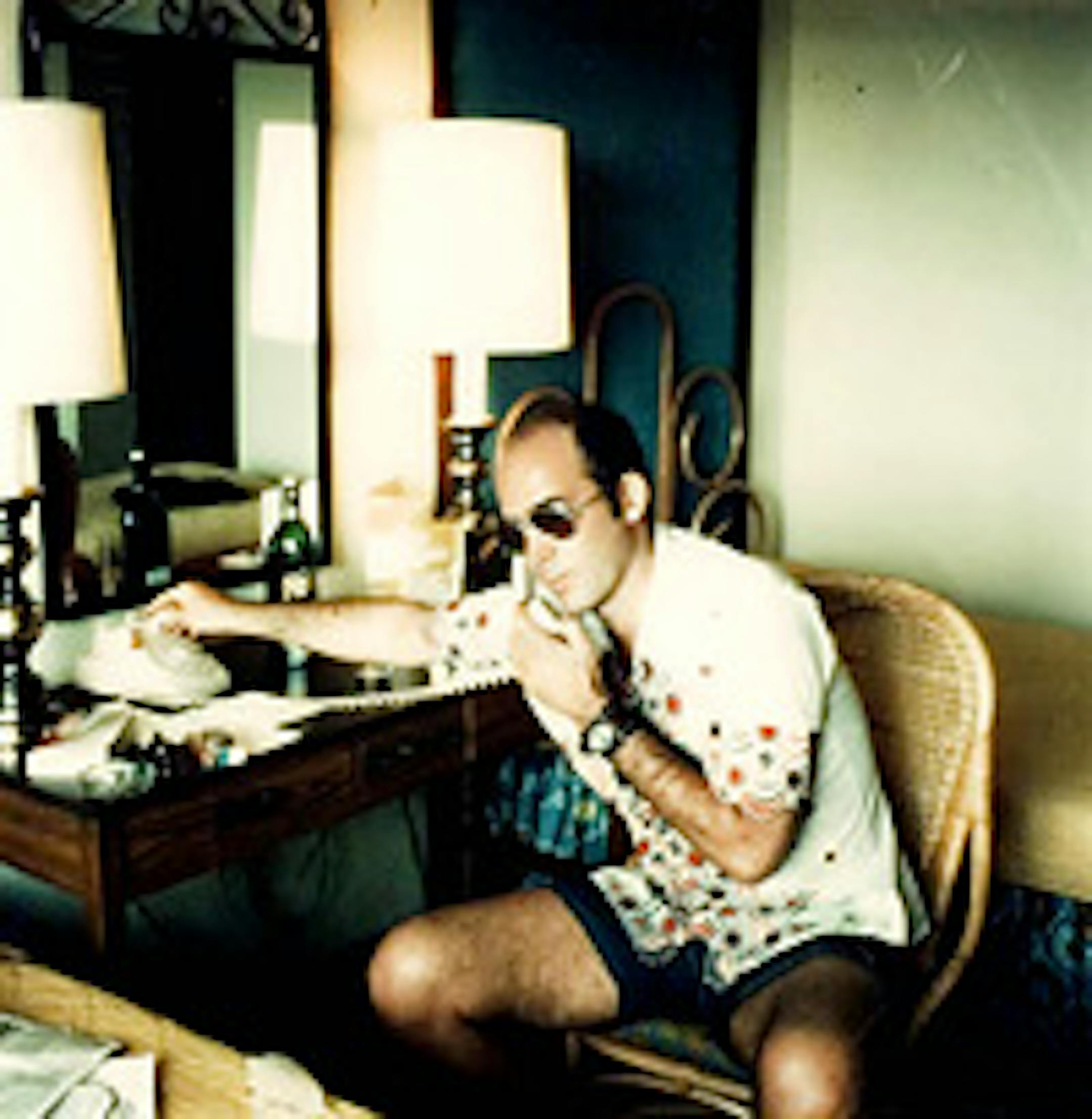
For artful hyperbole, scalding personal invective, jaundiced political analysis and drug- fueled fantasy, American news writing has never produced a wild man to equal Hunter S. Thompson. He was a troublemaker, a rule-bender and a lawbreaker. A sworn enemy of Objective Journalism, he was gleefully partisan and often brilliant. While other commentators marked the funeral of Richard Nixon in hushed and solemn tones, Thompson wrote from the gut: "If the right people had been in charge of Nixon's funeral, his casket would have been launched into one of those open-sewage canals that empty into the ocean just south of Los Angeles. He was a swine of a man and a jabbering dupe of a president. Nixon was so crooked that he needed servants to help him screw his pants on every morning." Nasty? Yes. Hilarious? Undeniably.
"Gonzo," a celebratory documentary by Alex Gibney, tracks Thompson from his days riding with the Hell's Angels to fame as a Rolling Stone political correspondent to his slow slide to suicide in 2005. It's a fond warts-and-all portrait of a writer who stands alongside Jack Kerouac and Walt Whitman as an American original.
Thompson burst onto the national scene at 26 with "Hell's Angels," his account of a year spent on the road with the outlaw motorcycle gang. It was vivid traditional reporting and became a bestseller, winning the young author a spot on "What's My Line?" But it was his invention of "gonzo journalism," mixing solid factual research and epic flights of fantasy, that won him a place in pop culture history. His writing was daring and adventurous; it took big chances and made important arguments in relentlessly funny ways.
The film's soundtrack is a greatest hits collection of period pop, but one Dylan lyric shines through: "There's something happening here, and you don't know what it is. Do you, Mr. Jones?" Thompson wrote to explain the culture and politics of the day, not to Mr. Jones, but to his bright 15- to 21-year-old kids.
It's always a challenge to make a writer's work look interesting, but Gibney ("Enron: The Smartest Guys in the Room" and the Oscar-winning "Taxi to the Dark Side") has a helpful subject in Thompson. With his love of motorcycles and guns (he kept two dozen, fully loaded, in his Aspen home) and his comfort in the spotlight, he made great pictures. Everything he did was an escapade, and still or movie cameras were around to capture most of it. Tom Wolfe, Patrick Buchanan, Jann Wenner, Jimmy Buffett and even Thompson's long-suffering first wife, Sandi Wright, reminisce about his mercurial personality and unruly talent.
Thompson's golden decade was '65 to '75, as Flower Power curdled into malcontent cynicism. The phantasmagoric travelogue "Fear and Loathing in Las Vegas" was a cultural event. His masterpiece, "Fear and Loathing: On the Campaign Trail '72" combined incisive political analysis and a highly developed disregard for authority at a time when the stakes were sky-high.
Rolling Stone colleague Tim Crouse, author of the classic campaign trail saga "The Boys on the Bus," tells Gibney: "He was the right man in the right place. He was uniquely equipped to capture a certain moment in history as no one else was equipped to do."
Thompson was in a long, slow decline during his final years, but he was still capable of prescient insights. Immediately after 9/11, he wrote:


