

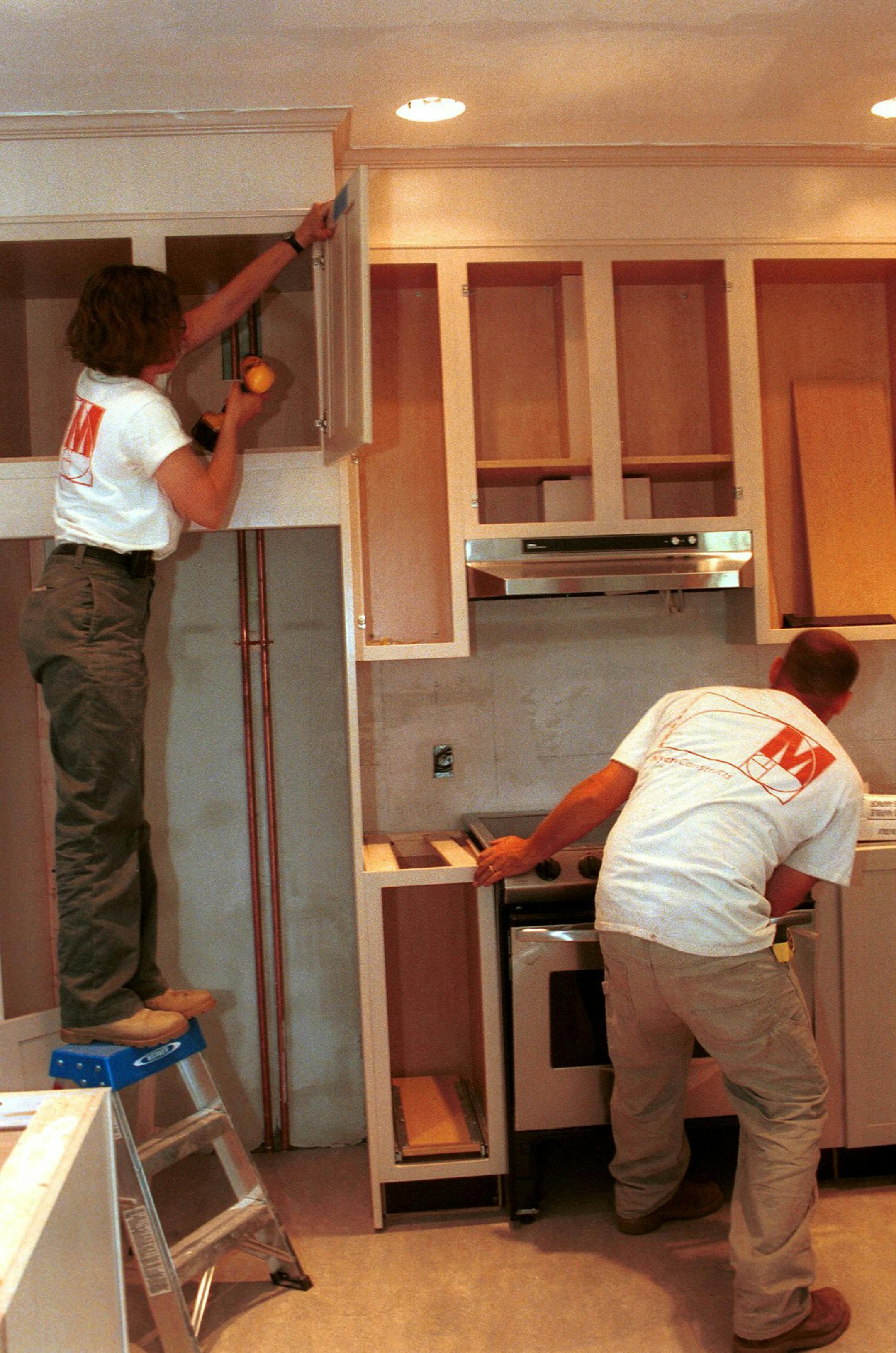
If you're remodeling your kitchen yourself or want to re-use existing or salvaged kitchen cabinets elsewhere in your home, hanging your own can save hundreds of dollars, Krista Williamson says. The owner of K2Workshops in Overland Park, Kan., offers classes on home repair and remodeling, and shares these tips for DIYers. First tip: Hanging cabinets is a two-person job.
Prep the area first by patching imperfections and priming and painting the walls. Remove cabinet doors, drawers and shelves to reduce weight and allow easy access for mounting. Mark each cabinet door and drawer so you'll know what goes where.
MEASURE
1To mark the location of your upper cabinets, determine where your lower cabinets will be. If you think your floor is uneven, find the high spot on the floor. Measure the height of your lower cabinets and mark that spot from the high spot. Measure up 54 inches from the high spot for the bottom of your upper cabinets. You may need to measure higher for shorter cabinets.
2Create level pencil or chalk lines through those two marks (a laser level or 4-foot level works best).
3Using a stud finder, mark your studs along the top line. If you don't have that tool, look for visual clues of nails or screws 15 inches apart.
HANG THE CABINETS
1Attach a 1-by-4 to the wall where you've marked your studs, matching the top of the board to the line.
2Start in a corner or wherever is most logical. With a helper, lift the first cabinet into place, resting it on the 1-by-4. Drill holes in the cabinet at the studs, and using 3-inch or longer screws, attach the cabinet to the wall at the top. If there is a hanging rail (a thicker material at the top inside), attach the cabinet through it. If not, attach the cabinet through the back of the box at the top.
3Use a level vertically to verify that the cabinet face is plumb. If not, shim by using spacers at top or bottom, and install the remaining hanging screws.


