

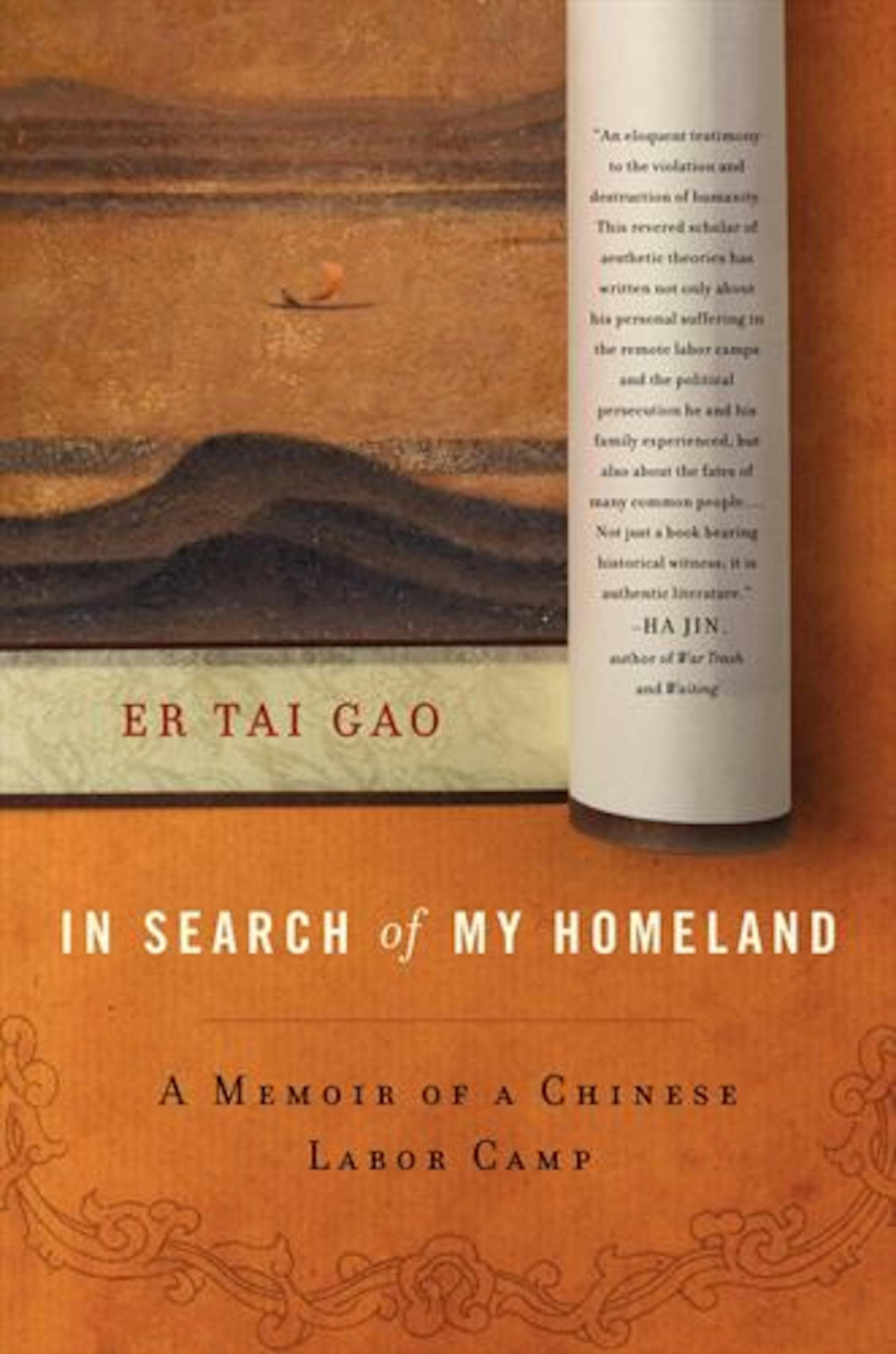
In February of 1957, a young artist and thinker published an essay in a Beijing newspaper that would determine much of the rest of his life. "On Beauty" was Er Tai Gao's meditation on what beauty is and how we perceive it.
It wasn't exactly a call for Mao Zedong's head, and it was even published during Mao's brief "Double Hundred Policy," an opening to diverse opinions, which soon closed and was followed by one of China's endless anti-rightist campaigns, many of which Gao recounts in his new book, "In Search of My Homeland: A Memoir of a Chinese Labor Camp."
Gao's simple idea was that beauty isn't some objective truth to be extracted from Leninism and/or Marxism, but rather something perceived by us personally, individually, and contingent on the life we had lived.
This hardly seems controversial to us, but Gao soon found himself perceiving the environs of the Jiabiangou Farm, a deadly work camp deep in the Gobi Desert where "Bad Elements," "Rightists" and "Counter-Revolutionaries" were sent to be corrected in their thinking, as well as to reclaim desert for the Revolution. Some 90 percent of the people at Jiabiangou died.
If this sounds bleak, it is. But for some reason "In Search of My Homeland" doesn't feel like that. Instead we see the work camp through Gao's clear eyes: The blowing sand to fill the trenches they dug, the bright blue, never-fading shirt of a fellow-prisoner, the honorable older man who tells Gao: "If you can look to the future, the present takes on meaning. You step out on a journey, and a path is made where there was none before."
Gao's journey took him out of the prison, to work as a party muralist, then back to another prison camp, and finally to the 1,600-year-old Mogao Caves, where he worked for the Ministry of Culture researching (and later sweeping) the caves filled with Buddhist murals, and where Gao's time was in some ways, more terrifying than his time in Jiabiangou. In 1966 the Cultural Revolution began, and the gentle arts scholars divided into factions, drew their knives, and turned petty disagreements into the much-feared labels, or "hats," like right-winger, capitalist roader, Three-Anti's element, evil boss man and so on.
"In Search of My Homeland" is a keen exploration of this time, when ideas had so much power but so little meaning, and a good reminder of the hard road the Chinese people have traveled. "The profundity of a work of art is dependent on the profundity of its imagery," Gao wrote in "On Beauty." We can be glad that from ugly times like those, such a beautiful book can emerge.
Frank Bures is a Minneapolis-based writer.


