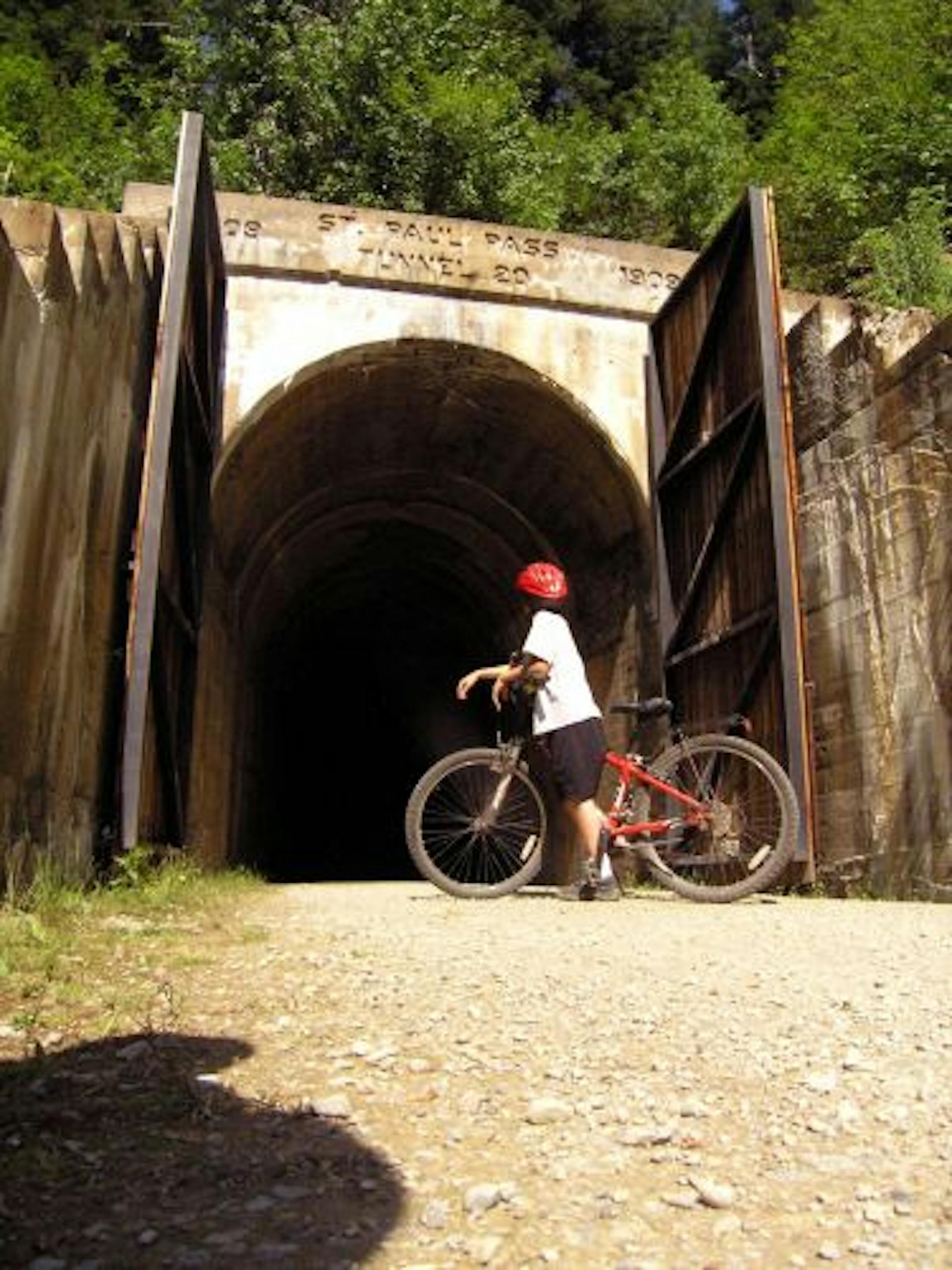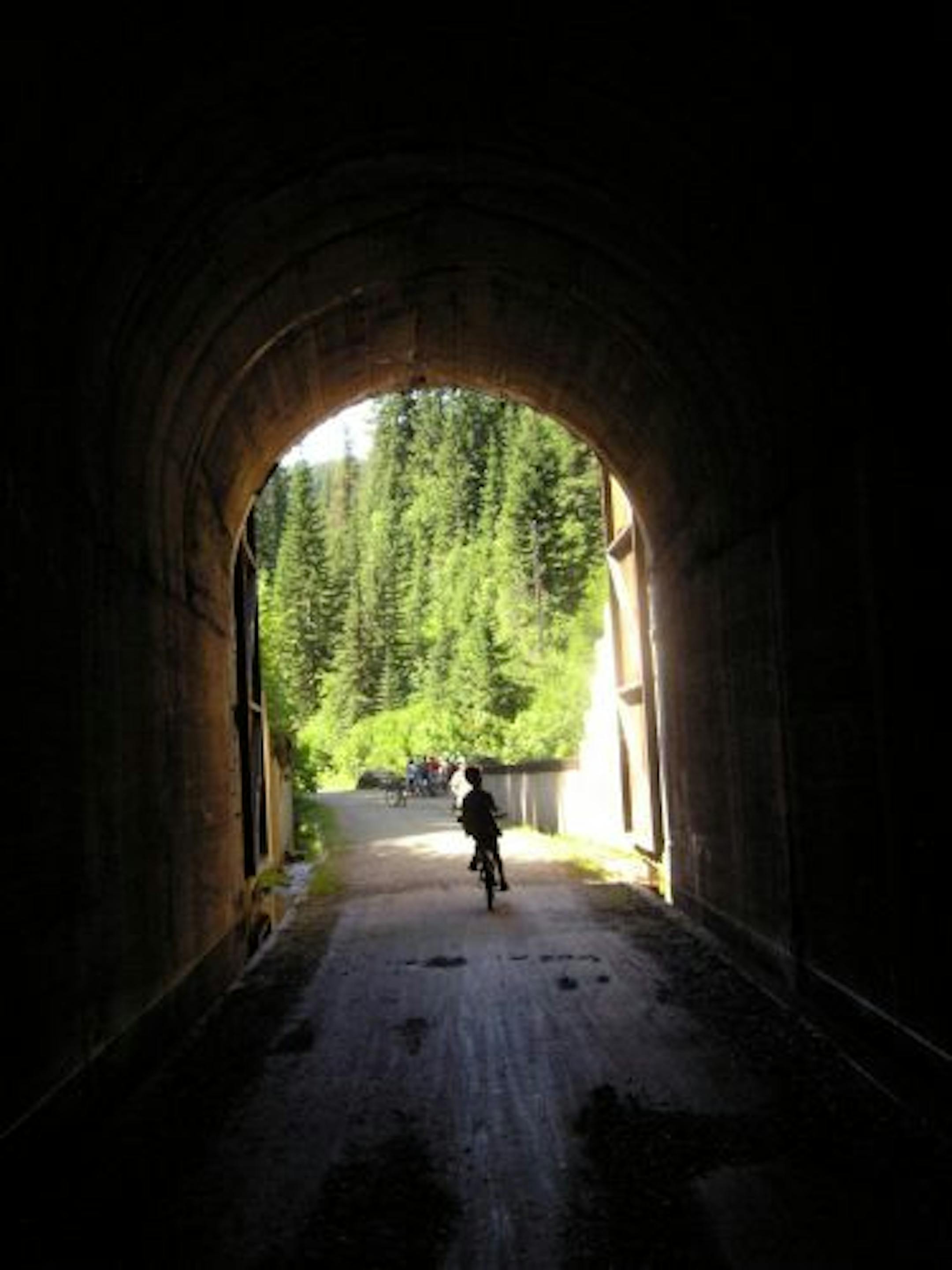
Pedaling into Taft Tunnel, which burrows beneath the Bitterroot Mountains at the Montana-Idaho border, my sons and I quickly plunged into blackness. Scents of damp rock, the sounds of water running down the walls and an abrupt drop in temperature enveloped us in otherworldliness.
The tunnel at St. Paul Pass, a signature link in the Milwaukee Road's rail route between Chicago and Puget Sound, was as tall and wide as a boxcar. It was, however, 1.6 miles long, and the head lamps strapped onto our bike helmets threw only meager beams onto the cement floor. We'd entered on the Montana side, what's known as the east portal. Several minutes passed before the west portal -- the proverbial light at the end of the tunnel -- came into view.
We emerged in Idaho, and parked next to a waterfall where we warmed up in the sun. It was just 55 degrees in the tunnel. Changing states had been big events for my sons, Patrick, 9, and Colin, 12, on our summer road trip, but this subterranean passage through the Rockies topped everything. We even changed time zones.
The Taft Tunnel was just the beginning of our ride on the Route of the Hiawatha -- a 15-mile bike path passing through 10 tunnels and across seven high trestles. Dropping about 1,000 feet from the pass to its endpoint in Pearson, Idaho, the trail is an easy downhill ride, a fact reinforced by the families, children and seniors on the trail. The hard gravel path and concrete floor of the tunnels are suitable for hybrid bikes, even tagalongs and run-behind baby carriers.
Owned by the U.S. Forest Service, the Hiawatha is one in a series of rails-to-trails spanning the Idaho Panhandle -- including the 72-mile-long, paved Trail of the Coeur d'Alenes.
The ease of rail-to-trail paths
In Idaho and elsewhere, the rails-to-trails movement has bloomed with the demise and consolidation of major railroads. The United States' rail infrastructure shrank from 270,000 miles in 1920 to 120,000 today. Some 19,000 miles nationwide have been converted to biking trails. Unlike the rugged single tracks favored by mountain bikers, rail right-of-ways are rather wide and flat -- typically less than a 2 percent grade because trains have difficulty with hills.
The Milwaukee Road, officially known as the Chicago, Milwaukee, St. Paul and Pacific Railroad, abandoned its Pacific extension in 1980. The name, Route of the Hiawatha, evokes the legacy of its premier long-distance passenger train, the Olympian Hiawatha. Orange and maroon with distinctively styled sleeper observation cars, the Hiawatha was as much admired for its aesthetics as its speed, which topped out at 100 miles per hour.