
Opinion | The Scopes ‘monkey trial’: 100 years of incertitude

The evolution case, an American cultural moment in 1925, ended anticlimactically, but the big questions live on.

July 24, 2025 at 7:59PM
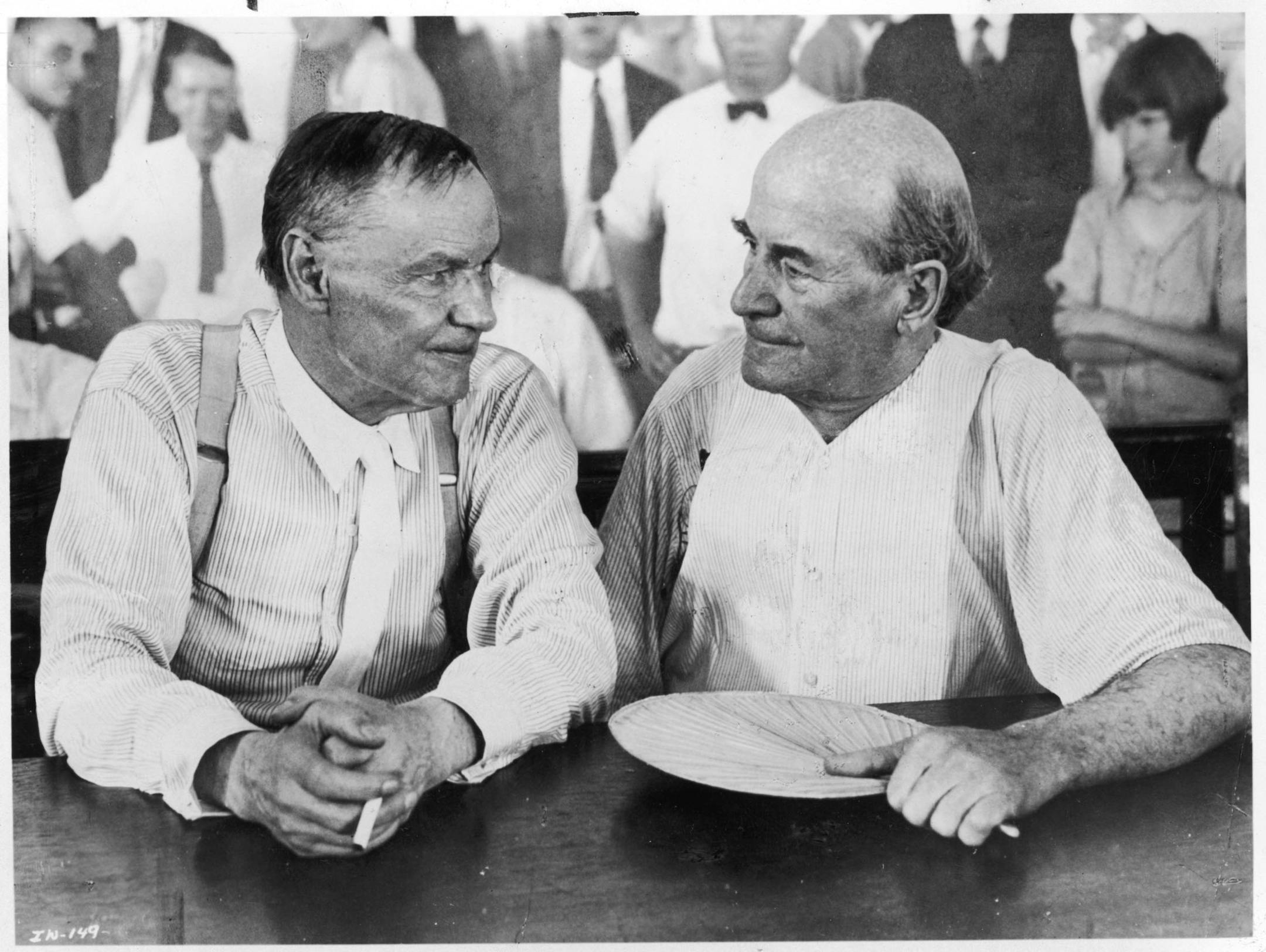
Photo made at Dayton, Tennessee, shows Clarence Darrow (left), the most famous criminal lawyer of his time, and William Jennings Bryan (right), noted lawyer & popular politician. They were rivals in the Scopes "Monkey" trial, about teaching evolution in schools, Darrow for the defense, Bryan for the prosecution.
Two "very American characters" took opposing sides in the Scopes "monkey trial," John C. "Chuck" Chalberg writes: Clarence Darrow, left, for the defense, and William Jennings Bryan, right, for the prosecution. (United Artists)

Opinion editor’s note: Strib Voices publishes a mix of guest commentaries online and in print each day. To contribute, click here.

•••

July 2025 should not come to an end without some attention paid to a very American event that took place exactly 100 years ago this month. The scene was a Tennessee courtroom, where the two main players were two very American characters, Clarence Darrow for the defense and William Jennings Bryan for the prosecution. A third character of more than minor note was the main outside observer of the proceedings, H.L. Mencken of the Baltimore Sun.

On March 21 of that year the Tennessee Legislature passed a bill making it a misdemeanor for any public school teacher to use the classroom to teach “any theory that denies the Divine Creation of man as taught in the Bible … .” The maximum punishment for violating this new law was a $500 fine.

Later that spring one John Scopes, a science teacher and part-time football coach at the local high school, was charged with violating what was already being called the anti-evolution law. Whether the case was brought to trial to test the law, or to put the town of Dayton, Tenn., on the map, or to actually prosecute a crime and thereby suppress freedom of speech in the classroom remains a matter of some dispute. But what is not disputable is the circus that resulted. On this score, no small measure of thanks must go to Mencken, both for helping to secure the participation of Darrow and for his reportage on events inside — and outside — the small-town courtroom.

In any case, given Tennessee’s current prominence in the news concerning what should or should not be taught in the classroom, and given the gradual evolution of the Democratic Party away from at least a significant element of its Bryanite past, there are more than a few good reasons to recall what has been dubbed the “monkey trial” on the centenary of its occurrence.

Bryan, known as the “Great Commoner,” was in many respects a big-government progressive. But he was also very much a traditionalist in matters of religion and morals. In both regards, he was quite the opposite of Mencken, who was at once a libertarian and a religious skeptic. For his part, Darrow shared Mencken’s theological skepticism, but he was largely in agreement with Bryan on the need for bigger and better government.

However, by the early 1920s Bryan had put all other issues aside in order to take to the Chautauqua lecture circuit to preach against the teaching of human evolution “as true or as a proven fact,” while also campaigning for local control of public education. Opposed to the notion that a teacher had a “right to teach anything that he likes,” Bryan contended that “parents who pay the salary have a right to decide what shall be taught.”

Actually, Mencken had similar thoughts. In an article in the Nation magazine he conceded that the elected officials of Tennessee could and should call the shots. The free speech of the teacher was “quite irrelevant. When a pedagogue takes his oath of office he renounces the right of free speech quite as certainly as a bishop does.” In his piece Mencken reduced said pedagogue to little more than a “paid propagandist of certain definite doctrines … and every time he departs from them deliberately he deliberately swindles his employers.”

Such a position was thoroughly consistent with Mencken’s thoughts on the nature of democracy, which he defined as the “theory that the common people know what they want and deserve to get it good and hard.” As Mencken biographer Terry Teachout translates this, “John Scopes was a fool to put himself up against the Tennessee legislature.” In sum, “if the people of Tennessee were stupid enough to elect representatives who in turn were stupid enough to pass an antievolution law, that was their business.”

Privately, though, Mencken was working with a fledgling organization called the American Civil Liberties Union to challenge the law. He also claims to have persuaded Darrow to join the defense team, all in the name of “sacrificing” Scopes in order to ridicule Bryan who, if he could somehow be lured to the witness stand might be made to “state his barbaric creed in plain English,” thereby making “a mockery of him before the world.”

Mencken also managed to persuade the Baltimore Sun to send him to Dayton to cover the whole affair. He was far from alone, since virtually every major newspaper in the country sent a reporter to Dayton. But it seems that only Mencken decided to explore the rural environs of the town. And why not? After all, for the first time in his life he was in the heart of what he had often dismissed as the “Sahara of the Bozart.” The result was one of his finest essays, “The Hills of Zion,” written after he had had a firsthand encounter with religious enthusiasm in action. Was he appalled? Not really. Was it all a comic scene? No again. The people were too much in earnest for him to draw such a conclusion.

But he might have been surprised — at least by their earnestness. Just as he was genuinely surprised by his treatment in Dayton, where he was not only warmly welcomed, but treated fairly and with friendliness, perhaps confirming the town fathers’ commercial intentions — and conflicting with the foreboding (not to mention anti-Southern-redneck) overtones to the 1960 film “Inherit the Wind,” with Fredric March assuming the role of an ex-politico akin to the harumphing Bryan, Spencer Tracy as the suspender-snapping Darrow-like lawyer and Gene Kelly as E.K. Hornbeck (or H.L. Mencken).

Mencken actually departed Dayton before Darrow’s interrogation of Bryan on the witness stand. Too bad for Mencken, since Teachout concludes that Bryan “came off looking like a rube, just as Mencken had planned.”

On the following day the judge struck Bryan’s testimony from the record, having ruled that the only matter at hand was “whether or not Mr. Scopes had taught that man descended from a lower order of animals.” The jury then deliberated for all of nine minutes before agreeing that he had so instructed his students and, therefore, was guilty. The fine was $100. The conviction, however, was subsequently reversed, and the law was later repealed by the Tennessee Legislature.

The ending was anticlimactic, but the case lives on, as it has for a century now. And the debate will live on for centuries more, as it must. Did life come from nothing or something — or someone? We didn’t know in 1925, and we don’t know today. We all have our beliefs, but we don’t know. Even Mencken the skeptic had his beliefs. He also had his doubts. Yes, the H.L. Mencken was an openly professed doubter. In truth, so open was he about his doubts that he would honestly — and tellingly — concede that “I doubt even my doubts.”

John C. “Chuck” Chalberg writes from Bloomington. He once performed around the country as H.L. Mencken, who accepted the Darwinian theory of evolution as essentially true, and as G.K. Chesterton, who very much doubted its truth.

about the writer

about the writer

John C. “Chuck” Chalberg

More from Commentaries

See More
card image
Leila Navidi/The Minnesota Star Tribune

When did we decide that the proper consequence for deep systemic failure is a soft landing?

card image
card image