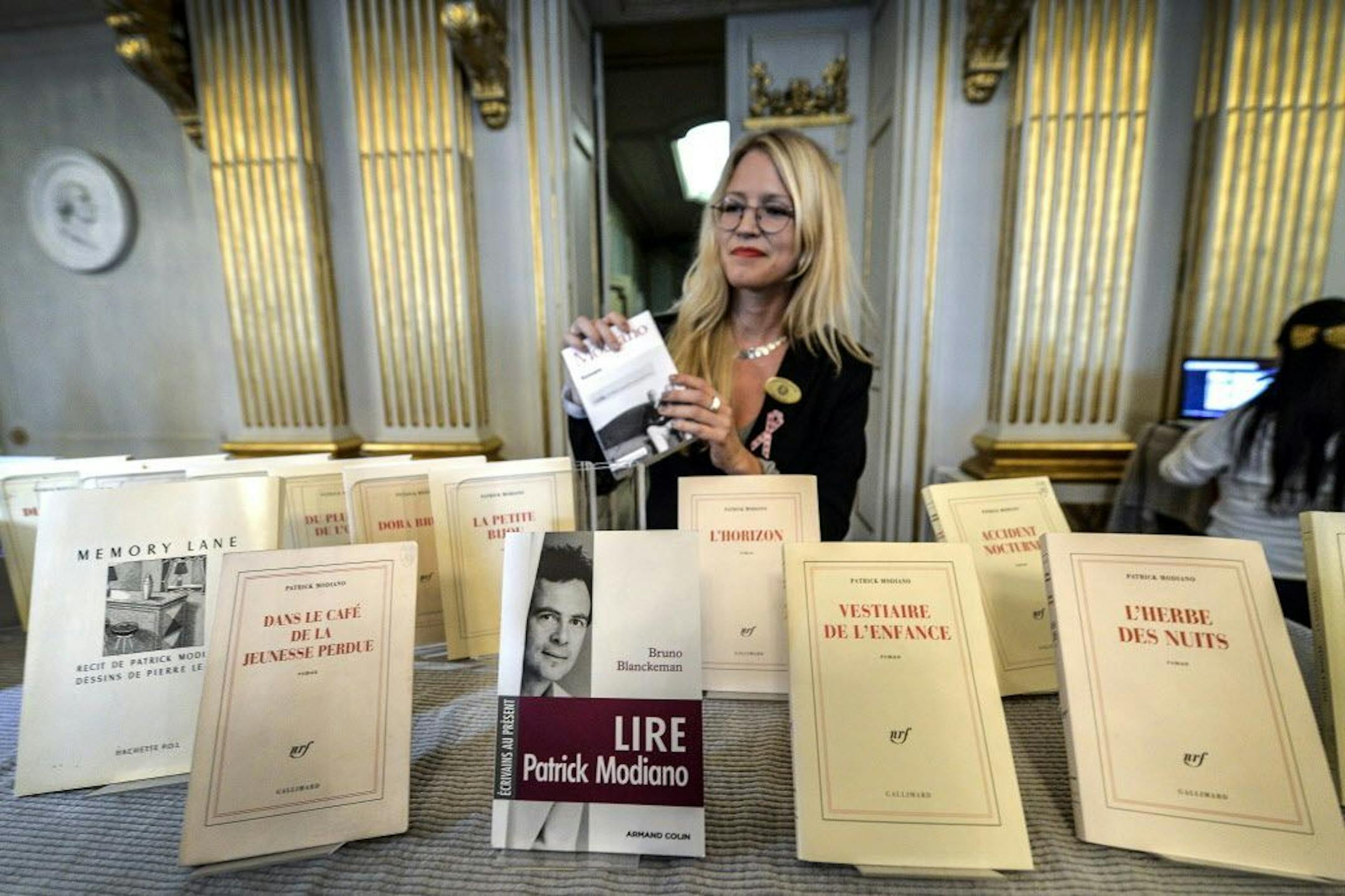
STOCKHOLM — Patrick Modiano of France, who has made a lifelong study of the Nazi occupation and its effects on his country, won the 2014 Nobel Prize in literature Thursday for what one academic called "crystal clear and resonant" prose.
Modiano, a 69-year-old resident of Paris, is an acclaimed writer in France but not well known in the English-speaking world. The Swedish Academy said it gave him the 8 million-kronor ($1.1 million) prize for evoking "the most ungraspable human destinies" and uncovering the humanity of life under Nazi occupation.
Jewishness, the Nazi occupation and loss of identity are recurrent themes in his novels, which include 1968's "La Place de l'Etoile" — later hailed in Germany as a key post-Holocaust work.
Modiano's novel "Missing Person" won the prestigious Prix Goncourt in 1978 and is among the more than 40 of his works published in French. Some have been translated into English, including "Ring of Roads: A Novel," "Villa Triste," "A Trace of Malice," and "Honeymoon."
Dervila Cooke of Dublin City University, author of a book about Modiano, said his works deal with the traumas of France's past but have a "darkly humorous touch."
"His prose is crystal clear and resonant," she said. "A common description of his work is of its 'petite musique' — its haunting little music."
Modiano was born in a west Paris suburb in July 1945, two months after World War II ended in Europe, to a father with Jewish-Italian origins and a Belgian actress mother who met during the 1940-44 occupation of Paris.
He has also written children's books and film scripts, including co-writing the 1974 movie "Lacombe, Lucien" with director Louis Malle and the 2003 movie "Bon Voyage" with director Jean-Paul Rappeneau. He was a member of the jury at the Cannes Film Festival in 2000 and won the Austrian State Prize for European Literature in 2012.