

"What is an artist?" The McKnight Foundation posed that question to recipients of 2011-12 visual art grants. You'd think that after 30 years of doling out money to "artists," the foundation would have nailed the definition. But apparently not.
While the query seems ripe for eliciting art babble and other high-minded sophistry, the four winners of 2012 visual art grants mostly dodged that temptation and just did more of what they've been doing all along. Each received $25,000 to produce new work. Their projects, on view at Minneapolis College of Art and Design through Aug. 17, reflect some of the diverse roles that artists assume today as problem-solvers, decorators, salesmen and seekers.
Problem-solver
As artist-in-residence for a 40-mile stretch of the Mississippi River known as the Capitol Region Watershed District, Christine Baeumler studies water pollution, runoff, drainage and ecosystem degradation. In her parallel life as an associate professor of art at the University of Minnesota, she uses art and design to address social and environmental issues.
With her McKnight grant she tapped her expertise to create a miniature, consciousness-raising tamarack bog atop the entrance canopy to MCAD's gallery. Improbable as that sounds, the bog is both visually arresting and evidently successful as an ecosystem. From the sidewalk, visitors see a scraggly collection of fragile-looking conifers sprouting from grasses that overhang the roof's edge. Near the door, rainwater trickles from a roof drain into a corrugated tank that sports an assortment of labels: bog, marsh, quagmire, peatland, flark, swamp, fen, wetland. A small solar-powered pump recycles the water through plastic tubing back to the roof.
The unexpected beauty and sophistication of this unlikely bog is best seen from the gallery's second-floor balcony. Visible through a glass wall, Baeumler's bonsai ecosystem has a small, dark "lake" at its center, surrounded by long, delicate grasses and a dozen miniature trees. As marshlands are nature's water purification systems, getting their chemistry right is tricky; Baeumler collaborated for a year with Barr Engineering ecologists Kurt Leuthold and Fred Rozumalski to perfect the balance of soil, water and plants that make her system self-sustaining. In this arty context, her lovely bog serves a mostly educational function but that's no small thing at a time when water quality, even in the Land of 10,000 Lakes, is constantly threatened and many people view marshes as worthless wastelands.
Decorators
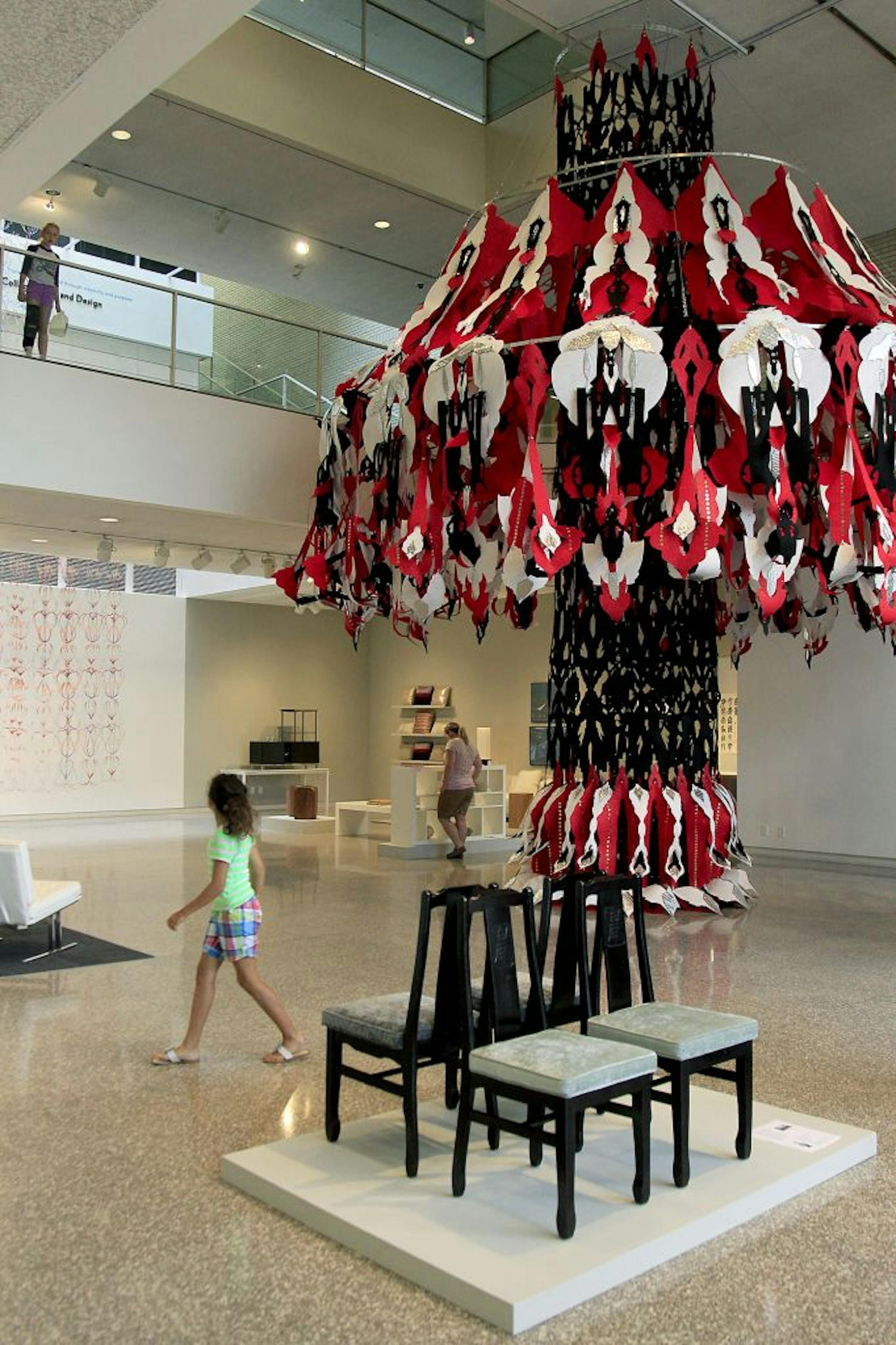
The word will doubtless enrage contemporary artists who find it trivial and demeaning, but artists have been "decorators" in the broadest sense since our remote ancestors first drew bison on their cave walls and Michelangelo set about depicting heaven and hell. Liz Miller nods to ancient ornamental traditions with a two-story fabric sculpture suspended from the gallery's ceiling. Fashioned from red, black, white and silver felt that she has stiffened and cut into elaborate, repetitive patterns, the sculpture is an imposing fantasy that invites imaginative interpretations. Her jagged shapes suggest Rorschach blots or insect silhouettes. Their colors recall playing cards, medieval heraldic devices, clothing patterns. The sculpture's explosive design suggests a tree, or perhaps a nuclear cloud.


