
Forgotten badge resurfaces 127 years after Hastings officer's death

Albert Jacobson was the first law enforcement officer killed in the line of duty in Dakota County and still the only one slain in the history of the Hastings police.

For the Minnesota Star Tribune
February 12, 2022 at 8:00PM
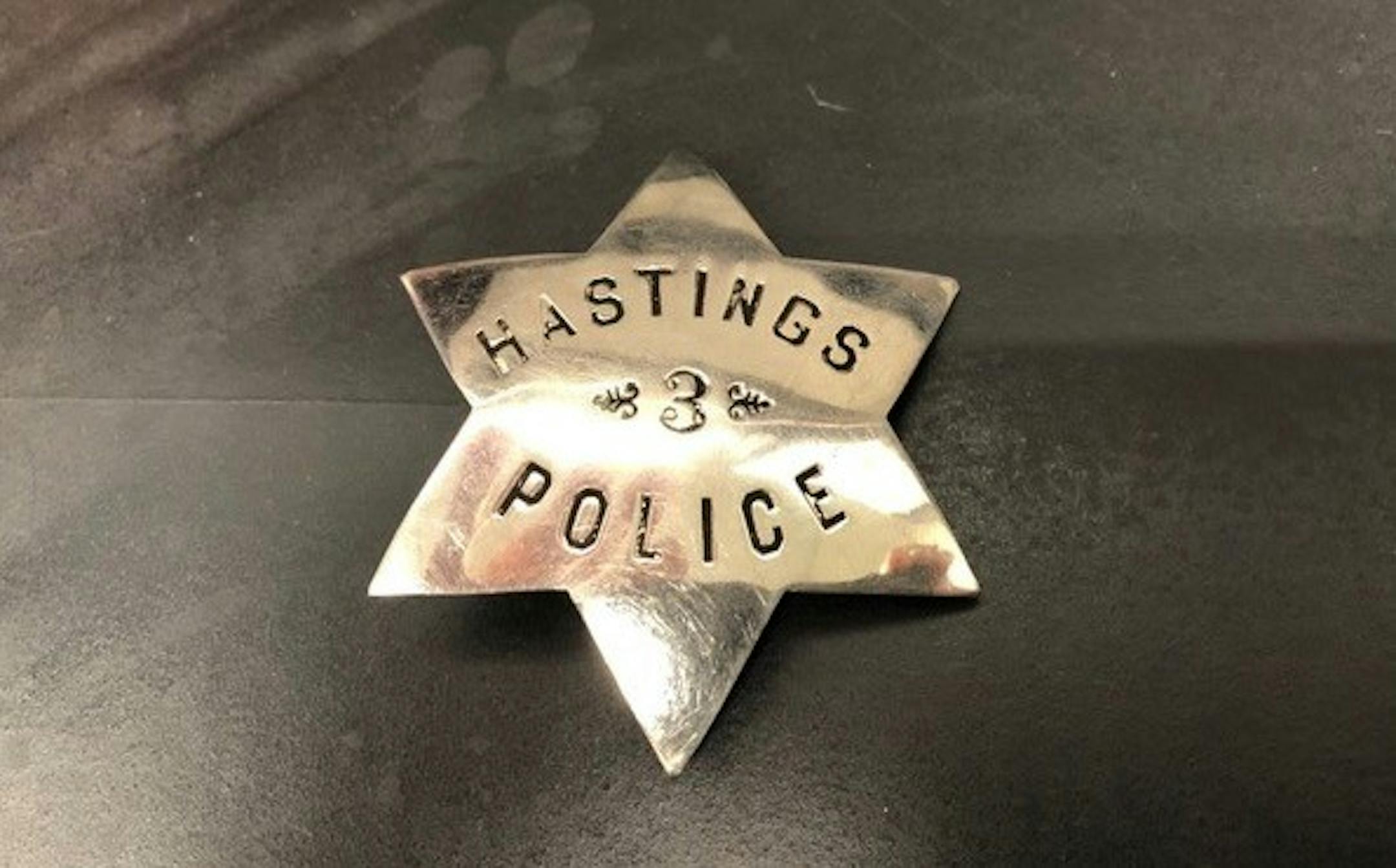
Hastings police officer Albert Jacobson wore his six-pointed silver badge for the last time on July 10, 1894. The Hastings Police Department promises to make it the centerpiece of a historical display. (Provided/The Minnesota Star Tribune)

Hastings police officer Albert Jacobson wore his six-pointed silver badge for the last time on July 10, 1894. A 33-year-old father of four with a neatly trimmed mustache, the Norwegian-born cop was shot in the abdomen while chasing a burglary suspect and died later that night — the first law enforcement officer killed in the line of duty in Dakota County and still the only one slain in the history of the Hastings police.

His badge spent most of the next 127 years "tucked away and totally forgotten" in a cedar hope chest, said Jacobson's great-granddaughter, Michele Groeneveld. "I remember seeing the badge as a kid, but no one discussed it or talked about it," she said.

When Groeneveld and her husband, Jerry, retired and moved from Hastings to Two Harbors 16 years ago, they schlepped three old family cedar chests — including one that belonged to Grandma Louise, Jacobson's daughter.

Spurred by the research of her distant cousin Gloria Hagestuen into Jacobson's tragic story, Groeneveld dug into a box in the cedar chest last summer and unearthed the old badge. It was still shiny.

"If you don't know who was behind it, it's just a piece of metal," she said. "But when you know the story and hold it right in your hand, it's like a piece of their soul — a strong, positive revelation."

Groeneveld and Hagestuen, both in their early 70s, hadn't seen each other since childhood. Their grandparents were siblings but the family had splintered over the years.

A one-time school bus driver from North St. Paul, Hagestuen has spent more than 25 years doggedly digging into Jacobson's past.

"All my life I'd heard about my great-grandfather being a cop who was killed," she said. "But I'd never even seen a photo of him."
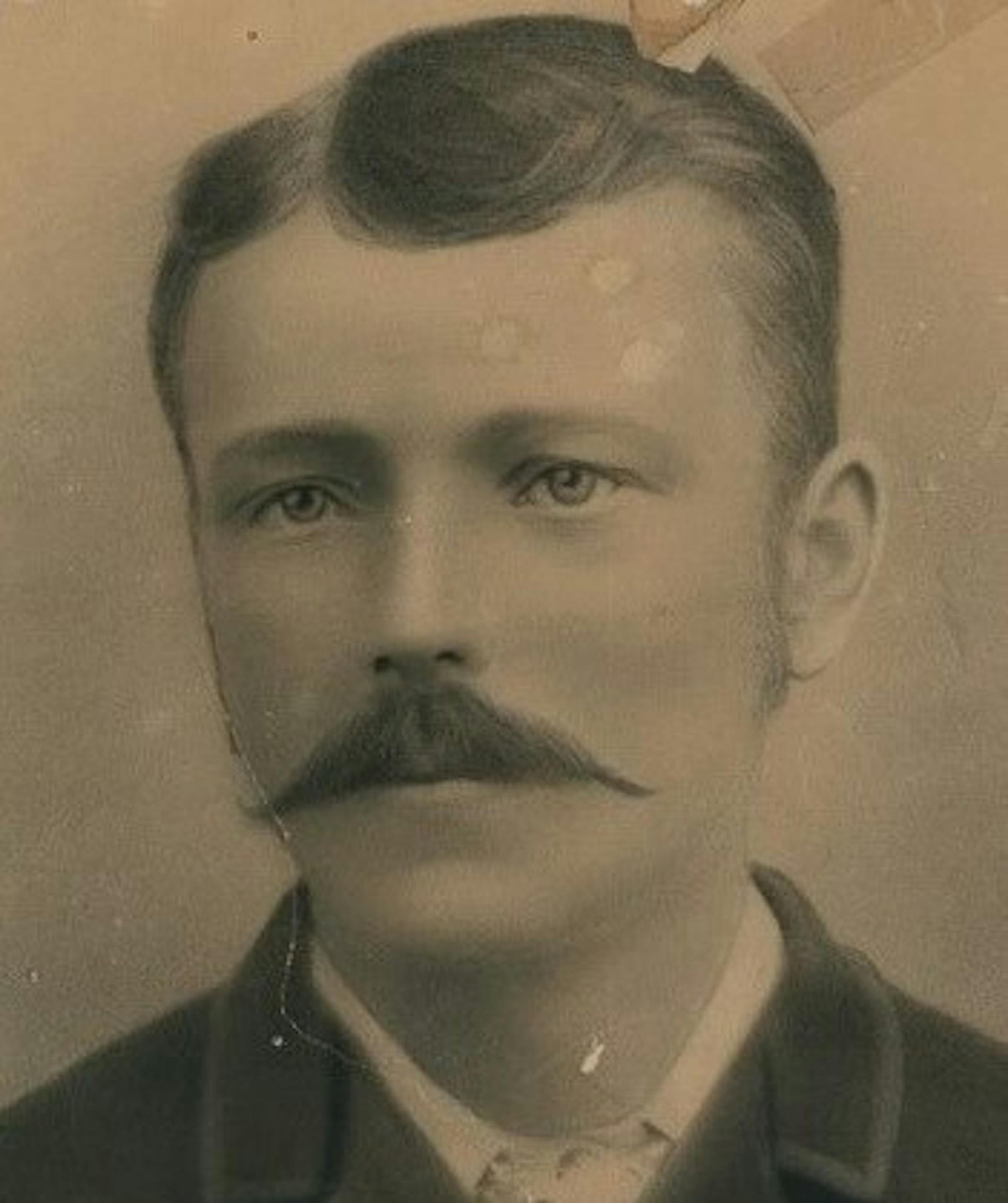
Albert Jacobson. Provided
Albert Jacobson was fatally shot in the stomach while pursuing a burglary suspect. (Provided/The Minnesota Star Tribune)

So five years ago, Hagestuen called Groeneveld out of the blue and asked if she had an image of their great-grandfather. Bingo — Groeneveld rediscovered a cracked photo in an old album.

Then last August, Groeneveld texted her cousin, who was driving up to visit. "She told me she had a surprise for me, and out came the badge," Hagestuen said.

The cousins have since presented the polished artifact to the Hastings Police Department, which promises to make it the centerpiece of a historical display.

"It was really exciting to finally fill in all the pieces," Hagestuen said.

Hastings Police Chief Bryan Schafer was as thrilled about finding the badge as the cousins.

"I was shocked and ecstatic with how Gloria connected all the dots," he said. "Sure as heck, it's 100 percent authentic."

In the mid-1990s, Hagestuen and her mother, Delores Peterson, scoured microfilm of 1894 newspapers at the Minnesota History Center to learn the details of Jacobson's last day on the job.

Jacobson and fellow officer Edward Schwartz were pursuing two suspicious men in a Hastings rail yard on the evening of July 10. They were soon to find out these "were not ordinary tramps but first-class burglars," the Hastings Democrat reported.

After one of the men was arrested, Russian-born suspect John Ivan ran off toward Lake Isabel.

"When the officers neared him the desperado fired, the bullet striking Policeman Jacobson in the stomach," the Minneapolis Tribune reported.

Avoiding Schwartz's gunshots, Ivan tossed his coat and hat, jumped in the Mississippi River and swam to the opposite shore. Schwartz commandeered a boy's rowboat and caught the knife-wielding suspect, who got stuck in a muddy slough and surrendered at gunpoint — not knowing Schwartz's revolver was out of bullets.

Jacobson died just after midnight. Ivan was convicted of murder two months later and sentenced to be hanged, but he won a gubernatorial reprieve to life in prison and spent the next 39 years locked up at Stillwater and the state hospital in St. Peter.

Hagestuen's research was news to the Minnesota Police and Peace Officers'Association, which had no record of Jacobson dying on the job. Jumping through the necessary hoops, she successfully applied to have Jacobson's name added in 1997 to the National Law Enforcement Memorial in Washington, D.C.

The next year, Schafer presented Hagestuen with an "End of Watch" cross during a ceremony at the Police Department.

That would have been a nice end to the story — but the cousins weren't done yet. Nearly two decades later, they came up with a photo of the slain officer. And now, his badge.

Schafer thinks the badge might be made of polished silver. Groeneveld and Hagestuen, who plan to get together this spring for more research, insist the old badge retained its shine and luster 127 years after Jacobson last pinned it on his uniform.

"My cousin Gloria has put such determination, heart and soul into seeing that our great-grandfather got recognized for his sacrifice to his community," Groeneveld said. "She's quietly and gracefully pursued her quest and conquered it."

Curt Brown's tales about Minnesota's history appear each Sunday. Readers can send him ideas and suggestions at mnhistory@startribune.com. His latest book looks at 1918 Minnesota, when flu, war and fires converged: strib.mn/MN1918.

about the writer

about the writer

Curt Brown

Columnist

Curt Brown is a former reporter for the Minnesota Star Tribune who writes regularly about Minnesota history.

See Moreicon

More from Minnesota Star Tribune

See More
card image
J. SCOTT APPLEWHITE, ASSOCIATED PRESS/The Minnesota Star Tribune

The "winners" have all been Turkeys, no matter the honor's name.

In this photo taken Monday, March 6, 2017, in San Francisco, released confidential files by The University of California of a sexual misconduct case, like this one against UC Santa Cruz Latin Studies professor Hector Perla is shown. Perla was accused of raping a student during a wine-tasting outing in June 2015. Some of the files are so heavily redacted that on many pages no words are visible. Perla is one of 113 UC employees found to have violated the system's sexual misconduct policies in rece