

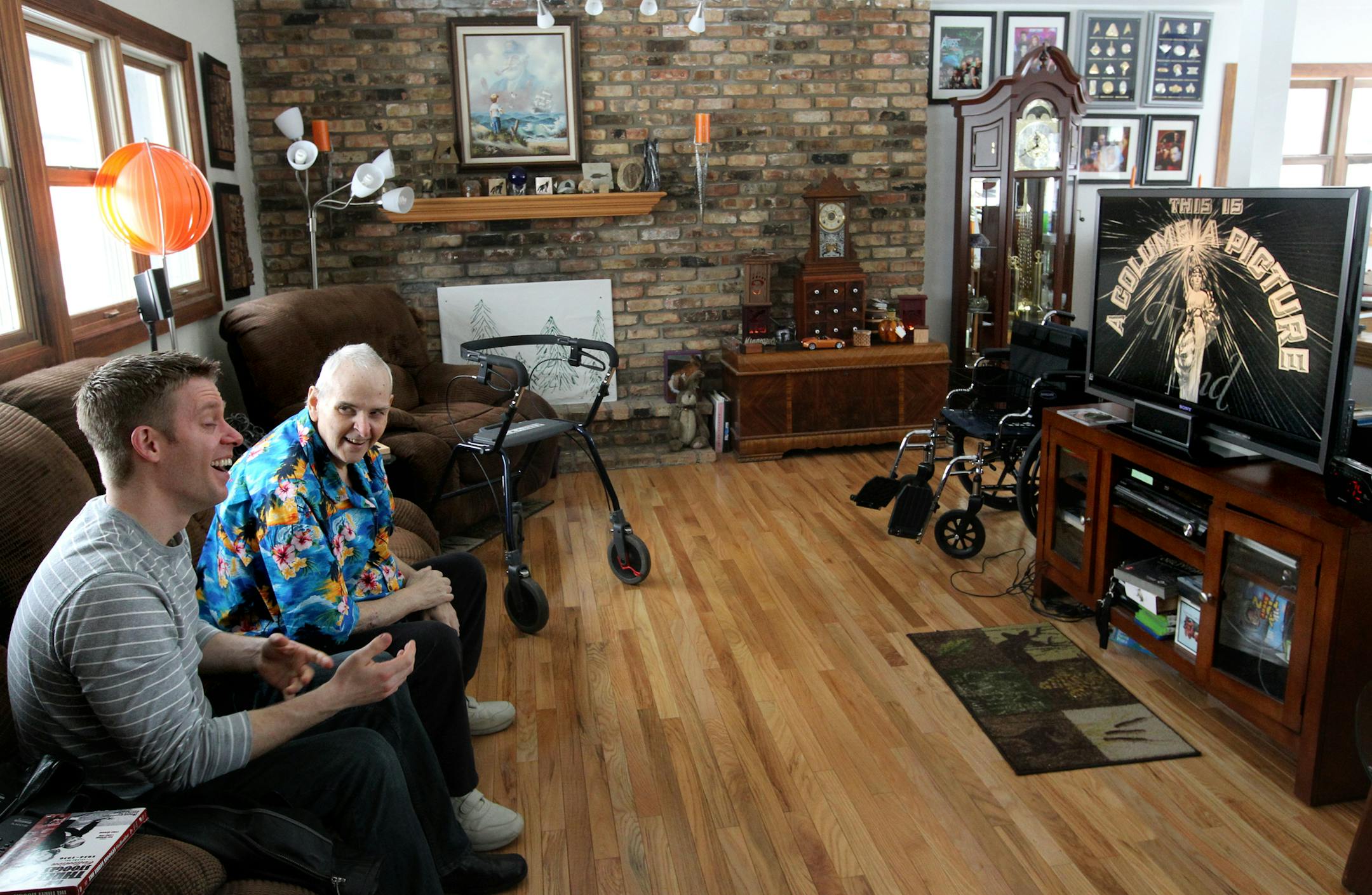
Nick Rasmussen and Bob Nell sit on the couch watching TV with the peculiar expectation common to "The Three Stooges" fans. In a scene with paint brushes and coffee mugs, they know that Larry inevitably will dip his brush into Moe's coffee. Yet when he does, it's still funny. That's the weird brilliance of the Stooges. Even when you see the joke coming from a mile away, you can't help but smile.
Their own relationship is like that. Nell is dying, which is how Rasmussen ended up on the couch as his hospice companion. Yet despite knowing how their relationship will end, they can't help but laugh.
"Nick is the first young person that I've liked right off the bat," said Nell, 63, who was diagnosed with liver disease four years ago. Their hospice relationship is unusual in its duration, given that Nell has been in hospice for two years. Yet he awaits no cure. "I'm at the point where I just move on to the next phase."
Nell's equanimity shapes how Rasmussen, 34, approaches his visits as a volunteer on the care team. Death, Rasmussen said, actually is more traumatizing "when you don't know when someone will die. This doesn't take a toll. It's a privilege."
Serving in the creases of care
We speak of "going into hospice" as if it's a place. It can be, but it's actually a philosophy of care that shifts the focus from seeking treatment to accepting life's finality.
Hospice mostly happens where you are, whether in a nursing home, a hospital or your house. Patients spend their remaining days as comfortably as possible, ideally with a dignity that can get lost amid the mechanisms of modern medicine.
Still, the word scares some people. Most people.
"They think hospice means giving up," said Sandy Nevinski, clinical director of Hospice of the Twin Cities. "Death is the final result, but it's not our focus. We believe hospice is about living — so you can make the days you have be the best they can be."
![Nick Rasmussen is a volunteer with Hospice of the Twin Cities who is visiting Bob Nell, who has a terminal liver disease. They both enjoy talking and watching the Three Stooges. ]rtsong-taatarii@startribune.com](https://arc.stimg.co/startribunemedia/TDZNPENQV2GFX5IGEDUU7B2LDI.jpg?&w=1080)


