

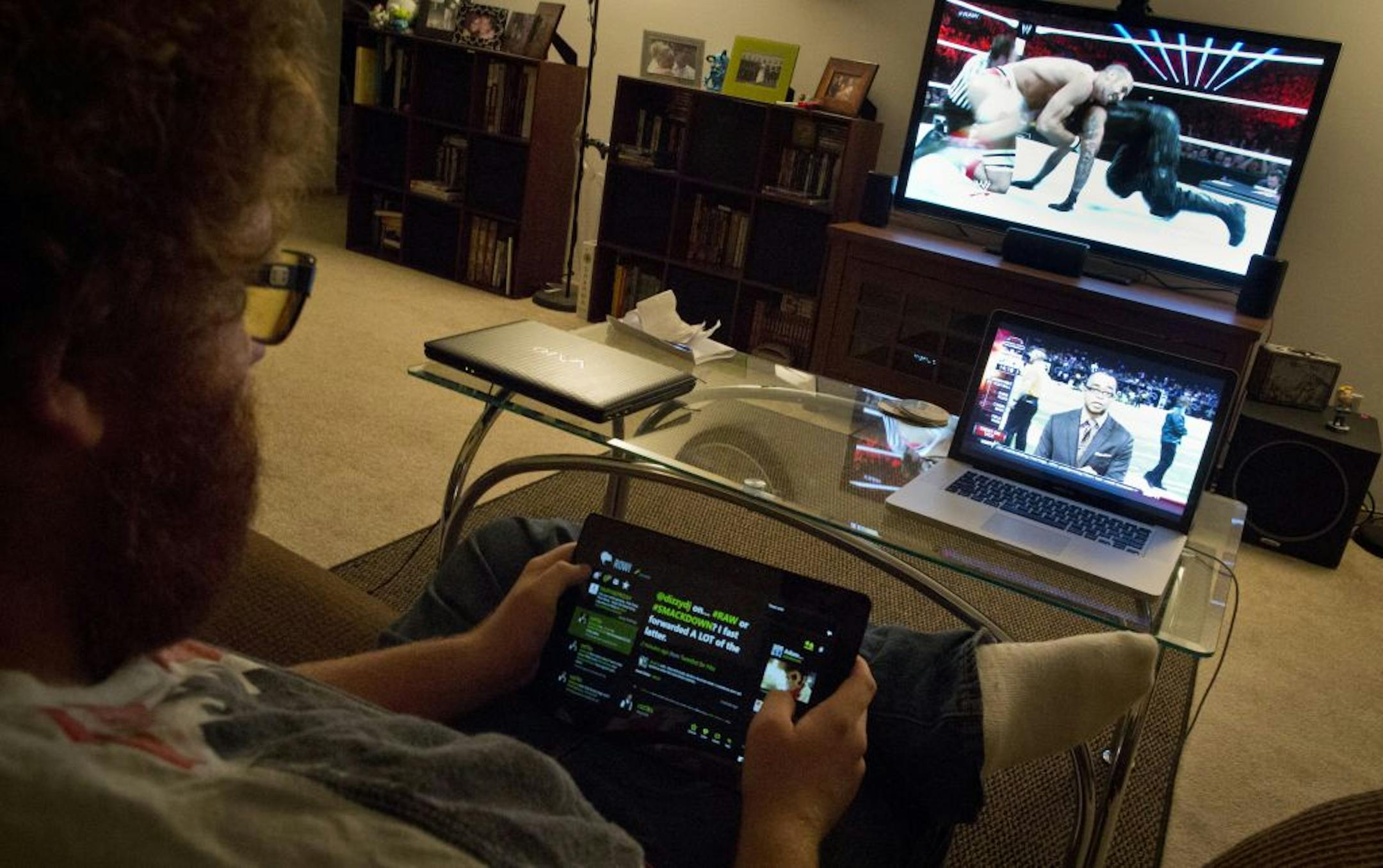
Most Mondays, Jacob Geiser watches TNT's pro wrestling with buddies who are so tight they finish each other's wisecracks. But when he sinks into the couch in his Eden Prairie apartment to enjoy the action on his 50-inch plasma screen, there's no one else in the room.
In fact, he's never even met most of his wrestling friends.
Geiser, 24, is part of a rapidly growing, potentially influential group that keeps one eye on the TV and the other on a laptop or smartphone, tweeting furiously with cyberpals about everything from an outrageous chokehold to an OMG twist on ABC's "Nashville."
"I like the idea that there are other people watching the same thing I am and that I can engage with them," said Geiser, a desktop support specialist who once spit out 250 tweets during an episode of "Lost." "There are shows I can't talk to my wife about because she's not that into them, but I can converse through social media for three or four hours."
In just a couple of years, the marriage between social media and TV watching has gone from a curious novelty to an addictive habit, one that is changing how we watch television and, perhaps, what we watch on television.
This year Americans have posted more than 750 million social-media messages on such sites as Twitter and Facebook while watching their favorite shows, according to Trendrr, a New York-based company that tracks social media. Traffic is up more than 800 percent from a year ago.
Geiser admits he misses some of the story lines while his fingers are flying across the keyboard.
"Often you can just listen to the audio and still follow what's going on," he said. "But there are definitely moments in, say, 'The Walking Dead,' where you want to look up, pay attention and watch them blow up a herd of zombies."


