

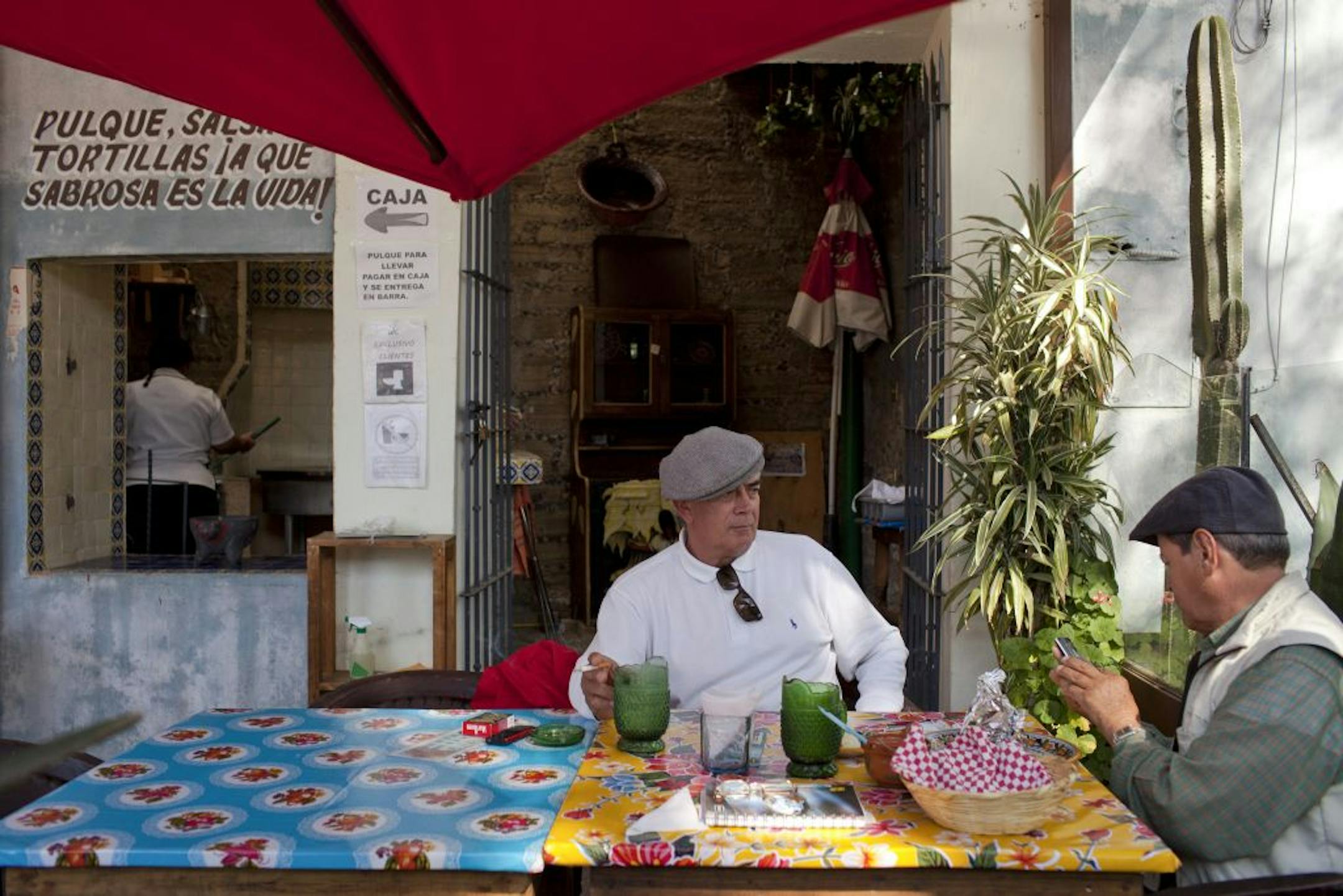
On the Sunday before Mexican Independence Day, Sept. 16, the town of Tlaxcala was overlaid with banners and lights in the red, green and white of the national flag. At dusk, there were celebratory firecrackers and, in the morning, the cloudless sky was a piercing aquamarine.Compared with the hazy-brown air surrounding Mexico City, just two hours to the west, Tlaxcala's palette is almost kaleidoscopic. The low colonial-era buildings are painted in burnt umber, salmon pink and mustard yellow, and the domes of the tangerine-toned cathedral are covered with cobalt blue talavera ceramic tiles. And unlike Mexico City, where the overwhelming traffic can feel like a glue trap, Tlaxcala has a compact center that makes an easy base for exploring the big-sky beauty of the surrounding countryside.
This is the central appeal of Tlaxcala, the small capital of Mexico's smallest state and home to about 15,000 people. It is a town built on a modest scale that has retained its historical charms -- perfect for a weekend getaway from its big-city neighbor. (It is also the seat of the safest state in Mexico, with a low crime rate to match.)
Tlaxcala (pronounced Tloks-KA-la) is set amid a sweeping valley where maize and chilies have been cultivated in the rich, volcanic soil since pre-Columbian days. The twin Popocatepetl and Iztaccihuatl volcanoes stand tall in the distance, capped in snow, with Popo occasionally smoking. On this fertile earth, Tlaxcalan ancestors built cities of stone and painted them with depictions of jaguars and feathered serpents; they warred with a powerful rival nation, the neighboring Aztecs. When the Spaniards landed, the area's indigenous warriors allied with the European conquerors.
In the centuries that followed, about 1,000 haciendas were built in the state -- large, rural estates that grew a mix of Old and New World crops, raised livestock and produced pulque, the slimy, fermented sap of the agave plant (known in Mexico as maguey). Today, about 200 or so haciendas remain, clusters of churches, stables and schools rising above the cornfields. Most are decaying relics, but about a dozen have been restored and are open to visitors, either as hotels packed with antiques and artifacts or as restaurants. In the landscape of central Mexico's highlands, these crumbling adobe and stone complexes give an eerie, cinematic glimpse into Mexico's gilded age.
Drinking in the highlands
Head to the small town of Huamantla, about 45 minutes from Tlaxcala, and you'll find Soltepec, the best known of the functioning haciendas. It towers above the surrounding farmland like a castle, with imposing stone towers and a tall wooden door. The hacienda reopened in 1994 with a swimming pool, tennis courts and a white-tablecloth restaurant. The rooms are drafty and, in the evenings, when only the overnight guests remain, Soltepec's maze of narrow, high-ceilinged hallways can feel like a south-of-the-border answer to the Overlook Hotel in "The Shining."
On the afternoon of my visit, Soltepec's owner, Javier Zamora Rios, had agreed to take me on a tour of the Tlaxcalan countryside. I had told Zamora, who often takes his guests to visit Tlaxcala's rural haciendas, about my appreciation of pulque -- a viscous, white, lightly alcoholic beverage, historically brewed on these rural estates.
We'd planned to meet after breakfast, but Zamora, who also holds a job at the state tourism office, was running late. Stuck in a meeting, he sent an emissary, Ruben, who took me to a 500-year-old Roman Catholic church in San Lucas, Huamantla's oldest neighborhood.


