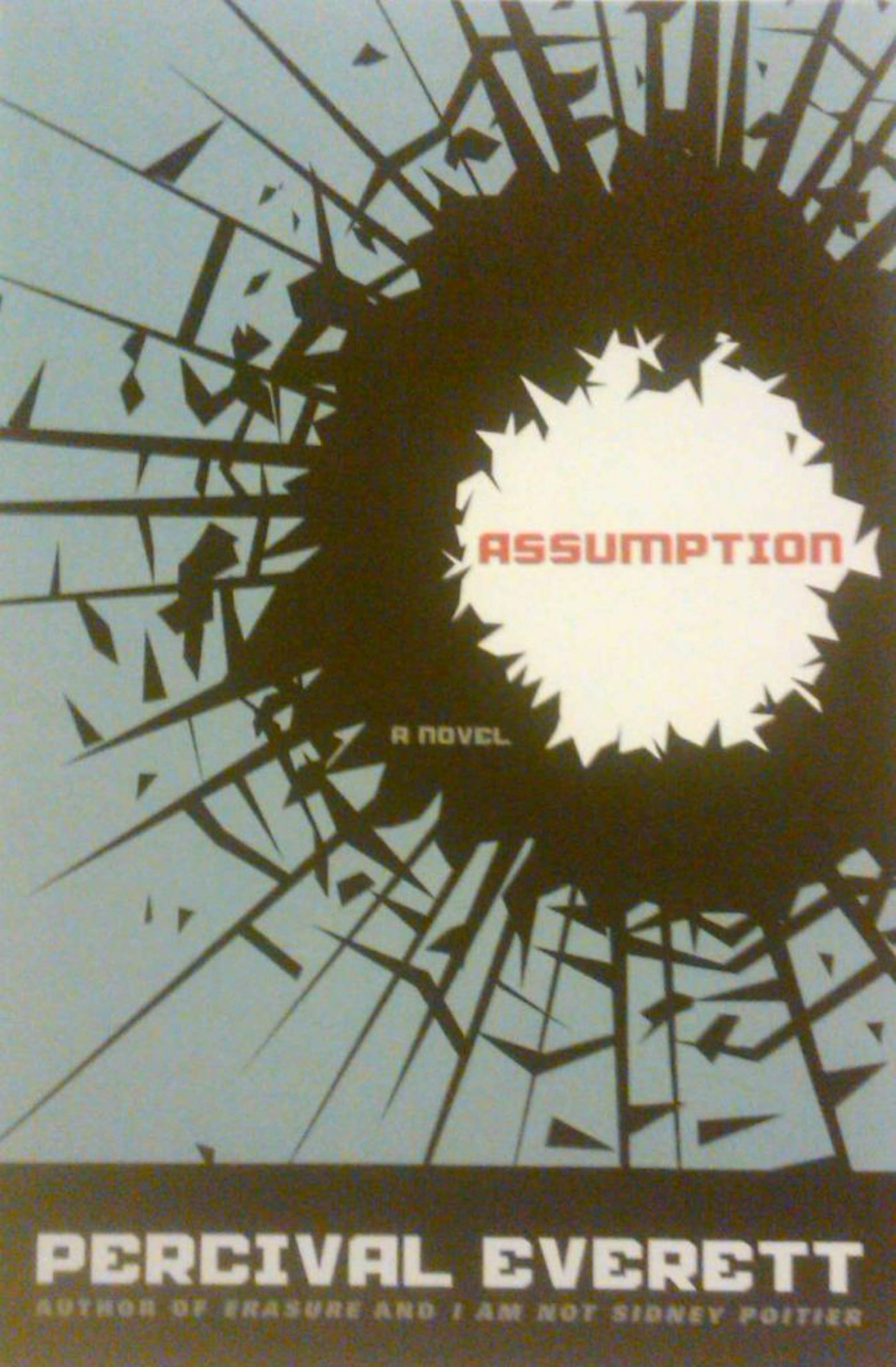
'Assumption" is Percival Everett's 22nd book, most of them novels or short-story collections. He is one of the lesser-known prolific, talented American novelists -- maybe because a smallish publisher in Minneapolis serves as his medium, maybe because he is a black man in a reading world dominated by Caucasians, maybe because he is a college professor (of English, at the University of Southern California) who tends to eschew publicity, maybe for other reasons I cannot explain.
In any case, "Assumption" can be described using some of the same phrases that apply to previous Everett books (I have read 20 of the 22): literary, mostly comprehensible but at some level baffling, about race and class in America but not primarily about those phenomena, well plotted and utterly unpredictable.
Describing Everett's plotting is always tricky, because readers of book reviews do not want to encounter a spoiler sentence. So, carefully, with no spoilers, here is a plot summary of "Assumption":
Ogden Walker, born to a black father and white mother but seemingly unconcerned about his racial heritage, served as a police officer in the U.S. military and returned home sort of aimless. That home, a small town in New Mexico, accepted Walker's application to become a deputy sheriff. As "Assumption" unfolds, Walker is investigating what appears to be a murder of an elderly woman. That case is wrapped up, more or less, on page 97. In the next section, Walker is investigating an apparently separate crime. That case is wrapped up, more or less, on page 172. Walker becomes involved in a third case, which ends at the end of the novel, page 225. But to say the third case is "wrapped up" would be less than accurate.
On that final page, talking to a fellow deputy, Walker mentions that the word "live" (as opposed to the word "die") is "evil" spelled backwards. And the word "lived" (past tense) is the word "devil" spelled backwards. Until near the end of the novel, readers have been led to believe that Walker is a sheriff's deputy with a conscience, a man not particularly enthusiastic about his job, not a whack job when it comes to crime, but capable and hardworking. Is Walker, in fact, something other than that?
Everett does not provide clear answers. He does provide enough clues so that readers will need to formulate their own conclusions based on evidence presented in Everett's fictional realm.
As always, this Everett novel is unsettling. Readers who prefer gift-wrapped endings should stay away. All other readers should enter.
- Steve Weinberg is a member of the National Book Critics Circle. His study of Everett's oeuvre appeared in the March-April 2006 issue of Bookmarks magazine.