

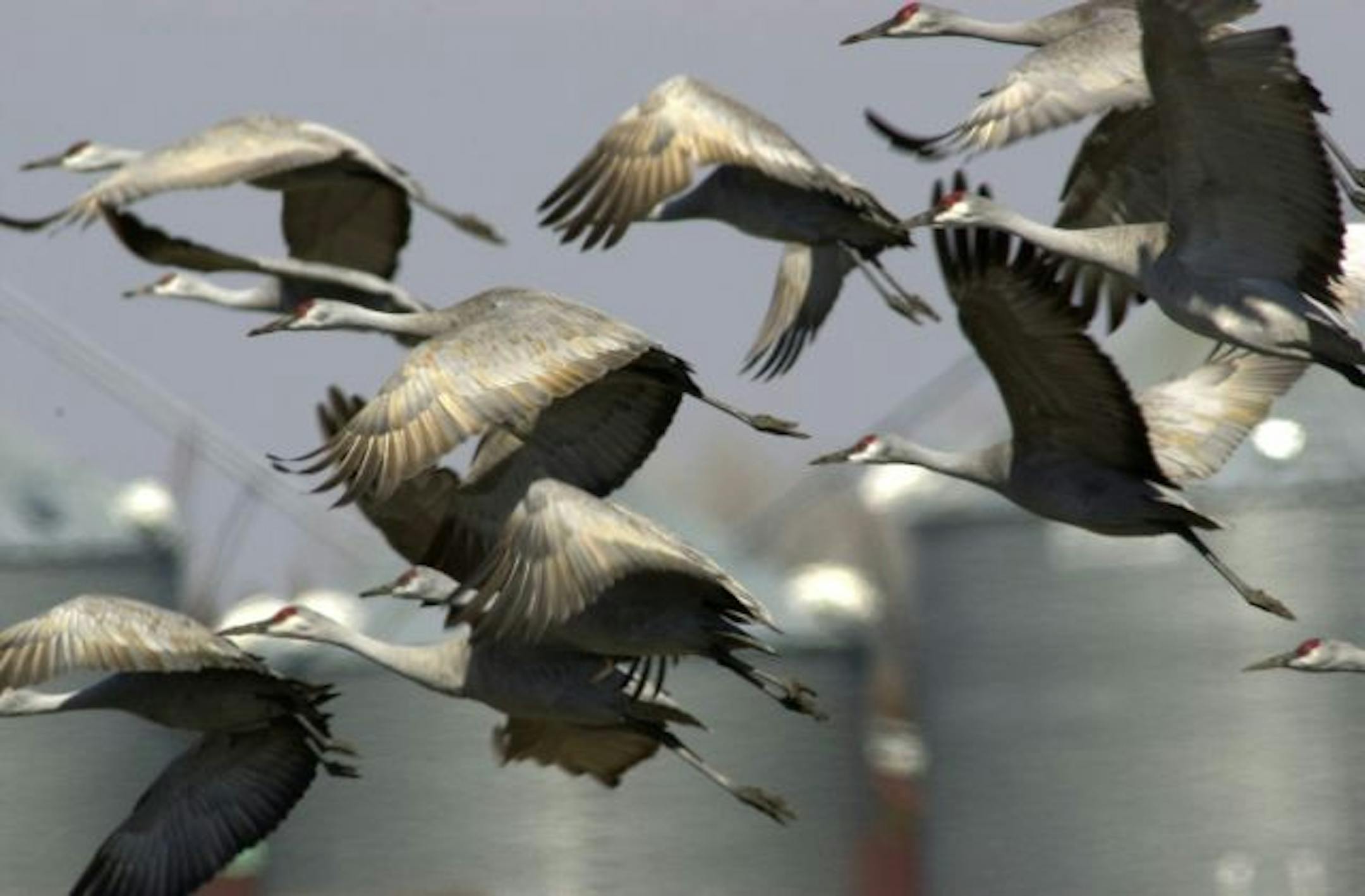
In the moments before daybreak, as braids of river, silty sandbars and tufts of prairie emerge from darkness, thousands of gray-feathered sandhill cranes are chattering as softly as a snore. A young eagle, a predator, flies upriver, and it is as though the Earth has moved: Several hundred cranes rise in a swarm, their 6-foot-wide wings working mightily, their voices clamoring in alarm. A minute passes, then two, and the frightened cranes descend -- long legs dangling, wings held open for a parachute landing -- to the Platte River to regain a place among those that did not budge because it is not time. Time, on this river in the middle of Nebraska, comes in many dimensions, but none as epic as the spring ritual that has occurred for thousands of years, when migrating cranes stop at the Platte to fatten up before continuing toward the Arctic. Snow geese arrive before the cranes each February, and a rich array of songbirds -- the Nashville warbler, Harris's sparrow and gray-cheeked thrush among them -- continue to visit into May. But it is the cranes, a half-million or more of which make the Platte their home until early April, that attract a human migration. Visitors from around the world gather in the predawn dark at spots along a 50-mile stretch of the Platte between Grand Island and Kearney. They silently shuffle along the riverbank and take their places on viewing platforms or, at Audubon's Rowe Sanctuary, in well-built blinds.
When the cranes awaken, the birds' long necks arcing as parents call out to offspring, males search for females, and all prepare to fly to the fields for a day of feeding, while the humans witness and wonder.
Erna Pihlar, who was born in Slovenia but for decades has made her home in Omaha, watches as two birds dance.
"I'm calling them ballerinas," she says. "It would be nice to have Darwin here, so he could tell me exactly what is going on."
She listens as the cranes chorus.
"Their voices," Pihlar says, in a whisper. "It reminds me of an elephant, but more fine. It is prehistoric."
Birds dine on corn, mice
When settlers arrived in central Nebraska not even two centuries ago, they found a Platte River that came to be described as "a mile wide and an inch deep." Development and dams have since thinned the flow, narrowed the river, and turned many sandbars into thickly wooded riverbanks. No good for cranes.


