

On matters of faith, even tiny gestures can cause an uproar. Take the number of fingers raised in a Christian blessing.
The Russian Orthodox church split apart more than 350 years ago in a squabble about fingers and other liturgical matters that might seem inconsequential today. For centuries the faithful had used a two-fingered blessing to signal that Christ was both divine and human. Then about 1650 a new church leader added the thumb, making the official gesture a three-digit affair that deeply offended traditionalists.
When they balked, the church divided, the czar stepped in, and the squabble escalated into a tax showdown and persecution of the Old Believers, as they came to be known.
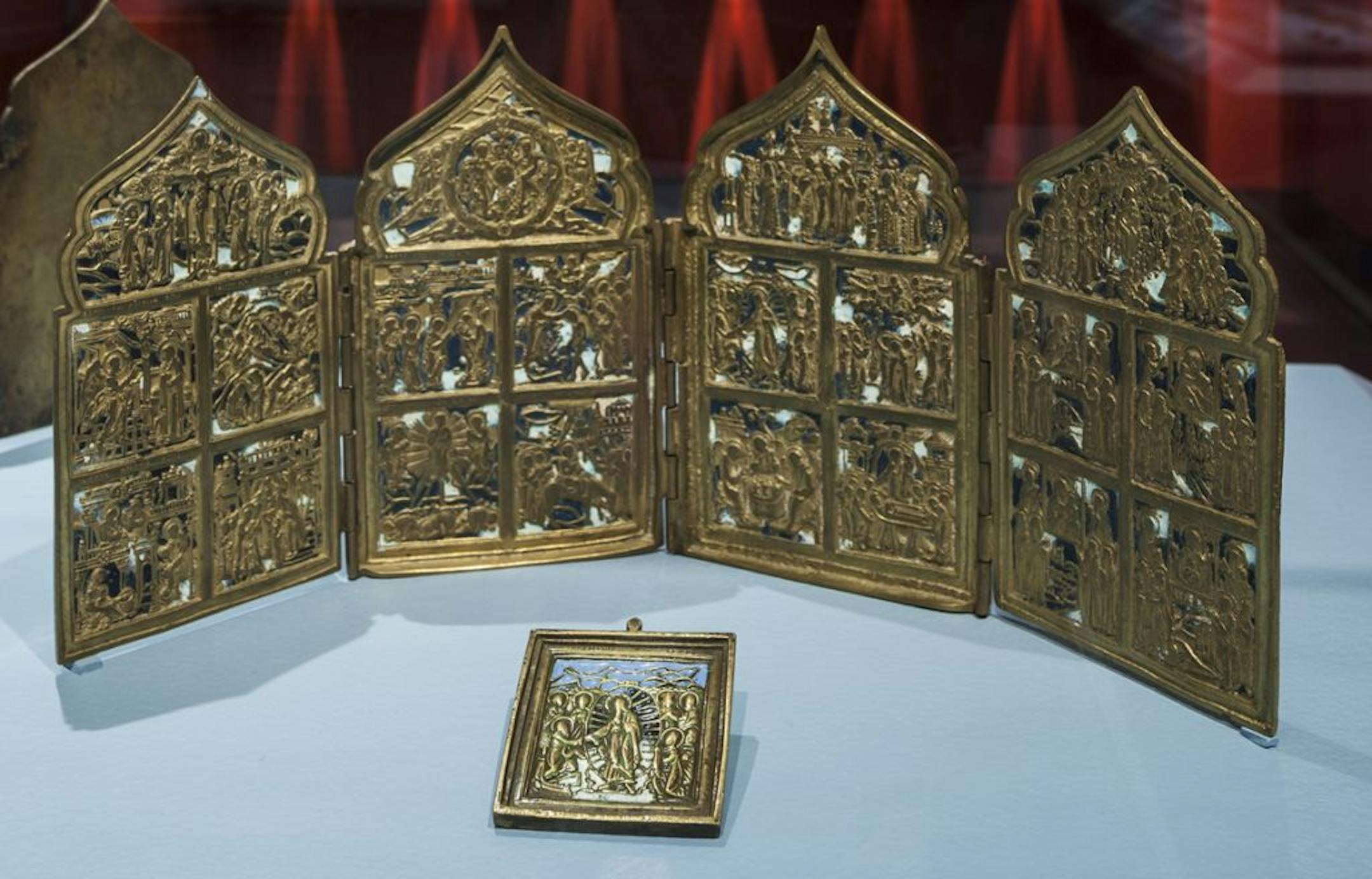
If the Old Believers hadn't been such skillful artisans, none of this would matter much to outsiders. But they were very talented indeed, as an elegant jewel-box of an exhibition proves at the Museum of Russian Art (TMORA) in south Minneapolis. On view through Jan. 20, "Cast Icons: Preserving Sacred Traditions" presents more than 100 gleaming bronze-and-enamel sculptures about the size and shape of book covers. Each is a little essay in Christian storytelling, with the beautiful bronze images enhanced by lovely backgrounds of pale blue enamel, or picked out with lime green, gleaming black, or flecks of sparkling white enamel.
As always at TMORA, the installation is exemplary. Gold lettering and walls of azure and red complement the art; historic photos and informative texts provide context, and magnifying glasses amplify details on some pieces. Gleaming like burnished gold, the icons are expressions of an ancient faith whose appeal reaches across the centuries to sparkle again in this fetching display.
Old Believer communities
Concentrated around the Vyg monastery near the White Sea in northwestern Russia, Old Believer communities cherished cast-metal icons as "incorruptible images" that had been purified by fire.
Foundries in the area became expert at producing intricate biblical scenes in bas relief panels that were hinged to fold like devotional books or stand open like little personal altars. Larger, cross-shaped icons were displayed on church altars or held aloft in processions.


