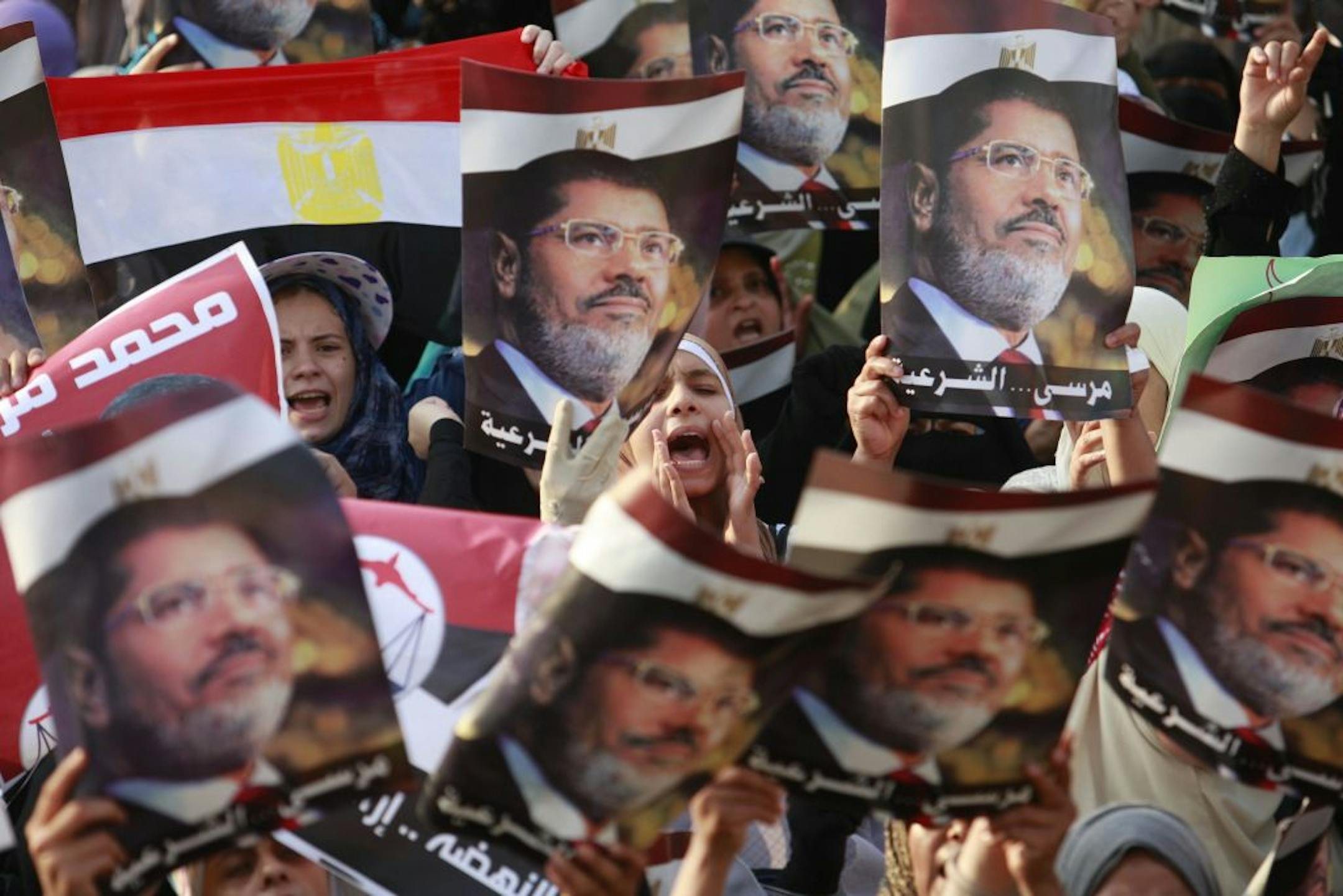
Two men I admire, U.S. Sen. John McCain and Robert Kagan of the Brookings Institution, have recently argued that the United States should suspend aid to Egypt after the army coup last week that ousted President Mohammed Morsi of the Muslim Brotherhood.
"We cannot repeat the same mistakes that we made at other times in our history by supporting the removal of freely elected governments," McCain said. Kagan says that continuing aid to the Egyptian military will eventually be a source of embarrassment.
Given that the Egyptian army appears, at least according to initial reports, to have committed a massacre against Muslim Brotherhood members, the case McCain and Kagan made looks fairly strong. And it is no use arguing, as President Obama's administration seems to be, that what happened in Egypt last week wasn't a military coup. It was, even though it came with an asterisk: The coup might not have happened had millions of Egyptians not taken to the streets to demand Morsi's ouster. But to keep the aid flowing, the White House and Congress would need to find an exception to their own rules, which require suspending aid to countries when their leaders are deposed by military force.
Finding a loophole could well be worth it: Cutting off aid might accelerate Egypt's self-destruction, and harm American interests in the Middle East. Here are four reasons why:
1) Before this coup, there was another coup — and I'm not referring to the events that brought about the downfall of the Egyptian dictator Hosni Mubarak in 2011. In November, Morsi initiated an internal coup, placing himself, by decree, above the law to make sure that his Islamist constitution would be approved.
It was at this moment that the Obama administration should have considered suspending aid. As we now know, the White House didn't consider doing very much at all. It maintained its close relations with Morsi and mostly ignored the intense anger his actions sparked among Egyptians, anger that eventually exploded last week in mass demonstrations against his rule.
If the United States cuts aid now when it refused to do so after Morsi's grab for absolute power, it will permanently alienate the millions of Egyptians who believed, with good reason, that Morsi was attempting to turn himself into an Islamist Mubarak. And these Egyptians — the ones who demonstrated against Morsi last week — are precisely the sort of liberals (or, at least, antifundamentalists) the U.S. should be cultivating.
2) Egypt's military is preventing the Sinai Peninsula from becoming a haven for Al-Qaida and similar groups. If terrorists take over stretches of Sinai, they will launch attacks on Israel. Israel will respond by invading Sinai (again). This is not something the U.S. wants. What the U.S. wants is to maintain leverage over the Egyptian military in order to encourage it and equip it to prevent the spread of Al-Qaida-like extremism. Chaos in Sinai is not only a threat to Israel, but also to Jordan and the United States. Chaos in the streets of Cairo and Alexandria isn't in U.S. interests, either, and that appears to have been where Egypt was heading last week.