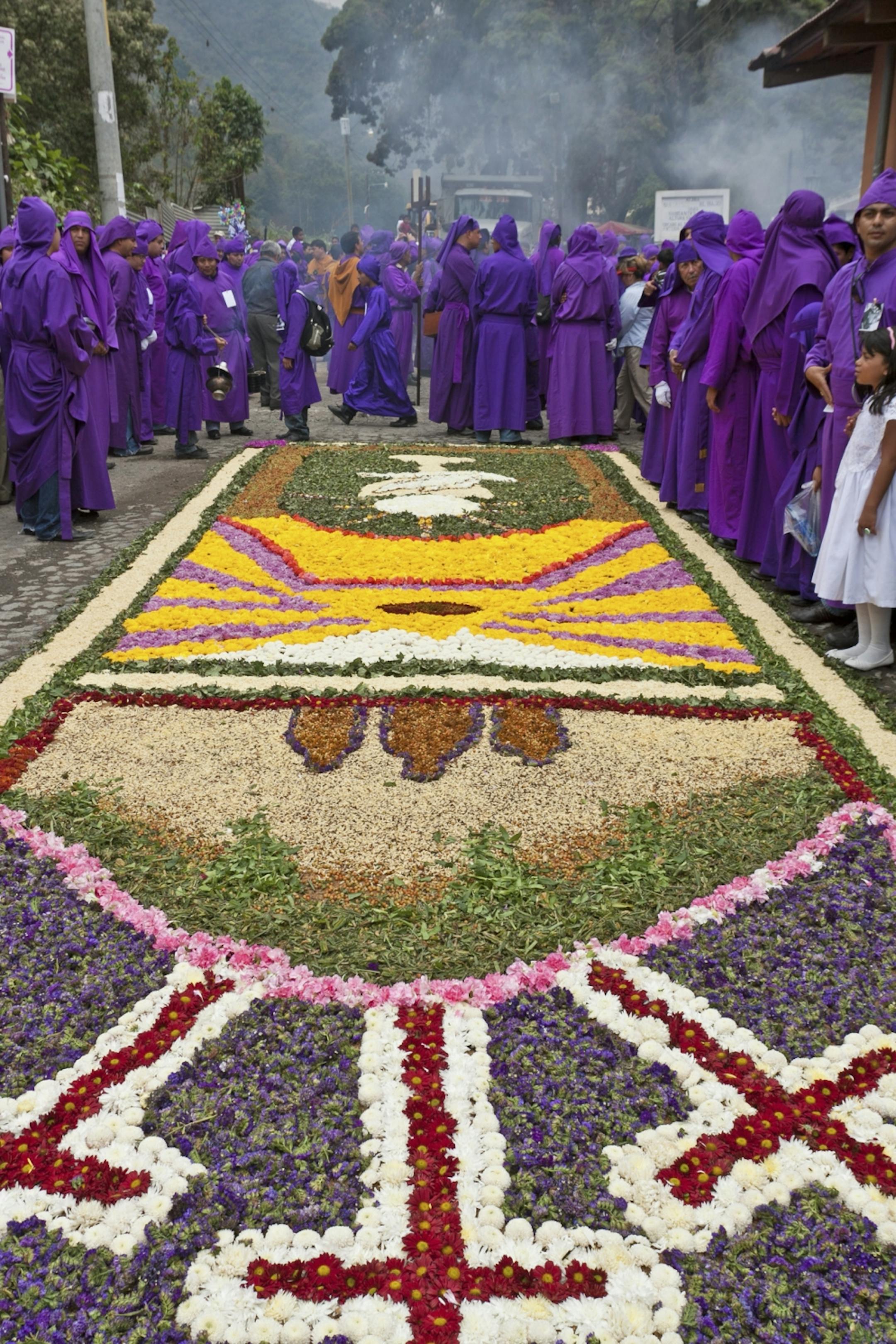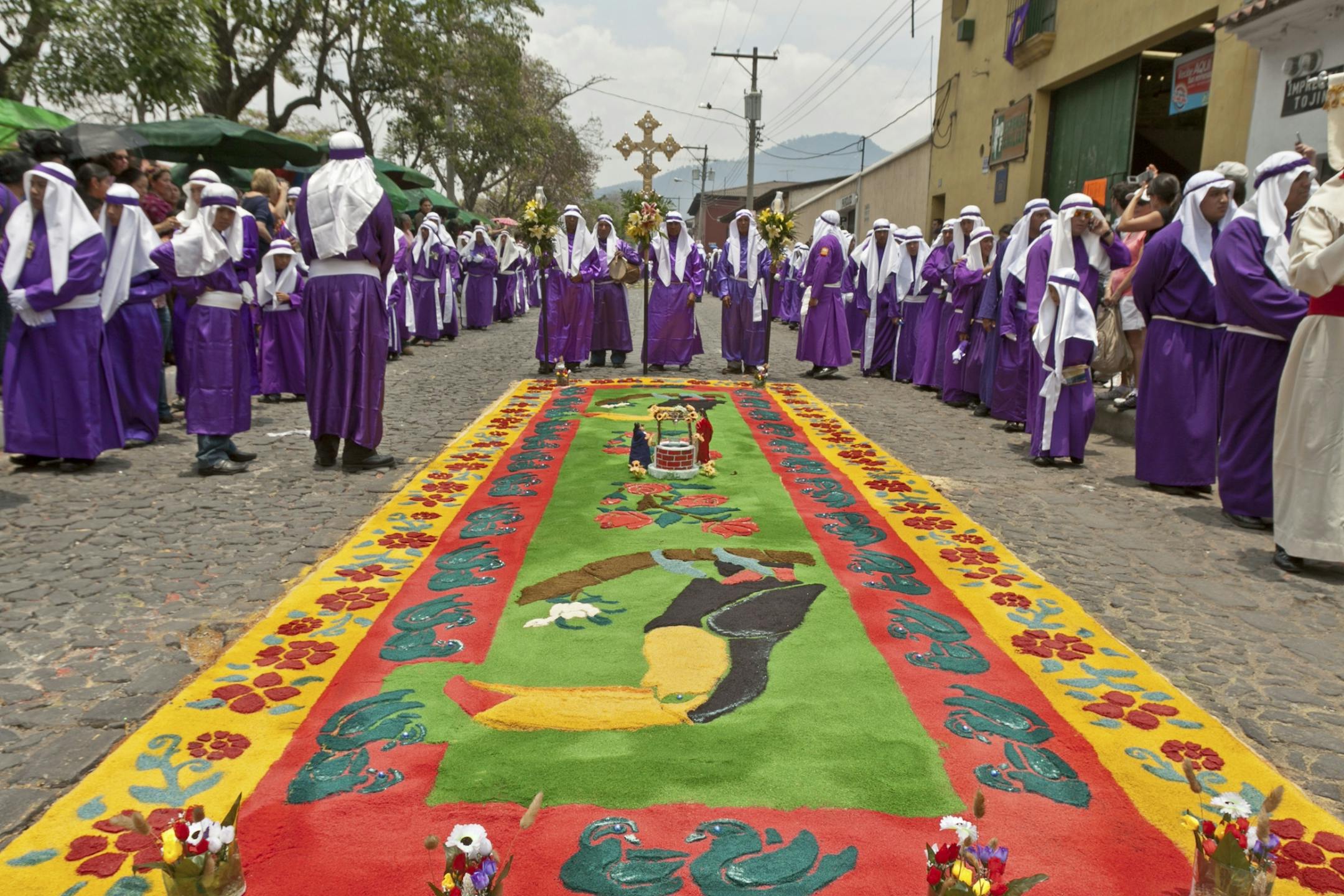
It didn't look promising. Eighty costumed men were trying to maneuver a 5,000-pound carved wooden float adorned with an elaborate scene from the final days of Jesus through the doors of the San Felipe Church in Antigua, Guatemala. The bearers' skill, precise choreography and perhaps a touch of divine intervention finally liberated the massive, lumbering float, called an anda, with mere inches to spare. Outside, the sun-splashed cobblestone streets had been decorated with intricate carpets, called alfombras, made out of flowers, dyed sawdust and glitter. Thousands of locals and visitors had gathered to watch the anda pass, leaving a trampled alfombra in its somber, yet somehow festive, wake.
Even among famously colorful Central American religious celebrations, Semana Santa (Holy Week) in Antigua, Guatemala, is in a class by itself. It attracts more than 200,000 people to this UNESCO World Heritage Site city between Palm Sunday and Easter Sunday.
The festivities, with all their age-old ritual, play well in Antigua. The city of some 35,000 was originally established by the Spanish in 1543 as a capital of the entire region, encompassing nearly all of Central America.
Three hulking volcanoes that ring Antigua, along with eruptions and earthquakes, eventually convinced the Spanish to choose a different capital city. But the majesty remains. After the city was razed, rebuilding efforts respected, preserved and re-created the city's original architecture. Even the streets remain cobbled and Antigua's many picturesque ruined churches give it a whiff of ancient Rome.
At an elevation of just over 5,000 feet, Antigua is also said to have one of the best climates in the world.
For all its glory, Semana Santa can be baffling. There are dozens of processions at all hours of the day and night. Costumes and customs are full of ancient symbolism. And what's with all the flower petals? I figured that out when I spent an afternoon last year helping create an alfombra with the owner of my hotel, and I gleaned a few other details along the way.
The processions
Street processions, a tradition believed to have started in Guatemala in 1524, tell the story of Jesus' persecution, crucifixion and resurrection depicted through intricate scenes displayed on top of handcrafted, carved wooden andas. They leave from and return to a home church and can last for 15 hours and cover many miles.