
Dress up brunch with these delightful egg recipes

Dress up the morning favorite for a change of pace or a holiday brunch, with a little science behind the cooking techniques.

For the Minnesota Star Tribune
April 8, 2020 at 4:10PM
Dennis Becker
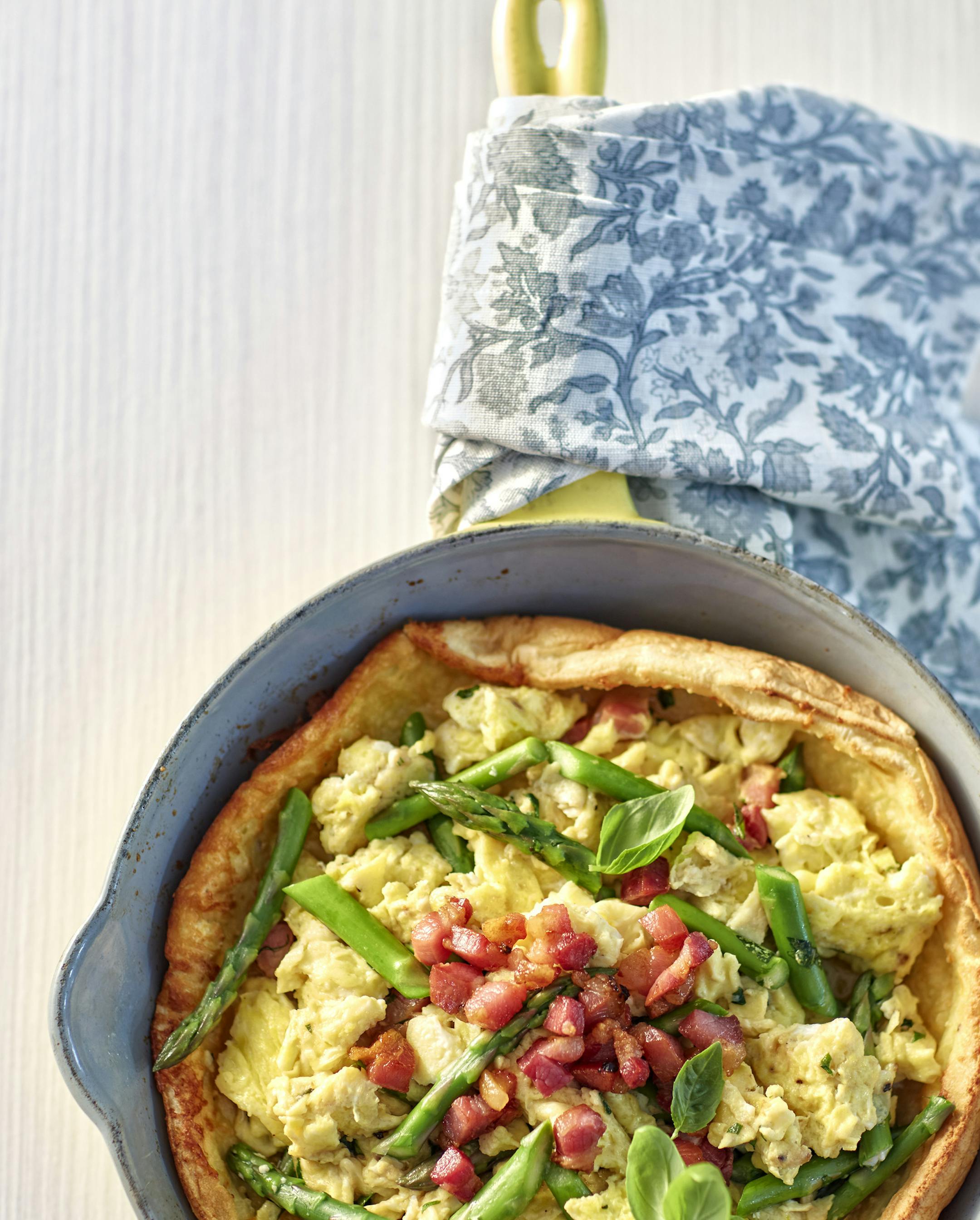
Asparagus Basil Scrambled Eggs in Parmesan Dutch Baby With Crispy Pancetta.
Asparagus Basil Scrambled Eggs in Parmesan Dutch Baby With Crispy Pancetta. (The Minnesota Star Tribune)

When everything else lets you down, eggs are always there for you. Forgot to thaw out that roast? Let's scramble some eggs for dinner. Need a high-protein snack? Peel a hard-cooked egg. Toast not cutting it for breakfast? Fry an egg and turn it into a sandwich.

Whatever your culinary dilemma may be, eggs are likely the answer, and for good reason. They're a quick-cooking, nutritious, inexpensive and tasty ingredient that most of us have in our refrigerators.

Because now more than ever you may need this superhero food to come to the rescue, here are a few tips and recipes that will be helpful before you get crackin'.

Eggs might seem like the simplest of ingredients, but cooking them can be tricky, so much so that cooking a basic omelet or fried egg is often a test given to new chefs seeking employment. This is true because, while eggs can be finicky, a good cook knows how to avoid any potential problems.

Those problems typically come in the form of heat, and here's why. Eggs are full of natural proteins. These proteins are all individual, free-floating, coil-like units. When heated, the protein coils unwind and begin to stick to other proteins, creating a mesh.

You can see it happening when you fry an egg and the white turns from clear to opaque. This indicates the proteins are linking together, forming a tight mesh that you can no longer see through.

If you cook the egg too long or at too high a temperature, the mesh tightens so much that it squeezes out any liquid and becomes dry and tough. Of course, what's too long and what's too high can be difficult to determine.

Let's take a look at Asparagus Basil Scrambled Eggs in Parmesan Dutch Baby With Crispy Pancetta. Scrambled eggs are a good illustration of the balance you need in time and temperature when it comes to cooking eggs.

In this recipe, we are looking for light and fluffy scrambled eggs to mix with sautéed asparagus and crispy pancetta, before we pile them into the perfect vessel — a savory, cheesy Dutch Baby.

To get the result we're looking for, we first add a little fat to the eggs, in the form of half and half. The fat comes in between the protein coils, preventing them from meshing too tightly together.

Next, we start the eggs cooking in the skillet at a high heat. This seems counterintuitive, but we need some heat to create steam, which is what inflates our eggs enough to make them fluffy.

Once the eggs begin to set and have reaped the benefit of the high heat, we reduce the heat to low to finish their cooking. The whole process takes less than 2 minutes, but the result is a perfectly light, yet moist scrambled egg.

Hard-cook the egg

Hard-cooked eggs are a bit controversial. Forever, we boiled eggs the way our mothers taught us: covered with water in a pot and boiled for about 10 minutes. The result was eggs with tough whites and green-tinged yolks, telltale signs of an overcooked egg. And those eggs would often be difficult to peel.

Then the Instant Pot came along and changed the world of hard-cooked eggs. The sealed environment of the electric pressure cooker provided even cooking with precise timing, both critical elements in the hard-cooked egg game.

You don't need a new small appliance, though, to make perfect hard-cooked eggs. You simply need to adjust your technique and start your eggs in boiling water. Placing an egg in water that is already boiling controls the temperature and timing. You know how hot the water is when you add your egg and how long it will take to cook them to your desired doneness once you lower the temperature.

Also, the shock of the heat prevents the egg white from adhering too much to the membrane of the eggshell. This dramatically lessens the possibility that you'll tear the egg apart in the peeling process.

For Crab-Stuffed Deviled Eggs, we want a hard-cooked egg with a fully done yolk, so I cook the eggs for 13 minutes after reducing the heat from a boil to low.

Once I've peeled the egg and separated the yolks, I mix them with a simple, but flavorful mixture of Old Bay Seasoning, lemon juice and a touch of hot sauce before folding in a generous amount of crab. What you get are not your mama's deviled eggs, but a satisfying bite of luxury, masquerading as a familiar family favorite.

Bake a custard

Crème brûlée, flan and cheesecake are all forms of baked custards, as are quiches and baked egg casseroles, i.e., bread puddings and stratas, and they are all subject to the time and temperature issues that come with egg cookery.

Many baked custards are cooked in a water bath — a large pan filled with hot water. The baking dish with the custard is lowered into the hot water and the whole thing is baked in the oven until the eggs are just set.

The water bath gives the custard insulation from the harsh heat of the oven and allows the proteins in the eggs to set without tightening too much, which would create a grainy, unpleasant texture.

It's a solid technique, but with our two baked custard recipes — Skillet Bacon-Cheddar Quiche With Hash Brown Crust, and Blueberry Lemon Cream Cheese French Toast Casserole — we create insulation in a different way.

For the quiche, we cook it in a cast-iron skillet. The cast iron provides an evenly cooked custard and tempers the oven heat. The hash brown crust acts as an additional layer of insulation, resulting in a silky custard.

In the French toast casserole, the sweet lemon-scented custard is soaked into bread cubes overnight and baked together with blueberries and cubes of cream cheese, which all act as a form of insulation.

It really is incredible how just a little bit of information and delicious recipes can take your egg-cooking game to the next level.

Meredith Deeds is a cookbook author and food writer from Edina. Reach her at meredithdeeds@gmail.com. Follow her on instagram @meredithdeeds.

about the writer

about the writer

MEREDITH DEEDS

More from Minnesota Star Tribune

See More
card image
J. SCOTT APPLEWHITE, ASSOCIATED PRESS/The Minnesota Star Tribune

The "winners" have all been Turkeys, no matter the honor's name.

In this photo taken Monday, March 6, 2017, in San Francisco, released confidential files by The University of California of a sexual misconduct case, like this one against UC Santa Cruz Latin Studies professor Hector Perla is shown. Perla was accused of raping a student during a wine-tasting outing in June 2015. Some of the files are so heavily redacted that on many pages no words are visible. Perla is one of 113 UC employees found to have violated the system's sexual misconduct policies in rece