

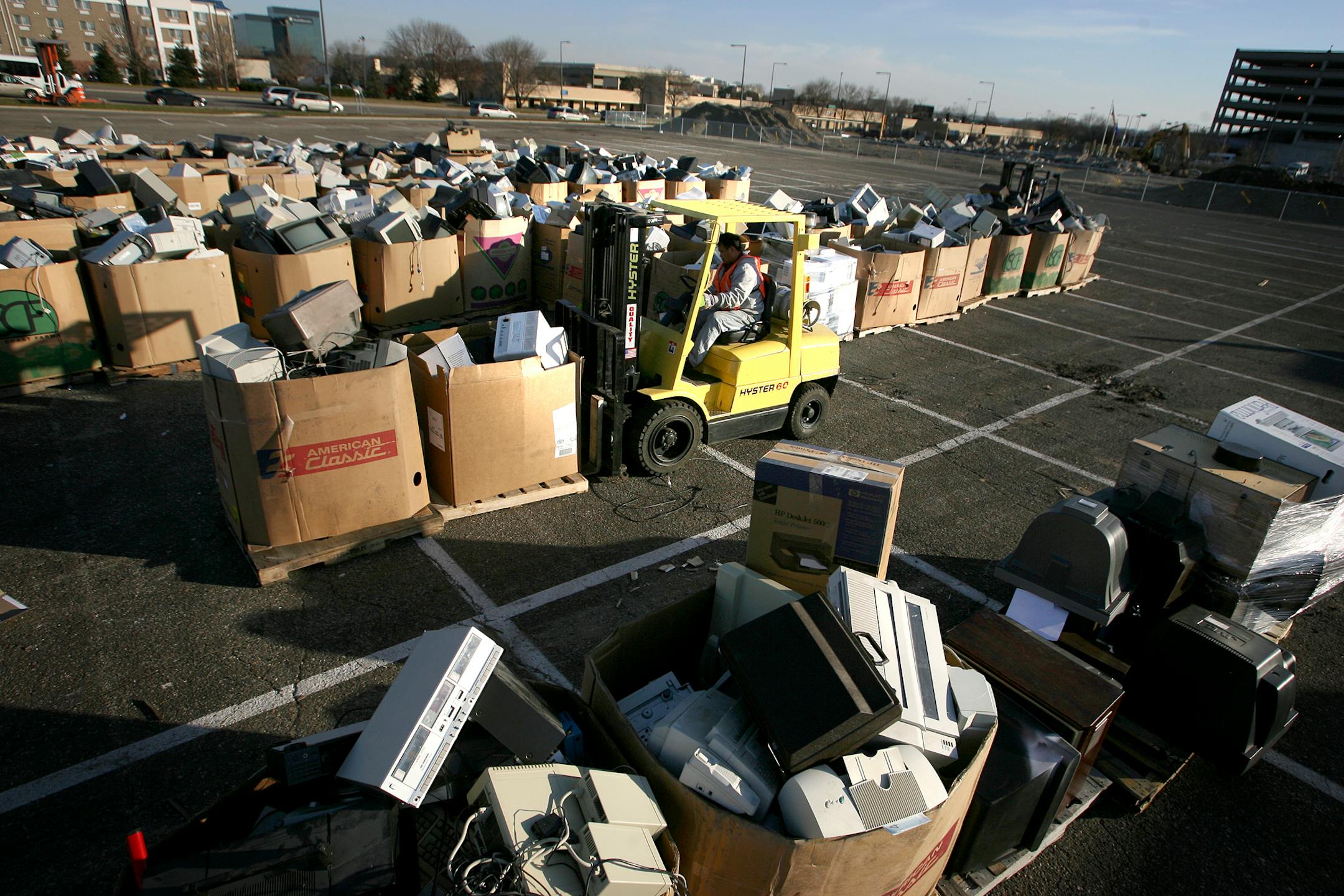
Every year, Americans toss out as much as 4.5 million tons of old mobile phones, laptops, televisions, Xboxes and other electronic gadgets.
Some is recycled; some is repaired and refurbished for reuse; and some is thrown into landfills or incinerators. Almost none of it, however, is "dumped" overseas.
That, at least, is the conclusion of the first comprehensive survey of what happens to U.S. e-waste after it is dropped into a recycling bin. Published in February, the study by the U.S. International Trade Commission surveyed 5,200 businesses involved in the e-waste industry (companies that received the survey were required by law to complete it, and to do so accurately), and found that almost 83 percent of what was put into American recycling bins in 2011 was repaired, dismantled or recycled domestically.
According to the same survey, only 0.13 percent of the 4.4 million tons of e-waste that Americans generated in 2011 was sent overseas for "final disposal" — a term that explicitly excludes recycling and reuse — with an additional 3 percent sent abroad for "unknown" purposes.
Reality is a far cry from the long-standing claim, first made by the Basel Action Network, a Seattle-based nongovernmental organization in 2002, that as much as 80 percent of U.S. e-waste is exported to the developing world. Amazingly, even with the wide currency the claim has enjoyed over the years among environmental organizations and the media, it was never based on a systematic study.
Misguided Efforts
This misunderstanding has led to several efforts at erecting partial export bans on U.S. electronics to developing countries, which — other studies demonstrate — import them as cheap and sustainable alternatives to new equipment. As a result, perfectly usable electronics are diverted into a recycling stream, where they are turned into raw materials, rather than into markets where they can be reused for years.
There are no statistics on how many used gadgets were exported from the U.S. to the developing world in 2002. Nor, for that matter, can anyone say for sure what happened to those gadgets. No doubt, many were broken down in developing-world facilities, where low-technology and often-hazardous methods of recycling and disposal were employed (such as the use of acids to strip copper and other metals from circuit boards in open, unprotected environments).


