

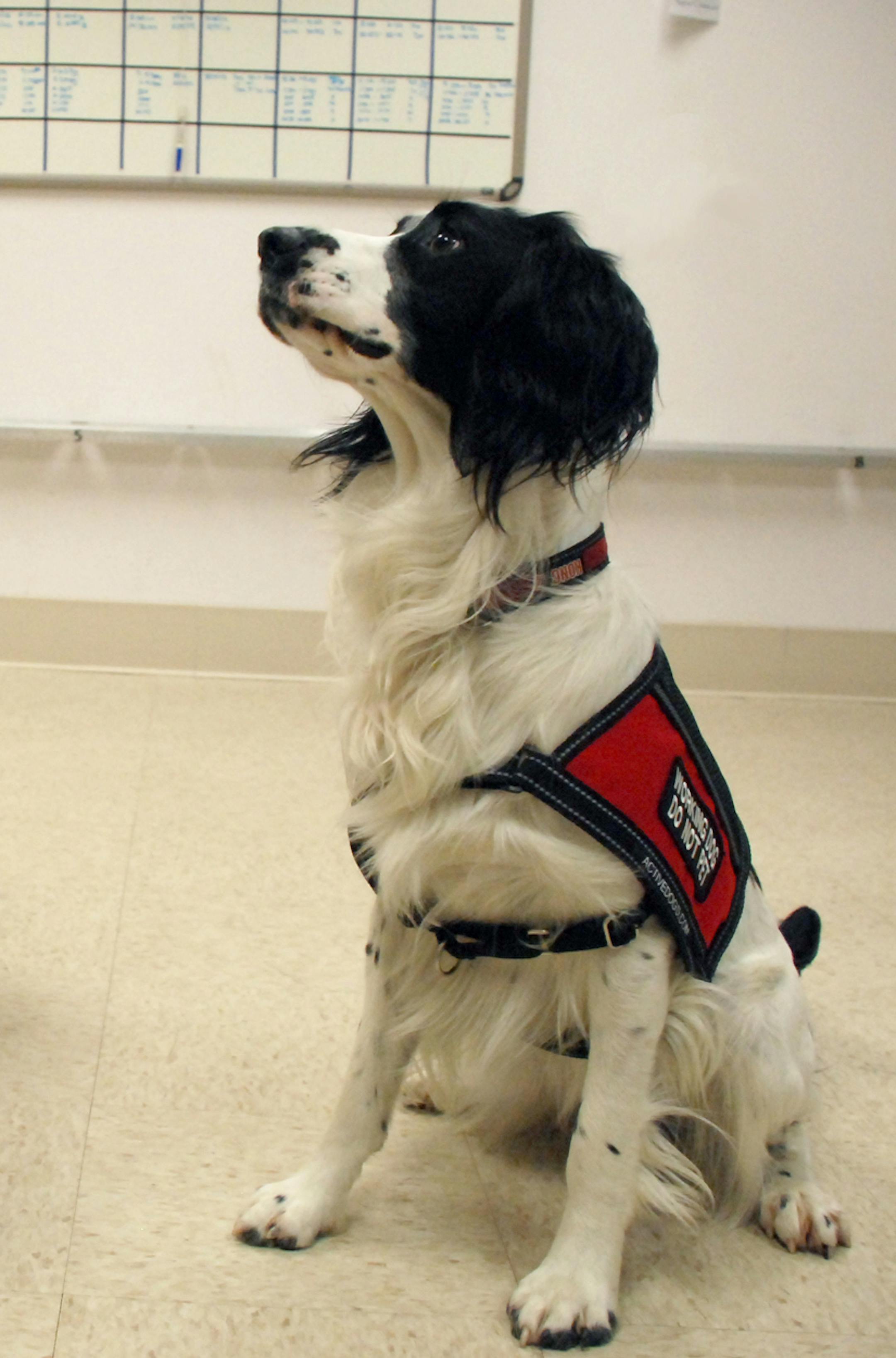
Which is better at detecting cancer, a laboratory or a Labrador retriever?
Consider the talents of Tsunami, a dog with attentive eyes and an enthusiastic tail wag for her trainer friends. University of Pennsylvania researchers say she is more than 90 percent successful in identifying the scent of ovarian cancer in tissue samples, opening a new window on a disease with no effective test for early detection that kills 14,000 Americans a year. When found early, there's a five-year survival rate of over 90 percent.
With 220 million olfactory cells in a canine nose, compared with 50 million for humans, dogs have long helped in search-and-rescue missions. Now, a growing body of evidence supports the possible use of canines by clinicians. The largest study ever done on cancer-sniffing dogs found they can detect prostate cancer by smelling urine samples with 98 percent accuracy. At least one application is in the works seeking U.S. approval of a kit using breath samples to find breast cancer.
"Our study demonstrates the use of dogs might represent in the future a real clinical opportunity if used together with common diagnostic tools," said Gian Luigi Taverna, the author of the prostate cancer research reported at the American Urological Association in Boston.
While smaller studies have long shown dogs can sniff out a range of illnesses, the question of whether they can be used on a large-scale basis has drawn skepticism. Questions remain on whether one type of dog is better than another, how to systemize their use and the financial viability of any such system. As a result, most current research is looking at how to copy the canine ability to smell disease either with a machine or a chemical test.
"Our standardized method is reproducible, low cost and noninvasive for the patients and for the dogs," said Taverna, the head of urology pathology at Istituto Clinico Humanitas in Rozzano, Italy, in an e-mail.
Taverna tested the ability of two professionally trained explosive detection dogs, Zoe and Liu, in 677 cases to assess their accuracy, according to his paper. The next step, according to Taverna, will be to extend the research into prostate cancer subgroups and to other urological malignancies. The results may one day be used to help develop an electronic nose that follows nature's lead in how a canine nose works, he said.
When dogs sniff for cancer, they are detecting the chemicals emitted by a tumor. These chemicals are referred to as volatile organic compounds, or VOCs. VOCs have been found in the breath of lung cancer patients and colon cancer patients, as well as in the urine of prostate cancer patients. The most recent findings have spurred increased interest in dog cancer — detection research, including efforts to develop devices that can mimic the animal's exquisite olfactory system.


