

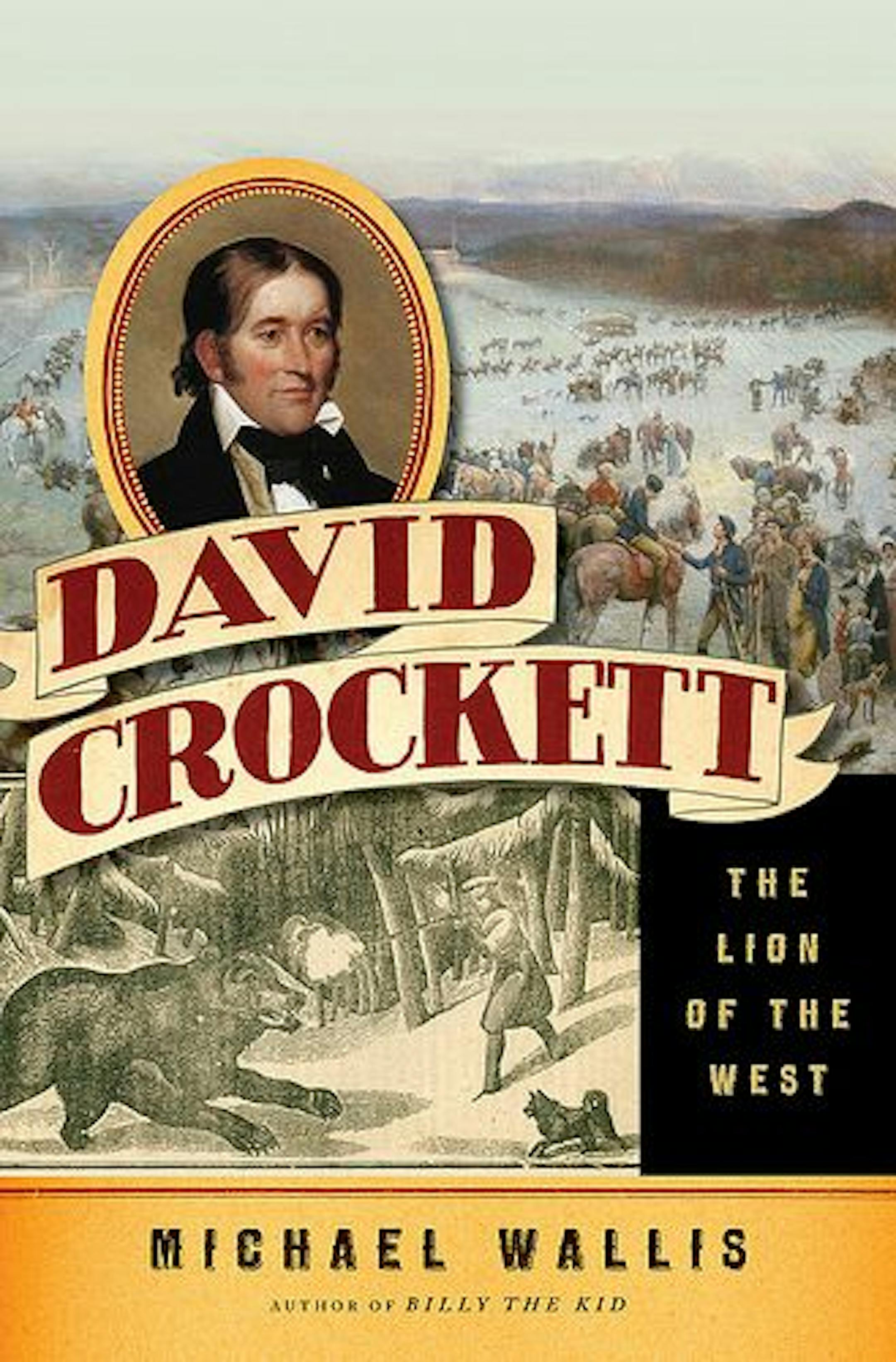
Contrary to the song, he wasn't born on a mountaintop in Tennessee -- he was actually born in a part of western North Carolina that later became Tennessee. No matter, his legend was big enough for several states to claim.
And he didn't kill himself a b'ar when he was only 3 -- though he insisted that at age 39, armed only with a knife, he killed a full-grown black bear.
In Michael Wallis' splendid biography, "David Crockett: Lion of the West," nearly every story or legend told about America's most famous frontiersman is proved to be an exaggeration -- but, happily, nearly every tale about Crockett (a great many originating with Crockett himself) has a hard kernel of truth at its core.
David Crockett -- he preferred his formal Christian name, and never signed "Davey" or "Davy" to a letter -- "believed in the wind and in stars. This son of Tennessee could read the sun, the shadows and the wild clouds full of thunder. ... He traversed the land when it was lush in the warm times and when it was covered with the frost that Cherokees described as 'clouds frozen on the trees.'"
He was born in 1786, one of nine children to a hardscrabble family of Scotch Irish stock from Ulster. Debt hounded the Crocketts all of their lives, and David never entirely escaped it. As a young man, he achieved a sizable reputation as a marksman and distinguished himself fighting with Andrew Jackson in the Creek War.
Although he only had a few months of formal education, he read Shakespeare and Ovid and was elected to Congress in 1826. His legislative record is dubious, and he seems to have used most of his time in Washington composing fanciful autobiographies. His record for integrity survives historical scrutiny, though he was not above using sly political tricks. (He was one of the first politicians "to perfect the tactic of 'branding opponents as being too elite.'")
As a populist, though, Crockett was the real thing: "without fail, Crockett always took up for the settlers; he believed they suffered at the hands of land speculators." And, following his own motto, "Be always sure you're right -- then go ahead," he was on the right side of one of the most important American issues, voting against Andrew Jackson's Indian Removal Bill. It was a vote, he said, that "will not make me ashamed in the day of judgment."
Too honest to be a successful politician, Crockett burned his political bridges behind him, and after a defeat in the 1836 congressional race, told his former constituents, "You may all go to hell, and I will go to Texas."


