
Dayton, Franken, Klobuchar ask for Ebola screening at MSP

Klobuchar, Dayton, Franken as for tests on west Africa flights.

October 14, 2014 at 1:06AM

Travelers arriving from west Africa would be checked visually and have their temperatures taken at Twin Cities International Airport under a request from Minnesota's governor and two U.S. senators for heightened federal screenings to prevent the Ebola virus from entering the state.

In a formal request to the U.S. Centers for Disease Control and Prevention, Gov. Mark Dayton and U.S. Sens. Al Franken and Amy Klobuchar asked Monday for the same screening measures being added at five international airports in the U.S.

"Ebola has already touched the lives of many Minnesotans as they hear about and pray for family, friends, and loved ones struggling with the disease in Liberia," the three wrote. "We hope to work with you to do everything we can to prevent the disease from spreading to Minnesota."

At JFK airport in New York, where heightened screening took effect over the weekend, 91 travelers were identified as Ebola risks based on their recent travel history, and five underwent medical evaluations, CDC director Tom Frieden said Monday in a national media briefing.

None were found to have Ebola, a virus linked this year to more than 8,000 illnesses and more than 4,000 deaths in west Africa.

Once similar detection systems take effect this week at Washington Dulles, Chicago O'Hare, Newark Liberty and Hartsfield-Jackson in Atlanta, federal officials believe that 94 percent of the travelers flying from Liberia, Sierra Leone and Guinea will be subject to screening. Add in similar screenings taking place at the departure airports in Africa and at stops in Europe, and 99 percent of travelers from the countries at the heart of the Ebola outbreak will be checked at least twice before entering the U.S.

The Minnesota leaders said nevertheless that they believe additional screening would be wise at Minneapolis-St. Paul International Airport because the Twin Cities is home to an estimated 30,000 Liberian natives. It is considered the largest community from that nation outside of Africa.

"While 99 percent is a comforting statistic, the Ebola experience in Dallas, Texas, has taught us that even one case of Ebola in our state or country can have devastating consequences," they wrote.

One man died at a Dallas hospital last week from an Ebola infection that he acquired while he was in Africa but which didn't produce symptoms until he was back in the U.S. One of his caregivers at the hospital has since contracted the virus, as well, despite efforts to protect herself with protective gowns and equipment while providing care. The virus does not spread through the air, but through contact with infected bodily fluids such as blood, saliva and urine.

Frieden said Monday that the federal airport screenings will help protect the United States, and that he does not favor a travel ban to or from west Africa, where there is an extreme need for medical supplies and personnel.

A travel ban would make it "much harder to stop the outbreak at the source," he said.

The request for additional screening in Minneapolis was not addressed in the teleconference. The CDC press office was closed for the national holiday Monday.

U.S. Customs and Border Protection Commissioner R. Gil Kerlikowske said about 150 people fly into the United States daily from the affected countries, and more than 90 percent arrive at one of the five airports already selected for heightened screening.

The idea of adding MSP emerged Thursday after Dayton gathered top cabinet and airport officials to review the state's Ebola preparedness. Airport officials supported the idea.

"Entrance screening at MSP would add one more layer of protection against the disease," said airport spokesman Pat Hogan.

Heightened screening would take place only at the customs checkpoint and apply only to travelers whose flight itinerary originated in Liberia, Guinea or Sierra Leone. They would fill out a health declaration form with the CDC, stating where they are traveling from, where they will be staying in Minnesota, and whether they have had any contact with an Ebola patient.

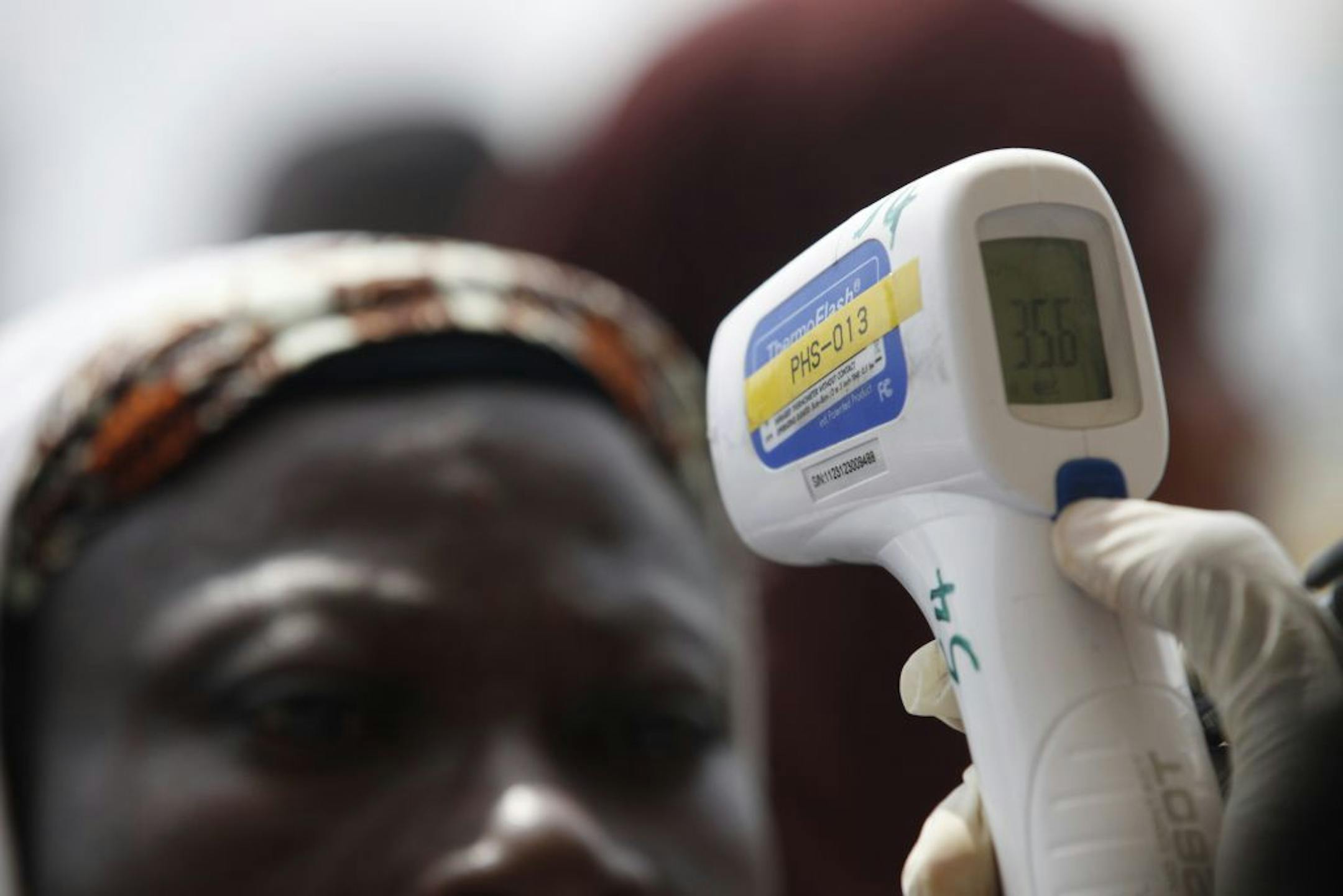
Medical professionals with the CDC also would conduct a visual examination of passengers and take their temperatures to check for fevers.

Already, the Minneapolis-St. Paul airport has isolation rooms for travelers who show signs of fever or severe illness. A CDC doctor would then evaluate the patients, and determine whether they need hospital care. They would be taken by ambulance to Hennepin County Medical Center in Minneapolis or another hospital of their choice for further care or quarantine.

Jeremy Olson • 612-673-7744

Reporters Paul Walsh and Janet Moore contributed to this report.

A Nigerian port official uses a thermometer to screen Muslim pilgrims for Ebola at the Hajj camp before boarding a plane for Saudi Arabia at the Murtala Muhammed International Airport in Lagos, Nigeria Thursday, Sept, 18. 2014.
A Nigerian port official uses a thermometer to screen Muslim pilgrims for Ebola at the Hajj camp before boarding a plane for Saudi Arabia at the Murtala Muhammed International Airport in Lagos, Nigeria Thursday, Sept, 18. 2014. (Associated Press - Ap/The Minnesota Star Tribune)
Gov. Mark Dayton, with Sens. Amy Klobuchar and Al Franken
Gov. Mark Dayton, with Sens. Amy Klobuchar and Al Franken (Vince Tuss — Star Tribune/The Minnesota Star Tribune)
about the writer

about the writer

Jeremy Olson

Reporter

Jeremy Olson is a Pulitzer Prize-winning reporter covering health care for the Star Tribune. Trained in investigative and computer-assisted reporting, Olson has covered politics, social services, and family issues.

See Moreicon

More from Minnesota Star Tribune

See More
card image
Provided/Sahan Journal

Family members and a lawyer say they have been blocked from access to the bedside of Bonfilia Sanchez Dominguez, while her husband was detained and shipped to Texas within 24 hours.

card image