

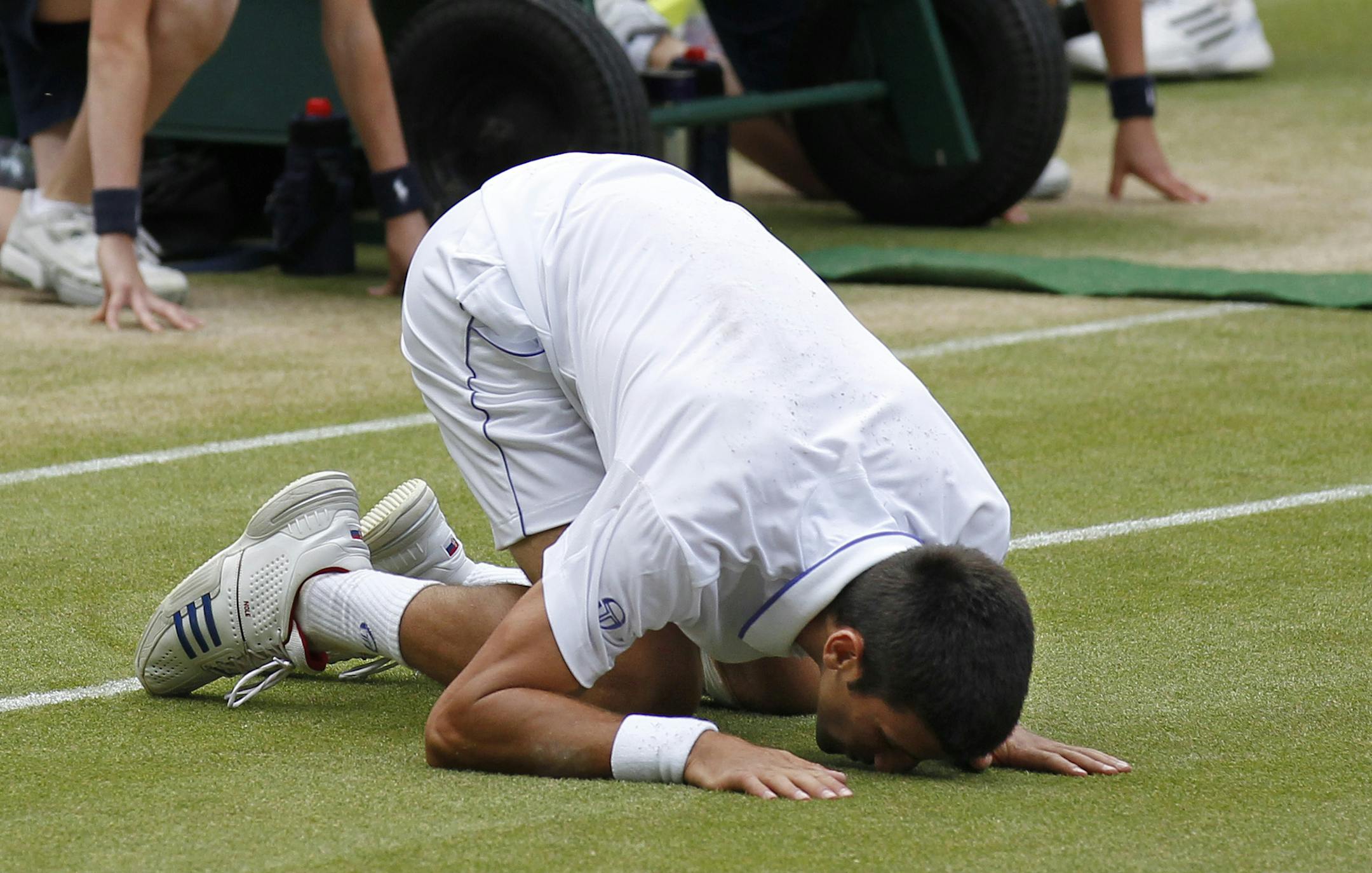
In one of the great ironies across all sports, the grandest event in tennis is contested on a surface that professionals rarely play on and the vast majority of fans will never see.
Imagine holding the Super Bowl on sand or running the Indy 500 on dirt. Even that wouldn't compare to Wimbledon and its preternatural grass courts. After all, most of us have tossed around a football at the beach or driven on gravel roads. But when was the last time you struck a forehand with blades of grass under your feet? Your back yard doesn't count.
According to the Tennis Industry Association, there are an estimated 270,000 tennis courts in America. Tens of thousands are hard courts; thousands are clay courts. Guess how many are grass? Answer: 269. And that might include a few back yards.
Of the 64 tournaments held worldwide on the men's professional tour this year, only six will be played on grass, all during a five-week span that starts the week after the French Open and ends the week after Wimbledon. Pros don't grow up playing on grass, they hardly practice on the surface, and yet the biggest tournament of the year is held on it. Strange … but please don't change.
Interestingly, it is the rest of the tennis world that is responsible for the anomaly of Wimbledon. Four decades ago and prior, three of the four Grand Slam events were held on grass, the exception being the French Open with its sock-staining red clay. With the mainstreaming of tennis outside the country club in the 1970s, the U.S. Open made the move to green clay in 1975 and then three years later to hard courts, its current surface. The Australian Open followed suit in 1987, scrapping its lawn mowers for a kind of cushioned hard court, thus leaving Wimbledon and the few tournaments surrounding it as the last vestiges of lawn tennis.
Grass court tennis used to be known for low, skidding, uneven bounces that favored serve-and-volley players over those who toiled away from the baseline. Back in the day, a highly ranked clay court player with heavy topspin ground strokes was considered easy pickings on grass for net-rushing types. That changed in 2001 when the All England Club, in an attempt to increase the length of rallies, performed a little sleight of seed by altering the mixture of grass. The result was harder courts, higher bounces and serve-and-volleyers going the way of the typewriter. Now the ones who raise the trophy at Wimbledon possess the best ground strokes and movement along with the steely nerve to perform on the game's most hallowed stage: Centre Court.
That pretty much explains why Serena Williams is the overwhelming favorite heading into this year's Wimbledon fortnight. Not only does she pack the most devastating arsenal of physical and mental skills on tour, but she has the momentum of a wrecking ball to go with it. Since her surprise first-round exit in last year's French Open, she has won 74 of 77 matches, including a fifth Wimbledon title, Olympic gold, a fourth U.S. Open and, just recently, her second French Open. Most people consider 31 to be aged in tennis, but to Serena, it only represents her current winning steak. Don't bet on the field.
On the men's side, America's best hope will be in the doubles with the ebullient, chest-bumping Bryan brothers. If they win a third Wimbledon title, the 35-year-old identical twins will hold all four Grand Slam trophies and an Olympic gold medal, a Hall of Fame year by anyone's standards.


