

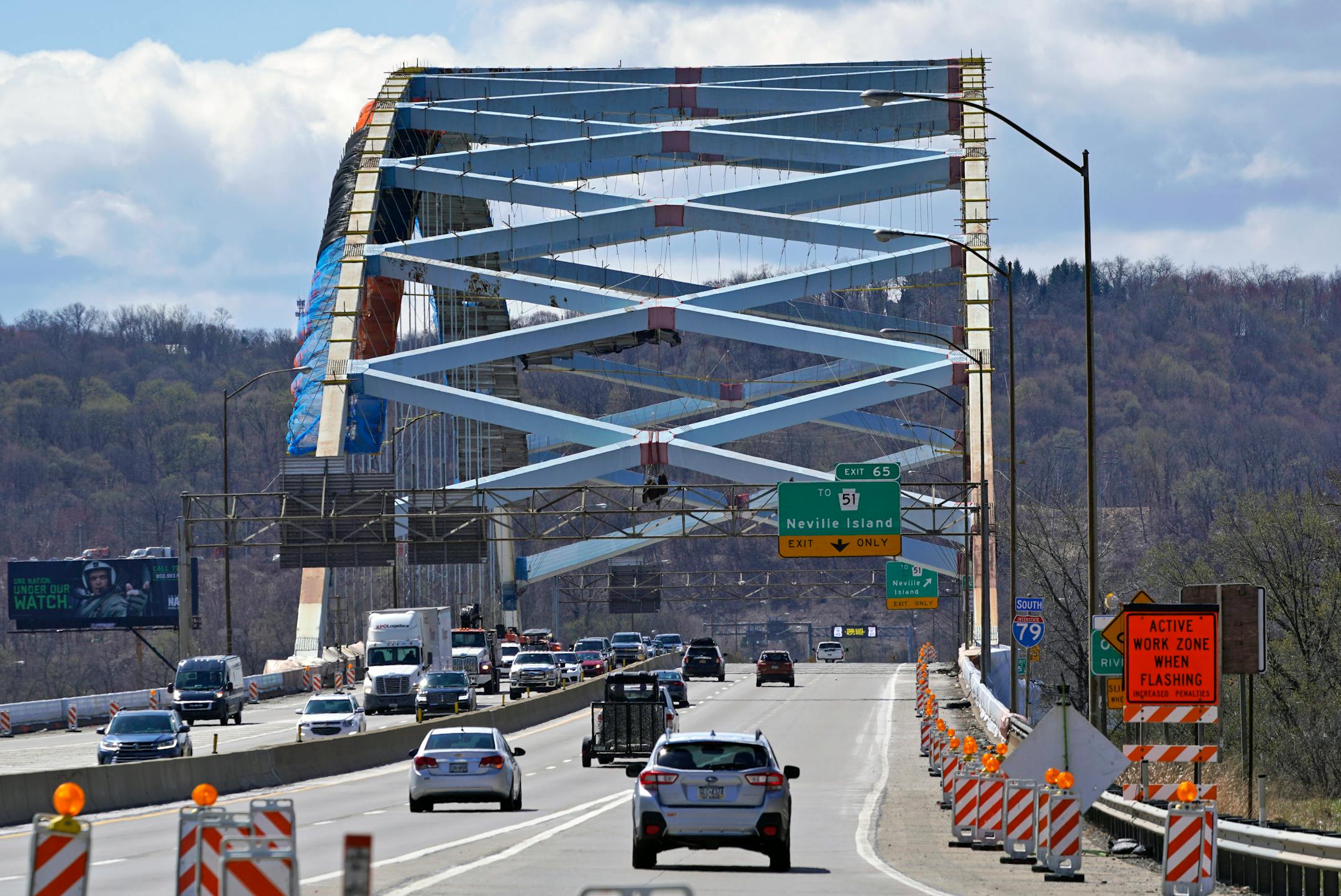
Speaking about his ambitious infrastructure plans in a press conference, President Joe Biden recently stated, "One in five miles of our highways and major roads are in poor condition," "More than one third of our bridges" need repair, and "we rank 13th globally in infrastructure." These statements probably don't sound surprising. Americans seem to believe that our infrastructure is, as some people say, "crumbling."
However, Biden's statements and this widespread perception don't square with some of the government's own recent data.
Let's begin with Biden's last point — that the U.S. ranks 13th worldwide with respect to infrastructure. It comes from the World Economic Forum's Competitiveness Report, which has a number of weaknesses. The WEF surveys almost 17,000 business executives — hailing from 139 countries, some industrialized and some developing, with vastly different economic and political systems. Those surveyed are asked 78 questions about their perceptions of a wide range of competitiveness issues ranging from security to education, as well as infrastructure.
This makes meaningful cross-country comparisons difficult. Busy executives are not experts on everything. Their rankings are their perceptions and are unlikely to paint a clear picture. Perhaps some executives can reasonably judge the quality and connectivity of roads. But can they also competently evaluate the efficiency of train services, air transport, water and power systems, and seaports? What if they don't use trains or their business doesn't ship?
The WEF also ranks the U.S. fifth among the G-7 industrialized democracies, a more meaningful comparison. However, the differences among these seven nations are not large. On a scale of 1 (worst) to 7 (best), the U.S. road quality score is 5.5. The top G-7 score is Japan's 6.1, and the low is Italy's 4.4. So, while the WEF survey gives us a good idea of how business executives feel, it's not wise to rely too heavily on the results.
In contrast, the Department of Transportation provides objective data on highway conditions across U.S. states. Surface conditions are measured by the vertical movement of a spring-mounted laser as it's driven along roads and highways in each state. Engineers have determined that for highway speeds, a roughness value between 100 and 200 indicates an acceptable highway surface.
To determine the share of U.S. highways in poor condition, I calculated the percent of total state highway miles with a value above 170 between 2014 and 2018. 170 is a conservative number to use, since higher values are acceptable in many cases. The roads examined included interstate highways, freeways, and principal and minor roads.
Urban and rural interstates, along with principal roads in urban areas, improved during that time. The percent of urban and rural interstates in poor condition was only 4.5% and 1.9%, respectively. The biggest improvement occurred in principal urban roads, where the percent in poor condition declined by half a percentage point, to a still-high 22.7%.


