

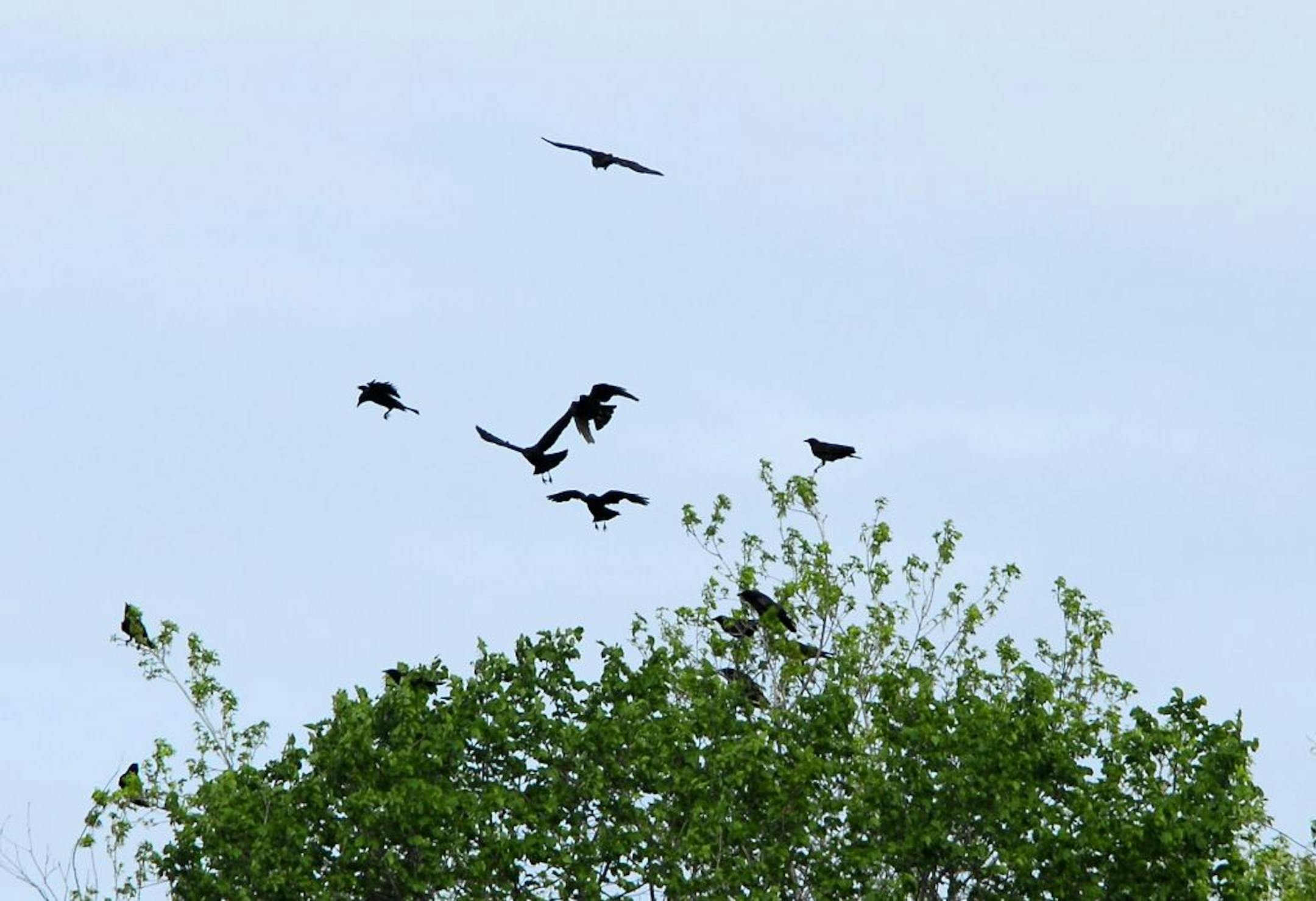
Q I've twice seen a crow divebombing a Canada goose on the ground. In each case the goose was walking along, minding its own business, but the crow kept swooping down on it. What was this all about?
A I can't imagine how a Canada goose would pose a threat to a crow, so this doesn't sound like the crow was protecting its young or its nest. The more likely explanation would be that in both cases these were young crows engaging in play behavior, practicing what to do when presented with a threat, although the poor Canada geese might not appreciate this. I once observed a crow and some very young kestrels playing what looked like a game of tag around a ball field, and the same explanation seems to fit: The young crow and the young falcons were playing at skills they'd need later as adults.
Snowbird diet Q I love to see the juncos arrive in the fall, and wonder what I should feed them.
A It's good to hear that you're feeding juncos, because they work so hard to scratch out a living during the winter. These small sparrows prefer to feed on the ground, but they will come to tray feeders, too. Juncos like millet and cracked corn, as well as sunflower seeds, especially hulled sunflower. They also hop around under nyger feeders to pick up what the goldfinches spill. They're always interested in fallen seeds, whether in the forest, on our lawns or under our feeders. They're thirsty birds, like all seed eaters, so if you have a heated birdbath, you'll really be putting out the welcome mat.
Siskin search Q I saw very few pine siskins last year and wonder: What are the chances of seeing siskins and redpolls this winter?
A Sorry to say, your chances aren't good. Both of these small birds, part of a group of birds known as winter finches, are abundant some winters in our area, but in other years they're hard to find. Siskins and redpolls are birds of the far north that move south when food is scarce in the boreal forests of Canada. The fact that there seem to be abundant spruce seeds up north for siskins and birch seeds for redpolls is good news for the birds, not so good for Minnesotans who'd like to see these handsome finches.
Waste management Q I don't really know how to ask this, but do birds urinate?
A That's a good question, and one with an interesting answer. Birds don't have bladders for collecting urine, so unlike mammals they don't excrete both solid and liquid wastes. Those white splotches we find on cars and in birdbaths are a concentrated paste combining both forms of waste. A bird's system reabsorbs most of the liquid before making a splat. Doing without a bladder is an example of the many ingenious ways that birds are streamlined in order to be able to fly.


