
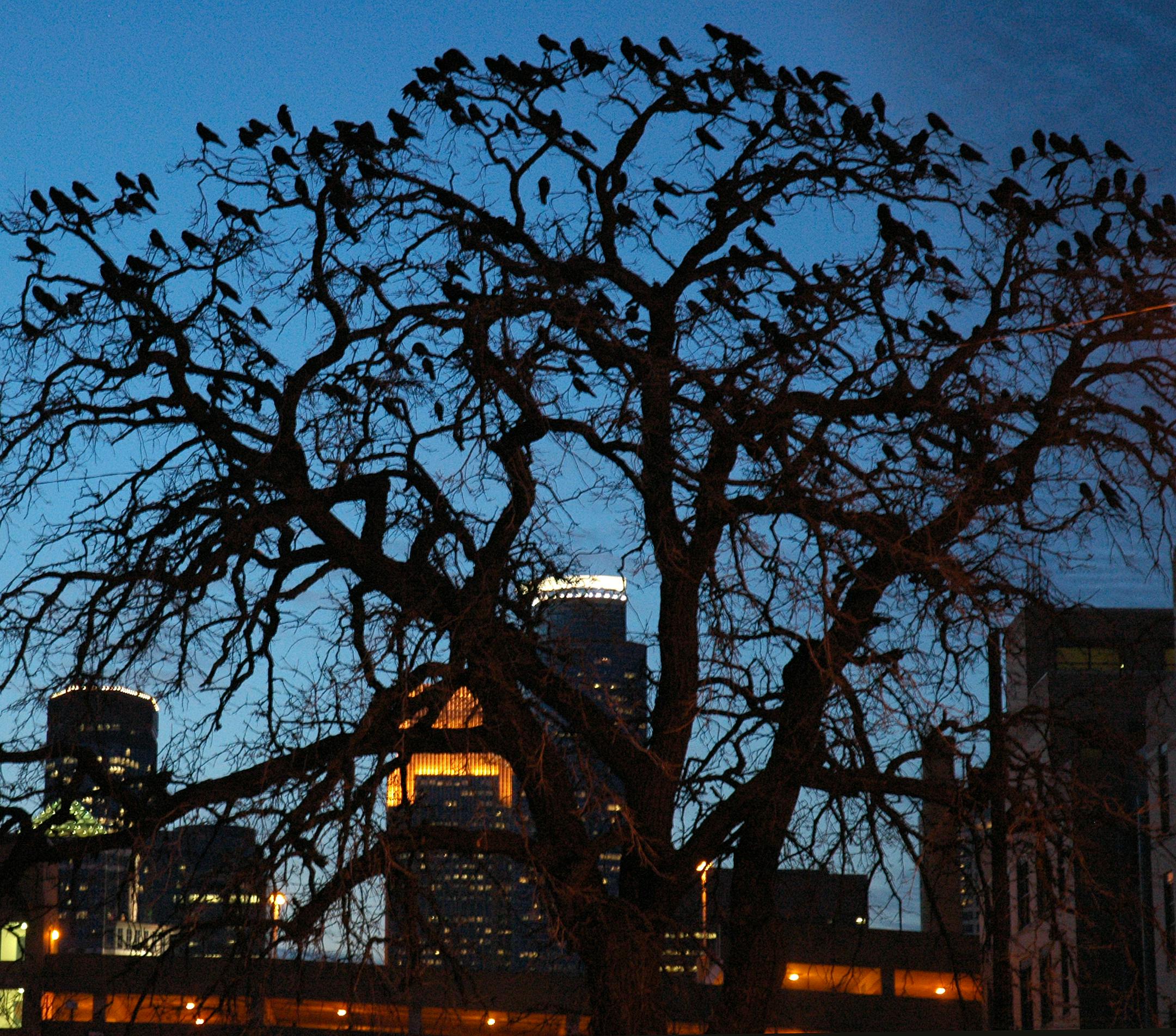
Crow central

In late winter, thousands of crows gather each evening to roost in downtown Minneapolis.

March 10, 2009 at 3:59PM
Crows congregate in a tree near downtown Minneapolis.
Crows congregate in a tree near downtown Minneapolis. (Paulette Henderson — Special to the Star Tribune/The Minnesota Star Tribune)

We've been chasing crows from our yard ever since we moved here. They hack at the suet, taking 50-cent chunks whenever they can. They snarf up any peanuts we put out. They yak it up early in the morning.

Now I wish we'd been more tolerant. That's because I have a new interest in these birds, thanks in part to a book I'm reading: "In the Company of Crows and Ravens."

According to authors John Marzluff and Tony Angell, the crows that make a nuisance of themselves in our yard aren't our grandfather's crows.

City folk offer crows unbounded feeding opportunities. Garbage is good and roadkill is frequent. Plus, urban crows have fewer predators than their country cousins. So, with our help, these birds have changed their culture from rural to urban. Corn is out. French fries are in.

In addition to being adaptable, the book details just how smart crows are. Apparently, they can converse, count and add as well as make and use tools. Sure, I've been seeing crows, but now I want to really watch them.

Social sleepers

The five crows that visit our yard routinely -- a family, I think -- come here to dine. I don't know where they've nested. I don't know where they sleep. But I do know that crows are social creatures and like the company of other crows. They come together in the evening to roost for the night at a selected place. You can find hundreds or thousands of them at those sites. In fact, there are records of a single roost that contained 2 million crows.

I occasionally drive west out of downtown in late afternoon. I'm always watching for birds when I drive, and I often see crows drifting across Interstate 394 as the sun drops ahead of me. They seem to form an endless line coming from the northwest, disappearing as they pass over Loring Park.

Since it's the end of the day, I've always assumed the birds were going to roost. But I never knew where.

One evening in late February, I decided to find out.

Following crows flying through in downtown Minneapolis during rush hour isn't a great idea, but I do it anyway.

Routing out a roost

I catch glimpses of crows flying between apartment buildings and houses, but they're not easy to follow. They fly diagonally across the grid of streets. I finally track down roosting birds along both sides of Interstate 94. They seem to crown all the trees along the freeway. Even more settle in, cawing as they arrive.

Crow central, as near as I can tell, is at about 14th St. and 11th Av. S. All the trees in that neighborhood wear noisy black toupees. Crows line the tops of apartment buildings and houses. There are several thousand crows here. They talk among themselves, loudly, with no concern about interrupting one another. They caw and croak and gargle.

In their book, Marzluff and Angell write that these birds use dozens of different vocalizations. While the authors caution against anthropomorphism, they suggest that crows communicate vocally -- talk -- in a sophisticated way. The crows I heard that evening might have been complaining about traffic or discussing a new place to eat. Or they might have been recommending the suet feeders in my back yard.

Downtown Minneapolis harbors thousands of crows each night, at least in late winter. They seem to arrive only from the northwest. I assume crows with daytime jobs in other parts of the metro area have other roosting sites. All of these roosts will thin when the birds establish nesting territories this spring.

I didn't stay downtown long enough to hear the crows say goodnight, to tuck bill into shoulder feathers and be quiet. But I'll bet people who live in that neighborhood wait eagerly for that moment.

Jim Williams, a lifelong birder, serves as a member of the U.S. National Wildlife Refuge Birding Initiative Committee. He also is a member of the American Birding Association, Ducks Unlimited, Pheasants Forever and Delta Waterfowl. Join his conversation about birds at www.startribune.com/wingnut. He can be reached by e-mail at two-jays@att.net.

about the writer

about the writer

More from Minnesota Star Tribune

See More
card image
J. SCOTT APPLEWHITE, ASSOCIATED PRESS/The Minnesota Star Tribune

The "winners" have all been Turkeys, no matter the honor's name.

In this photo taken Monday, March 6, 2017, in San Francisco, released confidential files by The University of California of a sexual misconduct case, like this one against UC Santa Cruz Latin Studies professor Hector Perla is shown. Perla was accused of raping a student during a wine-tasting outing in June 2015. Some of the files are so heavily redacted that on many pages no words are visible. Perla is one of 113 UC employees found to have violated the system's sexual misconduct policies in rece