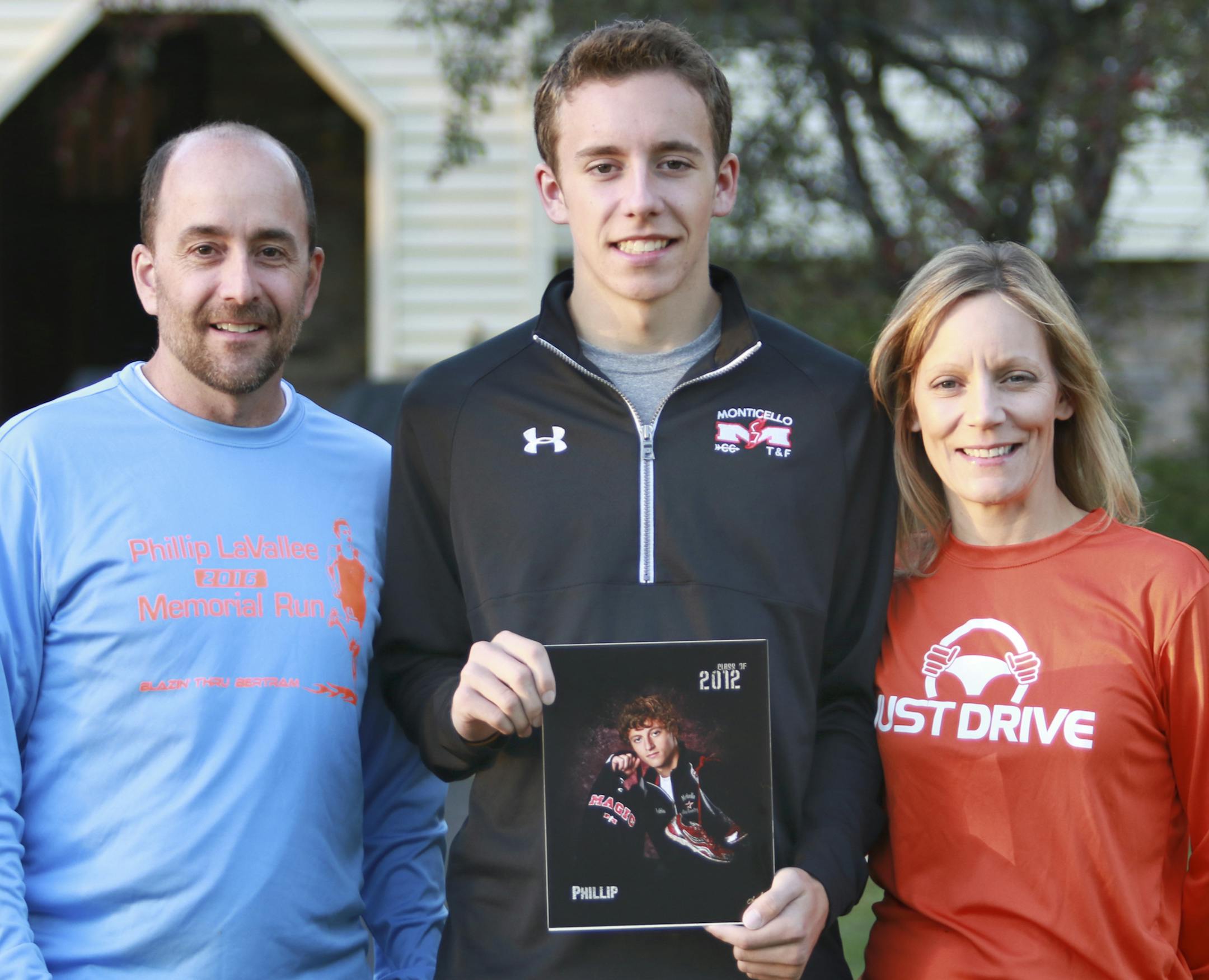
Greg LaVallee leaves his northwest metro home each Aug. 8 for a run to honor his son Phillip, a decorated cross-country runner at Monticello.
The route takes Greg along Wright County Hwy. 19, north of the Albertville Premium Outlets, where a van struck and killed his 19-year-old son during a morning run on that day in 2013. The driver, who received a call on her cellphone about the same time as the accident, later pleaded guilty to gross misdemeanor criminal vehicular operation.
The cars buzzing past make Greg nervous, but he presses on with the annual tribute.
Varsity cross-country coaches know the feeling. They collectively send out thousands of runners for training runs on the roads around their schools during the fall. Some overseeing teams with as many as 100 athletes, they share LaVallee's apprehension as well as concerns about an increase in distracted driving.
Traffic fatalities reached 411 last year in Minnesota, compared with 361 in 2014, a 14 percent increase, according to Minnesota Department of Public Safety data. Of those, distracted driving was listed as a contributing factor in 74 deaths in 2015 — a 21 percent increase.
In the wake of LaVallee's death, Monticello boys' cross-country coach Dave Wik eliminated some training routes that brought runners through higher-traffic areas. General coaching mandates for runners include running into traffic and staying single-file on the shoulders of roads, making eye contact with drivers at intersections and looking twice even when crossing with a green light.
Coaches work to promote awareness among athletes without being alarmists. Boys' and girls' cross-country, with a combined 16,422 runners in the 2015-16 school year, ranks fifth in participation among all sports under the auspices of the Minnesota State High School League.
Running loops on the campus grass, while safer, isn't always practical, Stillwater boys' coach Scott Christensen said. Each of his 79 runners, grades 9 to 12, logs 50 miles per week — a total of almost 4,000 miles.