

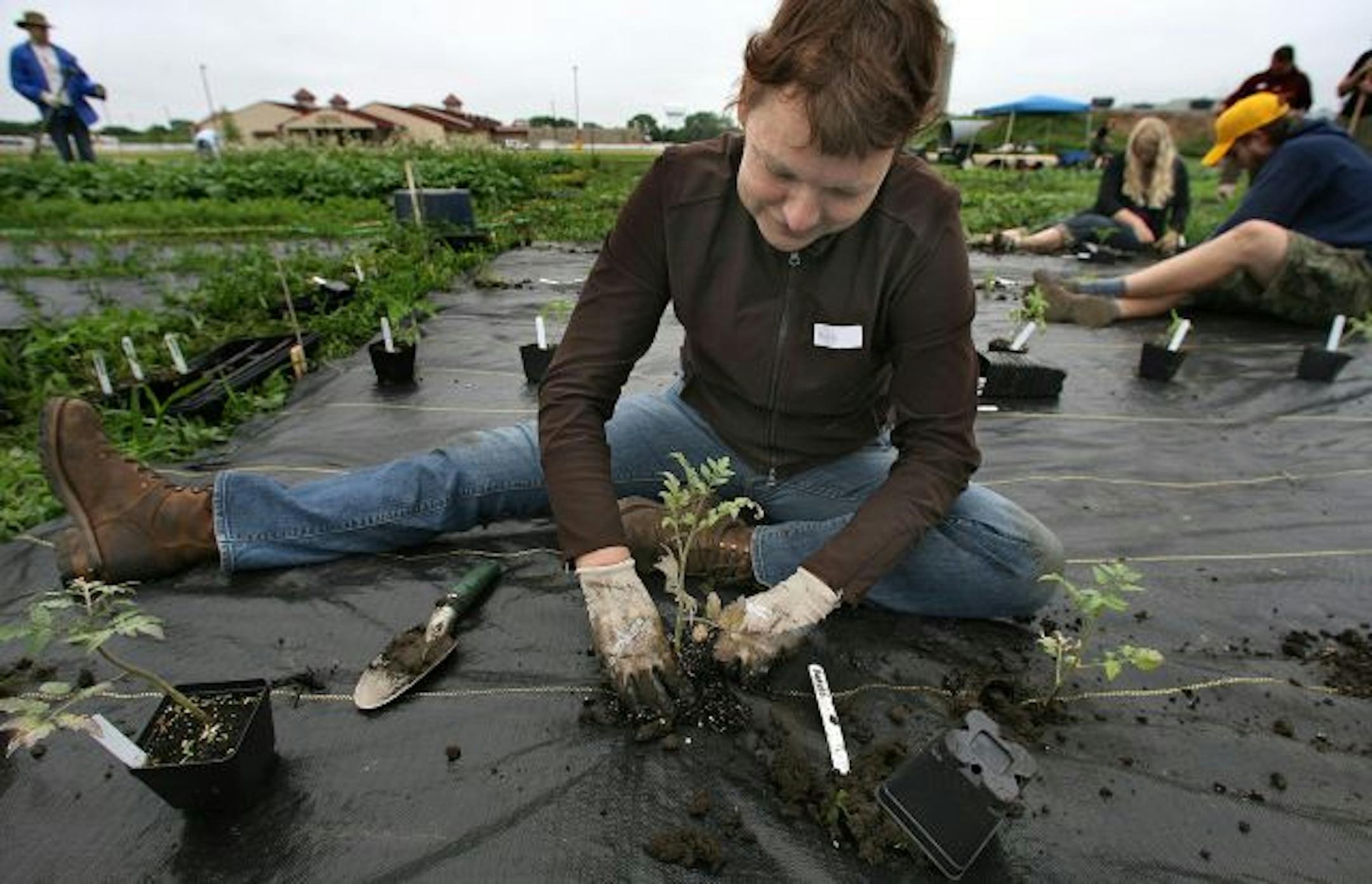
It was a rainy Saturday -- a perfect day for sleeping late or lingering over a latte. But graduate student Sarah Burridge of Minneapolis was in a farm field getting wet and dirty with a bunch of people she didn't know. They got a quick demonstration on the stirrup hoe, then got to work planting tomatoes and onions, and mulching paths using mown alfalfa.
Burridge didn't get paid. She didn't even get much produce -- just a few radishes. She spent the day as a farm hand for "fun," she said, after a Facebook friend told her about having a great experience volunteering at a farm near Washington, D.C.
All across the country, similar groups of mostly young urbanites are gathering in "crop mobs" to provide farmers with a few hours of free labor. While the mobbers say they do it because it's fun, there's also a mission: to support small-scale local agriculture.
"I'm extremely concerned about how we grow our food," said photographer Mette Nielsen of Minneapolis, who took part in a recent crop mob at Cornercopia Farm, an organic teaching farm on the St. Paul campus of the University of Minnesota. "It's important to get food produced closer to where we live."
The crop-mob phenomenon started two years ago in North Carolina (according to www.cropmob.org), and has spread rapidly across the country, fueled by social networking media. In the Twin Cities, there are at least two groups organizing mobs this growing season.
"It's just an opportunity for city mice to get out to a farm and get their hands dirty," said Barth Anderson, chief blogger at Fair Food Fight (www.fairfoodfight.com), who organizes monthly crop mobs via his website and the Twin Cities Crop Mob Facebook page. "We focus on small, sustainable organic farms. We want to help farmers, and we ask for jobs that don't require training and aren't dangerous. It's idiot work, and we're the idiots."
Niche mobs
Riverbend Farm in Delano has been hosting crop mobs before the term existed. Tracy Singleton, owner of Birchwood Cafe in Minneapolis, said monthly trips to the farm started a couple years ago as a way to help the local farmer, build community and educate restaurant staff about the origins of the food they were preparing. This year, her restaurant, along with Common Roots and Lucia's restaurants, started inviting its customers to take part, under the crop-mob moniker. "It's a new term people are using, and we adopted it," she said.


