

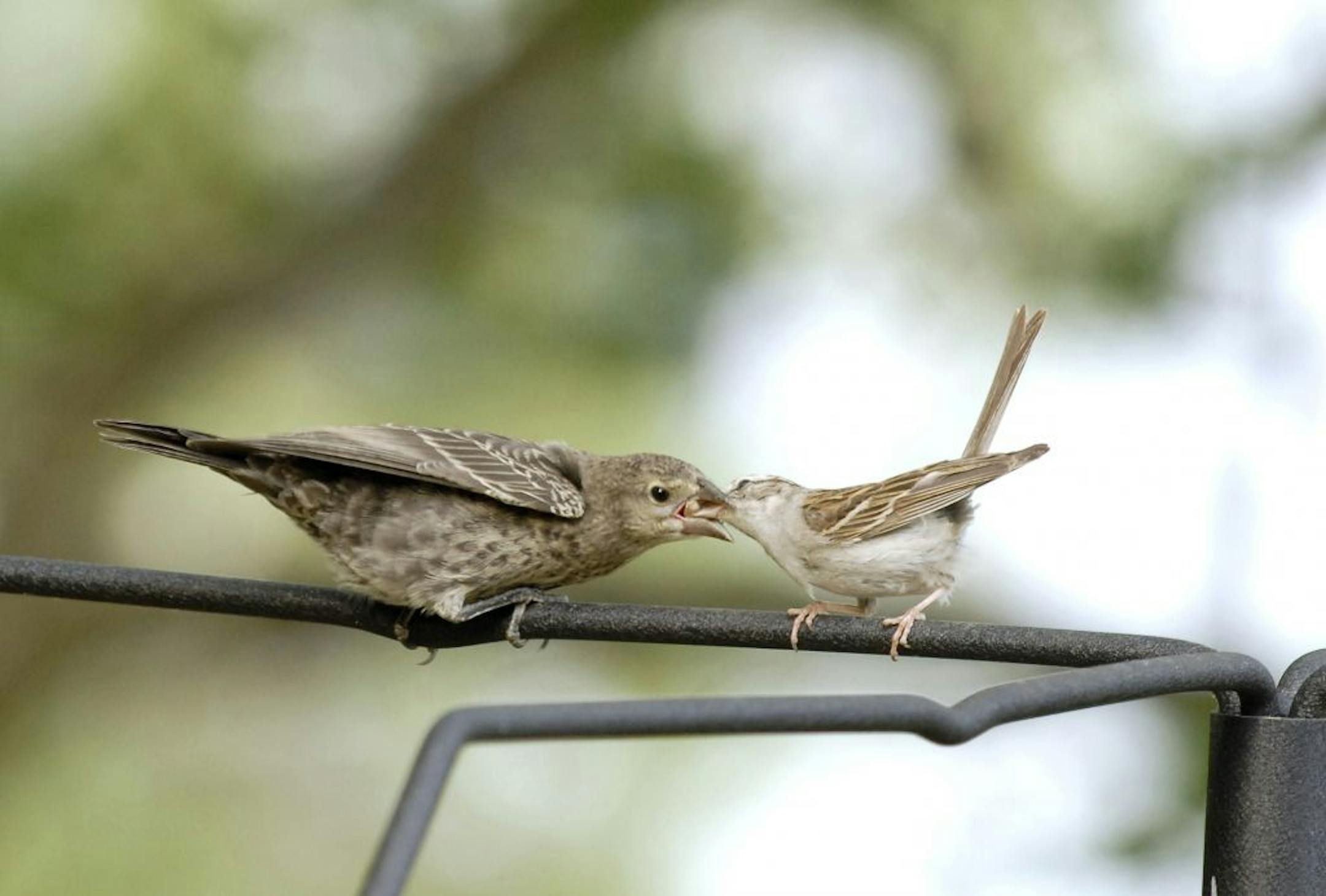
Q My wife and I have been wondering how cowbirds, raised by other species, manage to get together with other cowbirds. One would think that a cowbird raised by a cardinal would think it was a cardinal, too.
A That's an excellent question, and the answer has been evolving as we learn more about these birds. Cowbirds don't raise their young, instead depositing their eggs in the nests of other kinds of birds, from tiny chipping sparrows to larger cardinals, thus consigning their offspring to foster care. It's a behavior found only in this bird species in our region.
Soon after leaving the nest, young cowbirds become very attracted to other young cowbirds and meet up in large flocks in open spaces. The young birds make a chatter call that all cowbirds instinctively recognize, and it serves to draw a group of cowbirds together.
Some researchers also feel that cowbirds know what they, themselves, look like, and recognize these characteristics in other cowbirds. It's in these late summer gatherings that cowbirds learn to identify with their own species.
A combination of instinct and learning makes a young cowbird a cowbird. Find out more at www.startribune.com/a682.
Noisy wrens head south Q The little wrens that nest in my back yard make so much noise. I'm wondering if they sing all year long.
A Good question, and one I'd never considered, so I consulted the Cornell Lab of Ornithology's Birds of North American Online. It'll be a lot quieter in many back yards when these little chatterboxes depart in September for the southern United States or northern Mexico. House wrens become silent and secretive before they leave here, but males may sing sporadically in the winter, and as spring approaches, they begin to sing more frequently.
Pigeons plague barn owner Q We have a problem with pigeons in our barn and wonder if there is a humane way to get them to leave.


