

Opinion editor's note: Star Tribune Opinion publishes a mix of national and local commentaries online and in print each day. To contribute, click here.
•••
In a separate article, I write about the divergent intellectual climates in journalism and academia, but mostly leave conservative media out of the discussion. But a new YouGov survey on public trust in media also provides an opening to talk about the climate on the right.
The basic and unsurprising finding of the survey is that Democrats generally trust the media much more than Republicans do, and that this trust gap extends to almost every prominent outlet except a few websites and the right-wing cable networks — the big fish of Fox News and the minnows of Newsmax and OAN. Democrats aren't just more likely to say they trust ABC, NBC, CNN and PBS. They're more likely than Republicans to say they trust the Wall Street Journal, notwithstanding its conservative editorial page. They're even more likely than Republicans to say they trust National Review, theoretically the intellectual flagship of the right.
That last finding is a red flag, an indicator that some of the respondents probably don't recognize a lot of the outlets they're being asked about and are just guessing based on vague heuristics, memories of legacy brands and so on. (Do the Democrats who say they trust the right-leaning Washington Examiner read the Washington Examiner? I'm skeptical.) As the redoubtable press critic Jack Shafer notes, this is a good reason to discount a lot of the specific findings in the report: Bloomberg doesn't actually need to worry that it's less trusted by Americans than the shell of Newsweek, because most Americans don't read Newsweek anymore, they just recognize the name.
But the general finding is still illuminating: Republicans have a default against almost all non-Fox News-adjacent media, and many right-leaning respondents don't seem to recognize some of the print brands that are aimed directly at their minds and eyeballs.
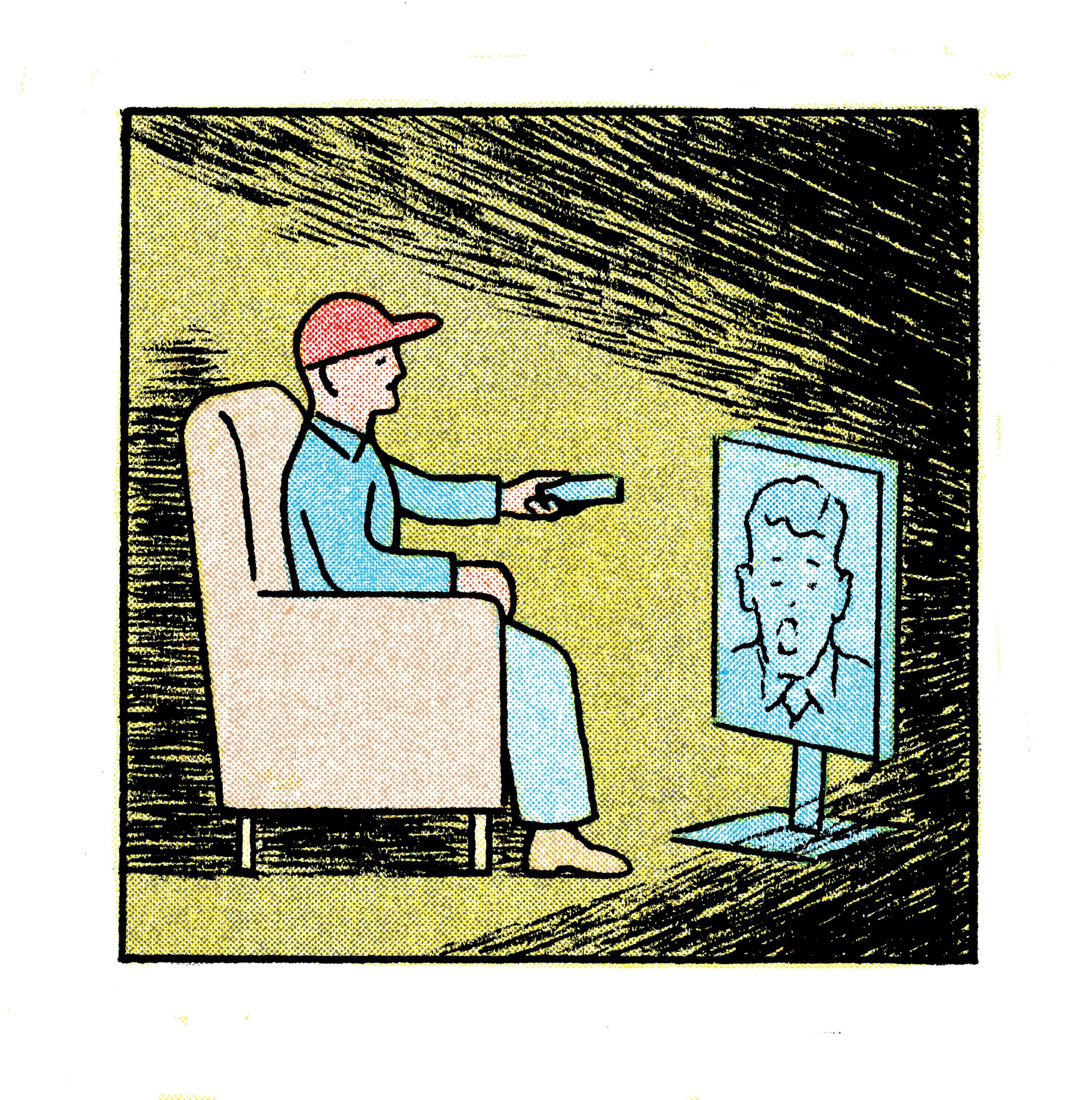
You can analyze these tendencies in terms of several different but mutually reinforcing patterns. One is distilled in the title of this Richard Hanania essay from 2021: "Liberals Read, Conservatives Watch TV." Obviously, that's an oversimplification, since conservatives also dominate the talk-radio dial, conservative book-buyers can drive bestsellers and so on. But it seems fair to say that liberalism has more of a print culture and conservatism more of an oral one, shaped especially by the rhythms of televised infotainment, with its celebrity hosts, its heroes and villains of the week, and its partisan cheerleading. (Not that Democrats don't have their own partisan cheerleaders, but MSNBC doesn't shape the left in the same way that Fox News does the right.) It might also be fair to say (as Hanania has argued in a different piece) that conservatives simply care somewhat less about politics overall — or at least its more granular aspects — and therefore constitute less of a natural audience for deep coverage of the kind that sustains much of the political press.
Much of this is connected to class divisions: Our political-ideological landscape is increasingly defined by polarization between populists and meritocrats, the working classes and the professional classes, and the more the Republican Party becomes the party of less educated Americans, the more it naturally reflects more mass-market media consumption patterns.


