

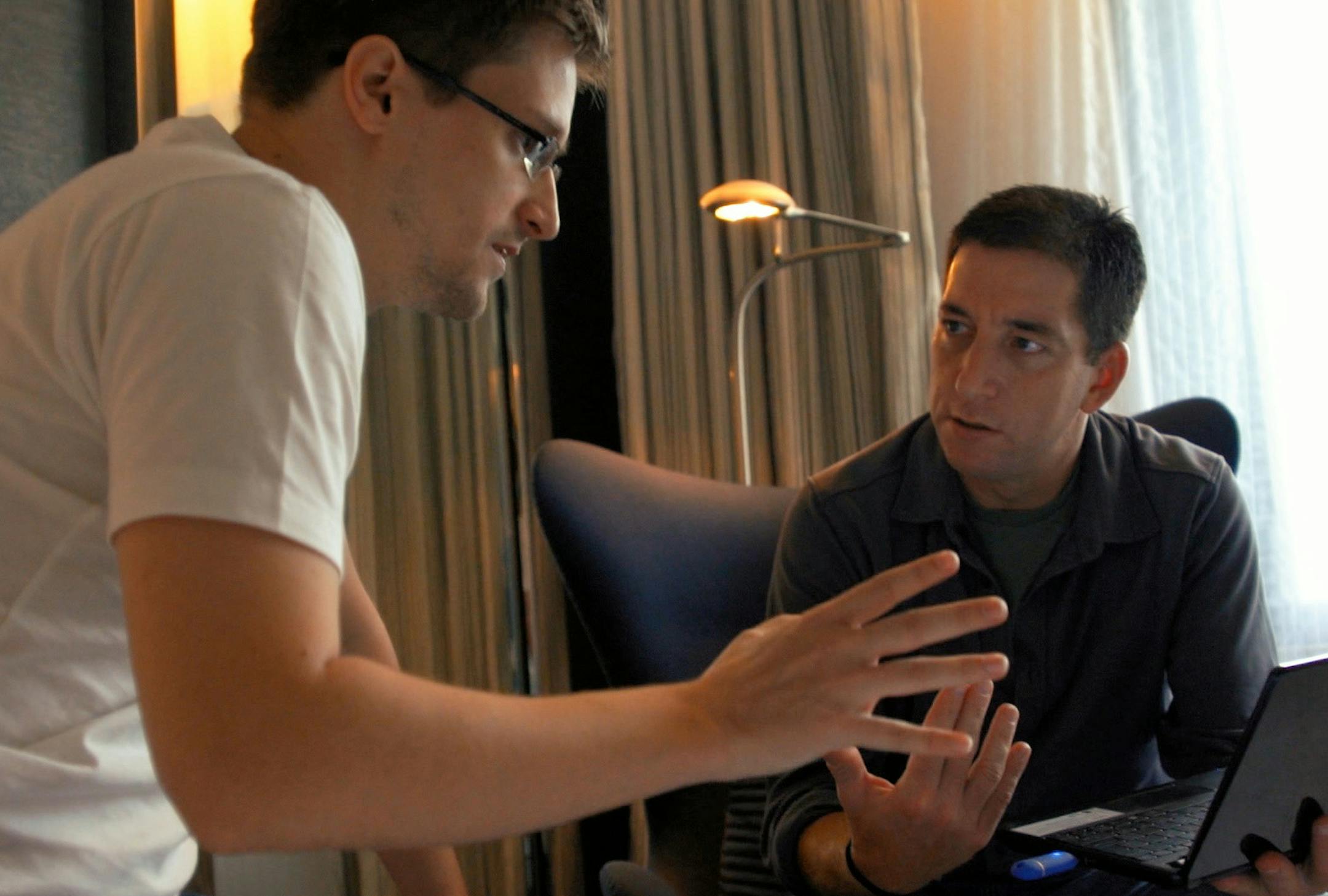
"Citizenfour," documentarian Laura Poitras' portrait of Edward Snowden, the rogue National Security Agency contractor who revealed the breadth and depth of NSA surveillance, is a gripping film. Ironically, that's partly because of surveillance of a different sort — "Citizenfour" (the code name chosen by Snowden) is a real-time reveal of Snowden spilling secrets to Poitras as well as journalists Glenn Greenwald and Ewen MacAskill. Viewers watch as a then-unknown Snowden opens a global debate on surveillance — and on Snowden himself.
"Citizenfour" is history, but not histrionic. The pace alternates between tedious and tense, but more than any emotion the movie's mood is claustrophobic, even paranoid, as Snowden, holed up in a Hong Kong hotel room, is afraid to leave, let alone answer the phone.
The mood also serves as a metaphor for the surveillance state, which Snowden — as well as many citizens and lawmakers — believe is closing in on fundamental freedoms.
Snowden wants this issue to get the media's attention, not him. The "modern-media focus is on big personalities," he says in the film. "I'm not the story here."
But he is, at least in "Citizenfour," where he's often shown in a white shirt on a white bed in a nearly all-white room. A black hat doesn't seem fitting, even to those who consider him a traitor, not a whistleblower. In fact, in "Citizenfour," Snowden is shown sympathetically — technically intelligent and personally principled, albeit geopolitically naive (there are more appropriate places to advocate against tyranny than China and Russia).
"Citizenfour" opened Friday, just days after Tuesday's election wins by resurgent Republicans. While former House Speaker Tip O'Neill's dictum that "all politics is local" still stands, the midterms were nationalized as a referendum on President Obama.
Among the disappointments driving some to vote against a president not on the ballot were NSA surveillance and an increasingly intrusive government. For others, their perception that Obama's foreign policy has led to a less-secure world may have motivated votes. Some voters may have been moved by both issues.
As Congress presses the president on immigration, tax policy and health care, among other issues, the balance between security and surveillance may emerge as surprisingly defining for not only Obama's lame-duck years, but for the contest to succeed him in 2016.


