
Chinese stocks fall further after biggest loss in 8 years as other Asian markets rebound

The Associated Press
August 25, 2015 at 4:45AM

BEIJING — Chinese stocks tumbled again Tuesday after their biggest decline in eight years while most other Asian markets rebounded from a day of heavy losses.

The mixed picture comes after a tumultuous day on Wall Street, where the Dow Jones industrial average ended down 3.6 percent after trimming much bigger losses. European markets were also hit badly. Analysts said it was unclear whether this was a sign the worst was over, or a reprieve in a longer-term bear market.

The declines in China were less severe. The Shanghai Composite Index was down 4.3 percent at 3,071.06 at midday Tuesday after falling 6.4 percent in the first minutes of trading. On Monday, it plummeted 8.5 percent.

In Tokyo, the Nikkei 225 index was up 0.9 percent at 18,702.66 in afternoon trading after dropping 4.6 percent the previous session. Hong Kong's Hang Seng, which also lost 4.6 percent Monday, was up 1.6 percent at 21,595.74. Sydney's S&P ASX 200 advanced 1.4 percent to 5,073.20 and Seoul's Kospi was steady at 1,829.06 after shedding 3 percent the previous day.

The global sell-off was triggered by the sharp drop in Chinese stocks Monday, but experts said there was little change in economic fundamentals to justify such a massive global slide.

"There was no clear catalyst for the global stock meltdown. The lack of clarity makes it difficult to assess what is needed to stem the rout," said Bernard Aw of IG Markets in a report.

"A coordinated policy response is critical, and much of this needs to come from Asian economies," Aw said. "A spate of better economic news may help to allay concerns that global growth is not deteriorating. Certainly, improvements in the Chinese economy will be welcomed."

China's fall was the latest in a series of jarring declines that have defied multibillion-dollar government efforts to stem a slide in prices following an explosive market boom.
In New York, the Dow Jones plummeted more than 1,000 points before ending the day down 588 points, or 3.6 percent, in its eighth-worst point decline ever. The Standard & Poor's 500 sank 3.9 percent, putting it in correction territory, meaning it had fallen at least 10 percent from a recent peak. In Europe, Germany's DAX index declined 4.7 percent, France's CAC-40 slid 5.4 percent and Britain's FTSE 100 lost 4.7 percent.

China's declines reflecting the cooling of a market boom that was driven by official policy and cheerleading from the government press, rather than by economic fundamentals. The Shanghai index rose 150 percent beginning late last year even as the world's second-largest economy was cooling, leaving little to support higher prices once investor enthusiasm faltered.

At Monday's close, the Shanghai index was down 38 percent from its June 12 peak and just under 1 percent from its closing on Dec. 31. That meant the latest declines have wiped out this year's gains.

Investors abroad are increasingly uneasy about China's outlook, though there has been little change in forecasts and some areas including retailing still look relatively strong.

"Investors are overreacting about economic risks in China," said Mark Williams of Capital Economics in a report.

"The surge in prices that started a year ago was speculative, rather than driven by any improvement in fundamentals," Williams said. "A combination of poor data and policy inaction in China may have triggered today's market falls but the bigger picture is that we are witnessing the inevitable implosion of an equity market bubble."

In currency markets, the dollar gained to 119.8390 yen from Monday's 118.6930 yen. The euro edged down to $1.1543 from the previous session's $1.1591.

Oil rebounded from Monday's steep declines.

Benchmark U.S. crude gained 24 cents to $38.42 per barrel in electronic trading on the New York Mercantile Exchange. The contract plunged $2.21 on Monday to close at $38.42.

Brent crude, used to price international oils, advanced 26 cents to $42.95 per barrel in London. It fell $2.77 the previous day to close at $42.69.

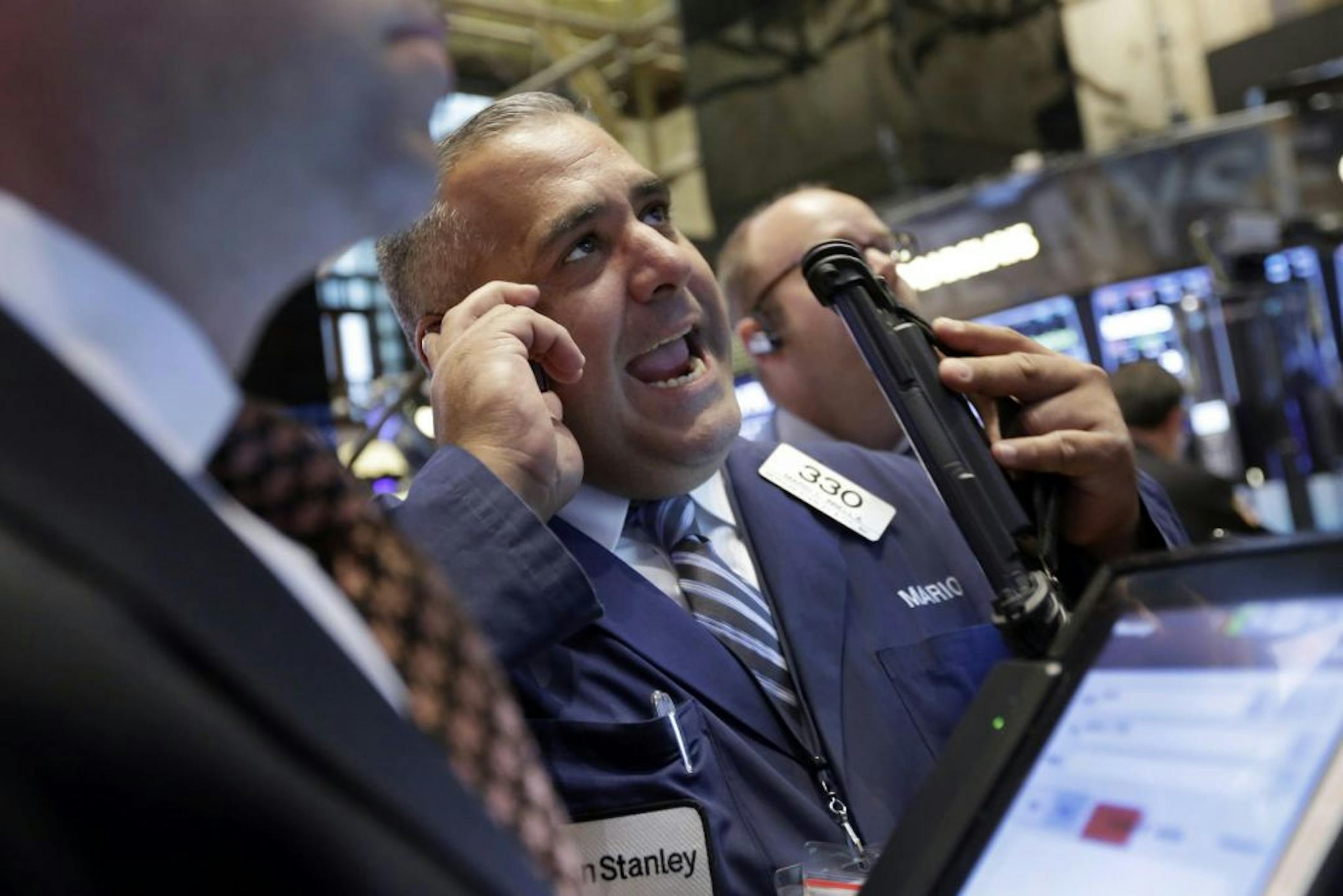
Trader Mario Innella works on the floor of the New York Stock Exchange, Monday, Aug. 24, 2015. U.S. stock markets plunged in early trading Monday following a big drop in Chinese stocks.
Trader Mario Innella works on the floor of the New York Stock Exchange, Monday, Aug. 24, 2015. U.S. stock markets plunged in early trading Monday following a big drop in Chinese stocks. (Associated Press/The Minnesota Star Tribune)
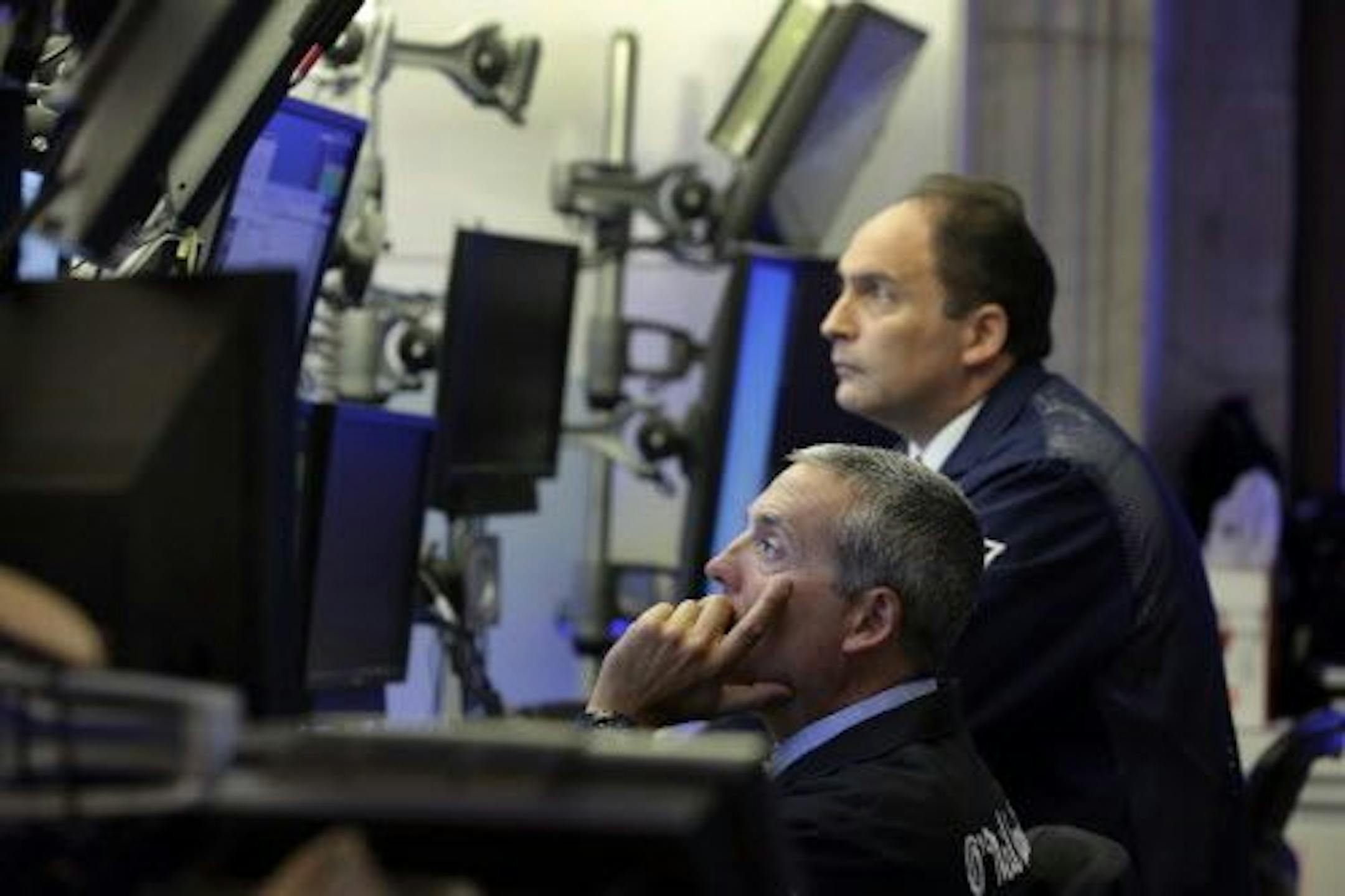
A pair of traders work in their booth on the floor of the New York Stock Exchange, Monday, Aug. 24, 2015. World stock markets plunged on Monday after China's main index sank 8.5 percent, its biggest drop since the early days of the global financial crisis, amid deepening fears over the health of the world's second-largest economy.
A pair of traders work in their booth on the floor of the New York Stock Exchange, Monday, Aug. 24, 2015. World stock markets plunged on Monday after China's main index sank 8.5 percent, its biggest drop since the early days of the global financial crisis, amid deepening fears over the health of the world's second-largest economy. (Associated Press/The Minnesota Star Tribune)
about the writer

about the writer

JOE McDONALD

More from Minnesota Star Tribune

See More
card image
J. SCOTT APPLEWHITE, ASSOCIATED PRESS/The Minnesota Star Tribune

The "winners" have all been Turkeys, no matter the honor's name.

In this photo taken Monday, March 6, 2017, in San Francisco, released confidential files by The University of California of a sexual misconduct case, like this one against UC Santa Cruz Latin Studies professor Hector Perla is shown. Perla was accused of raping a student during a wine-tasting outing in June 2015. Some of the files are so heavily redacted that on many pages no words are visible. Perla is one of 113 UC employees found to have violated the system's sexual misconduct policies in rece