

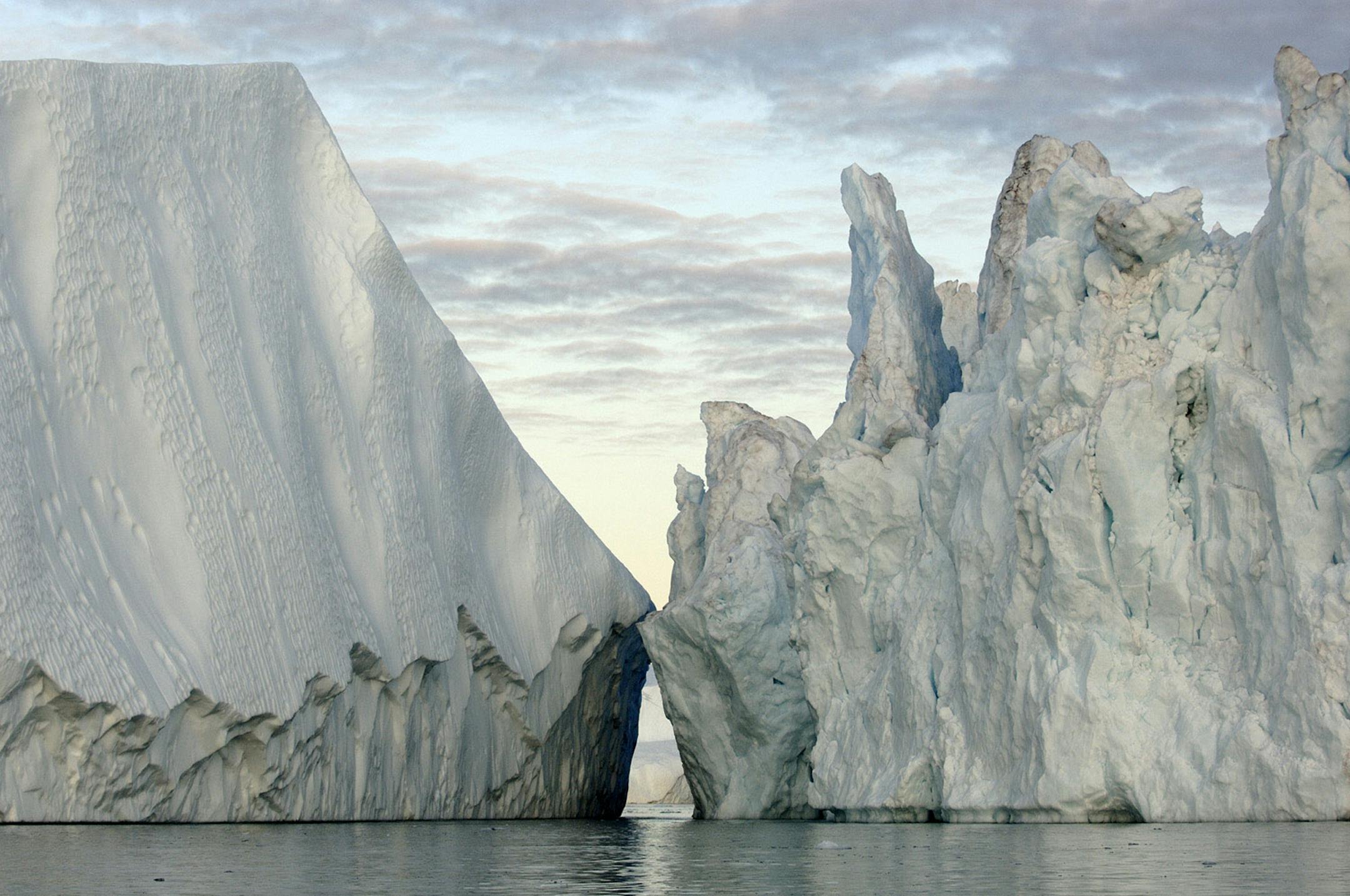
Sprawled on a massive sheet of ice that was shifting beneath him, James Balog looked down into a 2,000-foot-deep crevasse and aimed his lens.
"I'd obsessed for four years about getting that shot," he recalled. "I figured I'd have about two minutes. There was a crack in the ice where my waist was, and a tremendous amount of uncertainty. Where the ropes were anchored, I couldn't count on them to hold me. But once you've taken that initial investment of risk, you say, 'OK, it hasn't broken yet,' and go to work."
That experience in Greenland was one of many dangerous moments for Balog, a renowned environmental photographer who embarked six years ago on what he dubbed the Extreme Ice Survey. He and a team of explorers and scientists set up cameras in some of the most frigid, rough and remote corners of the world to record the rapid rate at which glaciers are now melting -- losing hundreds of feet a year in some cases. So much for the notion of moving at a glacial pace.
Balog will be in town Friday for the opening of "Chasing Ice," a film about his project, along with Minnesota-based polar explorer Will Steger. While the documentary is partly a profile of Balog and the passions that drive him, it also rings a breathtaking alarm bell about climate change. The film, from the producers of the Academy Award-winning "The Cove" (about dolphin slaughter), is on a short list of 15 documentaries in this year's Oscar race.
Glacier melt seems a problem far removed from our daily lives. Geographically, at least, it is. Humans don't generally live near them, and relatively few have seen one up close and personal. But videos that Balog's crew compiled from 25 time-lapse cameras, which snapped images every half-hour of daylight at several locations around the world, show the mighty monsters disappearing before viewers' eyes.
"Cameras reveal reality in a way mere numbers don't," said Balog, who also has a science background and was once a climate-change skeptic himself.
Based in Boulder, Colo., Balog, 60, had already gained accolades for his magazine work and photo books featuring portraits of trees and endangered species. EIS was originally funded by National Geographic and other sources, but now relies on private donations.
In the beginning, he focused on just shooting the glaciers. But the scale of the melting he witnessed convinced him to broaden his ambition.


