
Chicago museum lifts lid on coffin of 2,500-year-old Egyptian boy mummy for conservation work

The Associated Press
December 9, 2014 at 1:16AM
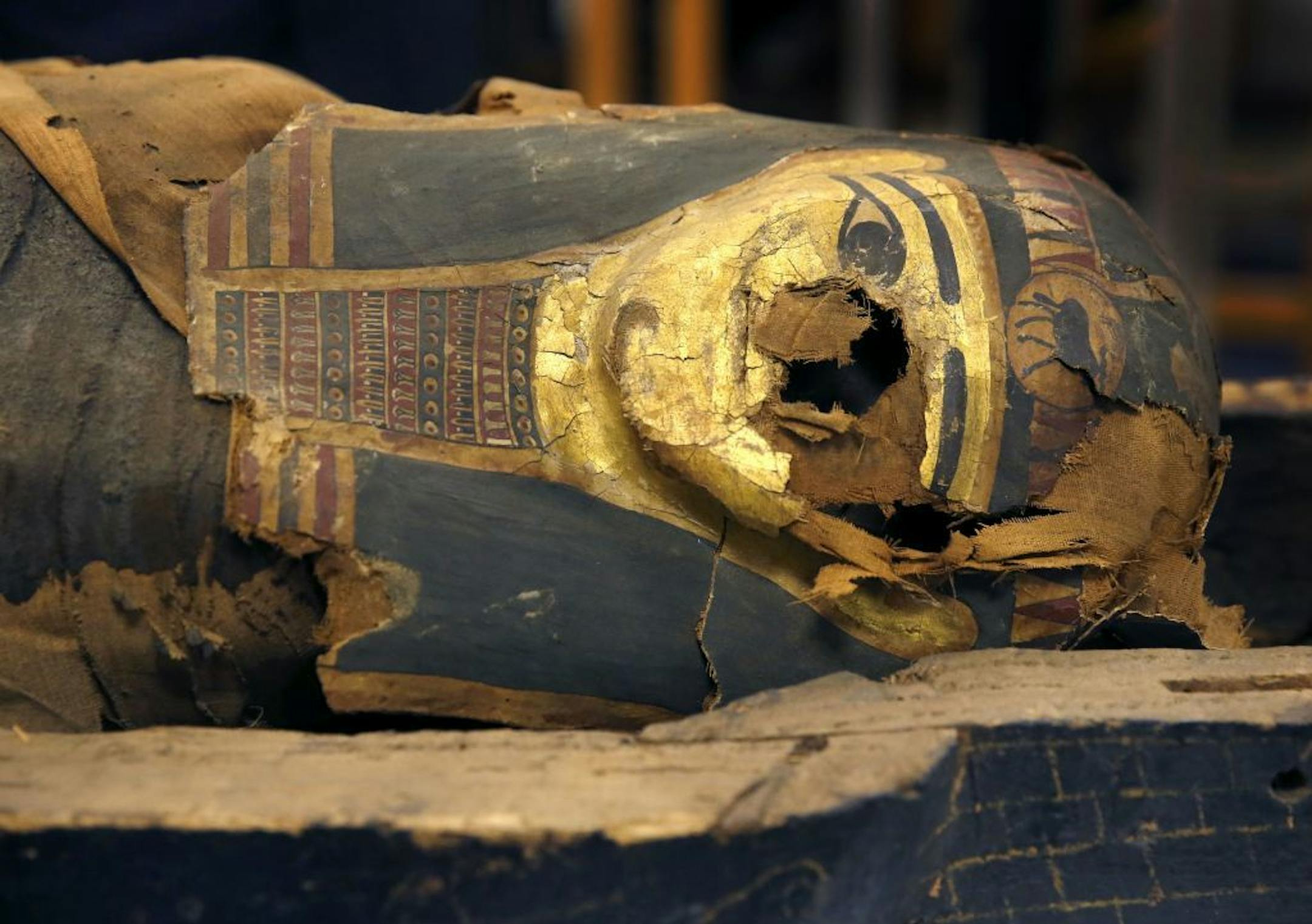
In this photo taken Friday, Dec. 5, 2014, in Chicago, the mummified body of Minirdis, a 14-year-old Egyptian boy and his burial mask lie in his opened coffin after J.P. Brown and his team of curators at the Field Museum opened the coffin for the first time. Brown and his team will begin conservation work on the 2,500-year-old boy before it becomes part of a traveling exhibition. Brown says they have to fix his burial mask, shroud, reconnect his detached feet, and do work to shore up the coffin a
In this photo taken Friday, Dec. 5, 2014, in Chicago, the mummified body of Minirdis, a 14-year-old Egyptian boy and his burial mask lie in his opened coffin after J.P. Brown and his team of curators at the Field Museum opened the coffin for the first time. Brown and his team will begin conservation work on the 2,500-year-old boy before it becomes part of a traveling exhibition. Brown says they have to fix his burial mask, shroud, reconnect his detached feet, and do work to shore up the coffin and mummy so they can withstand travel. (Associated Press - Ap/The Minnesota Star Tribune)

CHICAGO — Not until the lid was off the wood coffin — exposing the 2,500-year-old mummified remains of a 14-year-old Egyptian boy — could J.P. Brown relax.

The conservator at Chicago's Field Museum and three other scientists had just employed specially created clamps as a cradle to raise the fragile coffin lid. Wearing blue surgical gloves, they lifted the contraption and delicately walked it to safe spot on a table in a humidity-controlled lab.

"Sweet!" Brown said after helping set the lid down, before later acknowledging the stress. "Oh yeah, god, I was nervous."

The much-planned procedure Friday at the museum, revealing the burial mask and blackened toes of Minirdis, the son of a priest, will allow museum conservators to stabilize the mummy so it can travel in an upcoming exhibit.

"Mummies: Images of the Afterlife" is expected to premier in September at the Natural History Museum of Los Angeles County, then travel to the Denver Museum of Nature and Science in fall 2016.

The Field Museum has had the mummy since the 1920s, when the institution received it from the Chicago Historical Society. It's part of the museum's collection of 30 complete human mummies from Egypt.

"There's always a risk of damage," said Brown, who works in a lab filled with plastic-covered examination tables behind a large window that allows schoolchildren to watch him work. "So we like to handle these things as little as possible."

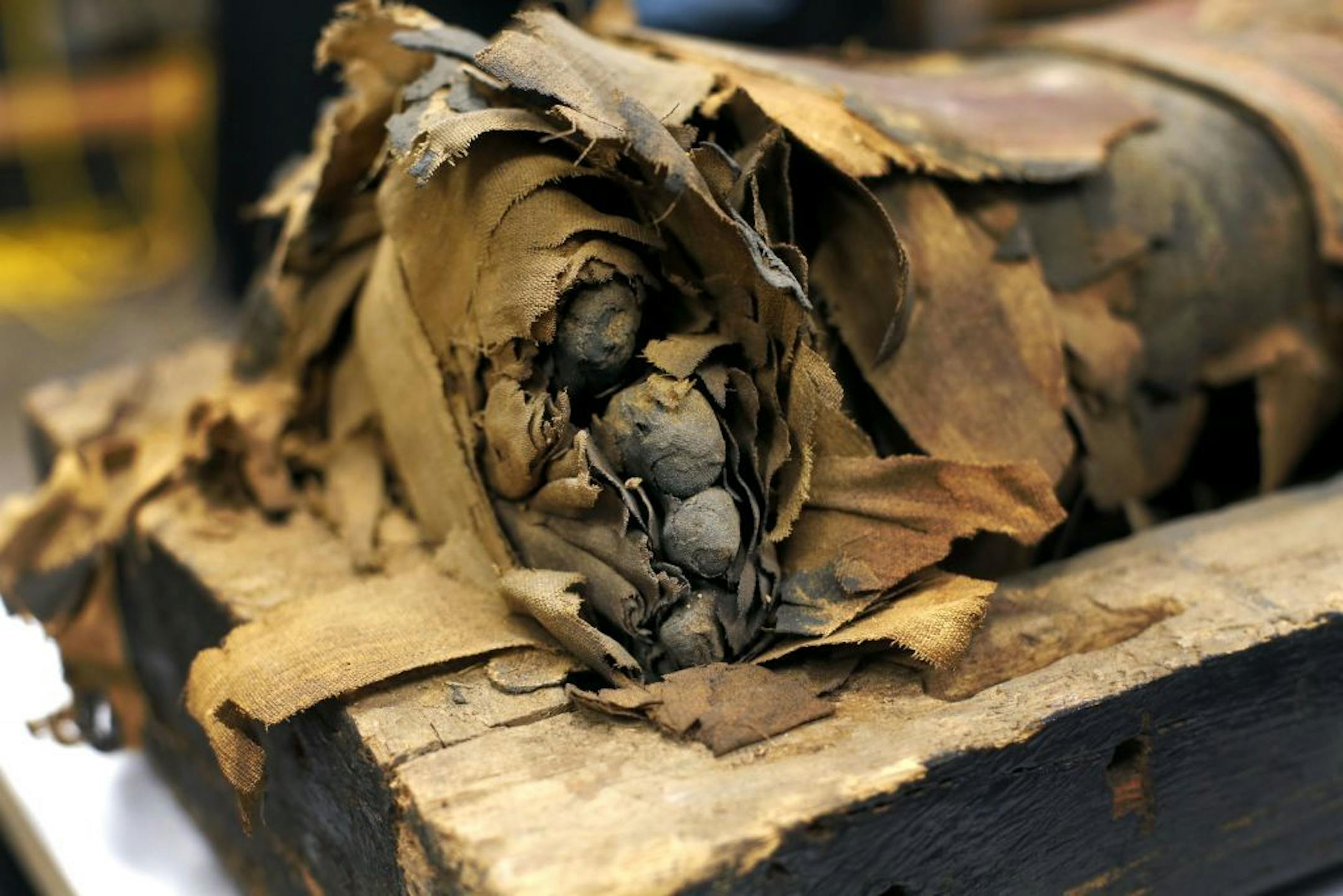
Even before opening the coffin, the conservators knew some of what to expect. CT scans, which make X-ray images allowing scientists to see inside, showed the boy's feet were detached and partially unwrapped with his toes sticking out. His shroud and mask were torn and twisted sideways. Those also will be repaired.
Pieces of the coffin had previously gone missing, so the mummy had been exposed to the elements before. For that reason, Brown wasn't worried about the mummy scattering to dust when the lid came off — a notion familiar to moviegoers.

"The last bit of 'Indiana Jones' and all that — that's not going to happen," he reassured before the lid-raising began.

Walking around the opened coffin, Brown pointed and explained the significance of a particular marking, the colored resin on linen wrappings and the gilded gold on the mask. If Minirdis had lived, he would have been a priest like his father, Brown said.

Scientists don't know why he died so young.

"The fascinating thing about any mummy is that it's survived as long as it has," Brown said. "They're actually amazingly fragile."

This kind of work is always painstaking, with lots of pre-planning and tests to prevent the unexpected, said Molly Gleeson, who works with mummies as project conservator at Penn Museum's "In the Artifact Lab: Conserving Egyptian Mummies" exhibition in Philadelphia.

"There's nothing else like them," she said, noting that if something goes wrong, "We can't put things back together exactly the way they were before."

In this photo taken Friday, Dec. 5, 2014, in Chicago, the mummified body of Minirdis, a 14-year-old Egyptian boy and his exposed toes lie in his opened coffin after J.P. Brown and his team of curators at the Field Museum opened the coffin for the first time to begin a conservation process on the 2,500-year-old boy before it becomes part of a traveling exhibition. Brown says they have to fix his burial mask, shroud, reconnect his detached feet, and do work this week to shore up the coffin and mum
In this photo taken Friday, Dec. 5, 2014, in Chicago, the mummified body of Minirdis, a 14-year-old Egyptian boy and his exposed toes lie in his opened coffin after J.P. Brown and his team of curators at the Field Museum opened the coffin for the first time to begin a conservation process on the 2,500-year-old boy before it becomes part of a traveling exhibition. Brown says they have to fix his burial mask, shroud, reconnect his detached feet, and do work this week to shore up the coffin and mummy so they can withstand travel. (Associated Press - Ap/The Minnesota Star Tribune)
about the writer

about the writer

CARYN ROUSSEAU

More from Minnesota Star Tribune

See More
card image
Provided/Sahan Journal

Family members and a lawyer say they have been blocked from access to the bedside of Bonfilia Sanchez Dominguez, while her husband was detained and shipped to Texas within 24 hours.

card image