

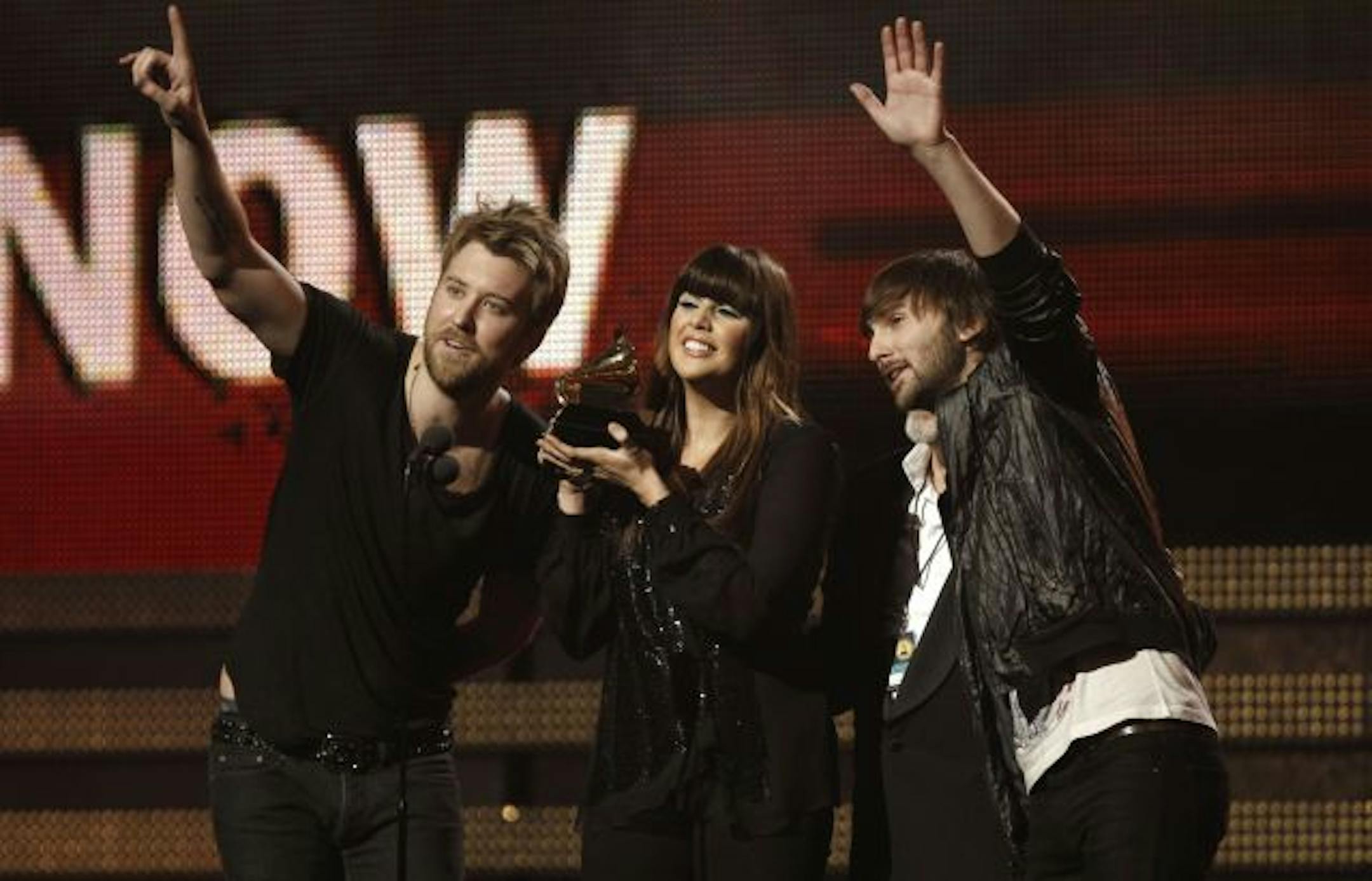
COUNTRY/POP: Lady Antebellum, Own the Night (Capitol)
For three seemingly chipper, well-adjusted country folk, the pretty people in Lady Antebellum function much better out of love than in it. When tears and tell-offs are involved, the group's third album is often a deceptively sharp, moving dissertation on relationships teetering on kersplat.
Much like 2010's Grammy-winning smash album "Need You Now," the new LP has several spots of cheery, momentum-killing goo. When not letting the Care Bears take over, however, Lady A paints a few brutally beautiful portraits without losing those million-dollar hooks. Driven by a bucolic piano line, the song "As You Turn Away" is like "Need You Now: The Day After," with the harsh light of sobriety shining down on the cracks of an irreparable pairing. It's one of the best things the band has done, and singer Hillary Scott sells this one as though she's very much been the one staring at a lover bidding adieu too soon.
Co-lead singer Charles Kelley -- a Mississippi bluesman trapped in a country hunk's body -- is one of the best singers in any genre. But she pulls some short straws in terms of star turns here. The generically rocking "Friday Night" is so pandering to country revelers it's almost insulting. That said, the guy is so good, he's able to take so-so songs and give them a certain heft. The prolifically selling Lady A can do no wrong these days, so it makes zero sense to change the happy-sad formula now. But a little life, and a little more loss, will do this group good.
- SEAN DALY, St. Petersburg Times
R&B/HIP-HOP: Terius Nash, "1977"
No songwriter and producer of the past few years has done more to define the sound of female R&B than Terius Nash (aka The-Dream). Rihanna, Mariah Carey, Beyoncé -- he's reinvented them all. And yet no male R&B singer is more skeptical about women than Nash, who on his albums as The-Dream portrays relationships as dysplasias born of the unfortunate intersection of romance and money and fame and fear.
Nash made "1977," his fourth album -- which he made from soup to nuts in less than two weeks, he said -- and released it free on his website under his given name, suggesting some friction with his record label, Def Jam.
Or maybe he just wanted to curse a lot. "1977" is Nash at his most flagrant and insolent, an album of disappointment and frustration but not self-doubt. It's a sketchbook teeming with rough drafts, would-be parodies, half-ideas and good themes not fully fleshed out. In that, though, it's not unlike the other albums by The-Dream. Nash has always been a more careful and precise songwriter for others than for himself. Frustrated though The-Dream albums may be, it's clear that no one in R&B is having more fun than Nash, whose gift for melody is prodigious and who can spin a comic concept into soul gold. Here, that's "Wedding Crasher," in which Nash half-apologizes, "I hate to have to cry at your wedding" before insisting, "Let me sing you my drunk song."
- JON CARAMANICA, NEW YORK TIMES


