
Boy Scout became a national hero

October 15, 2016 at 11:13PM
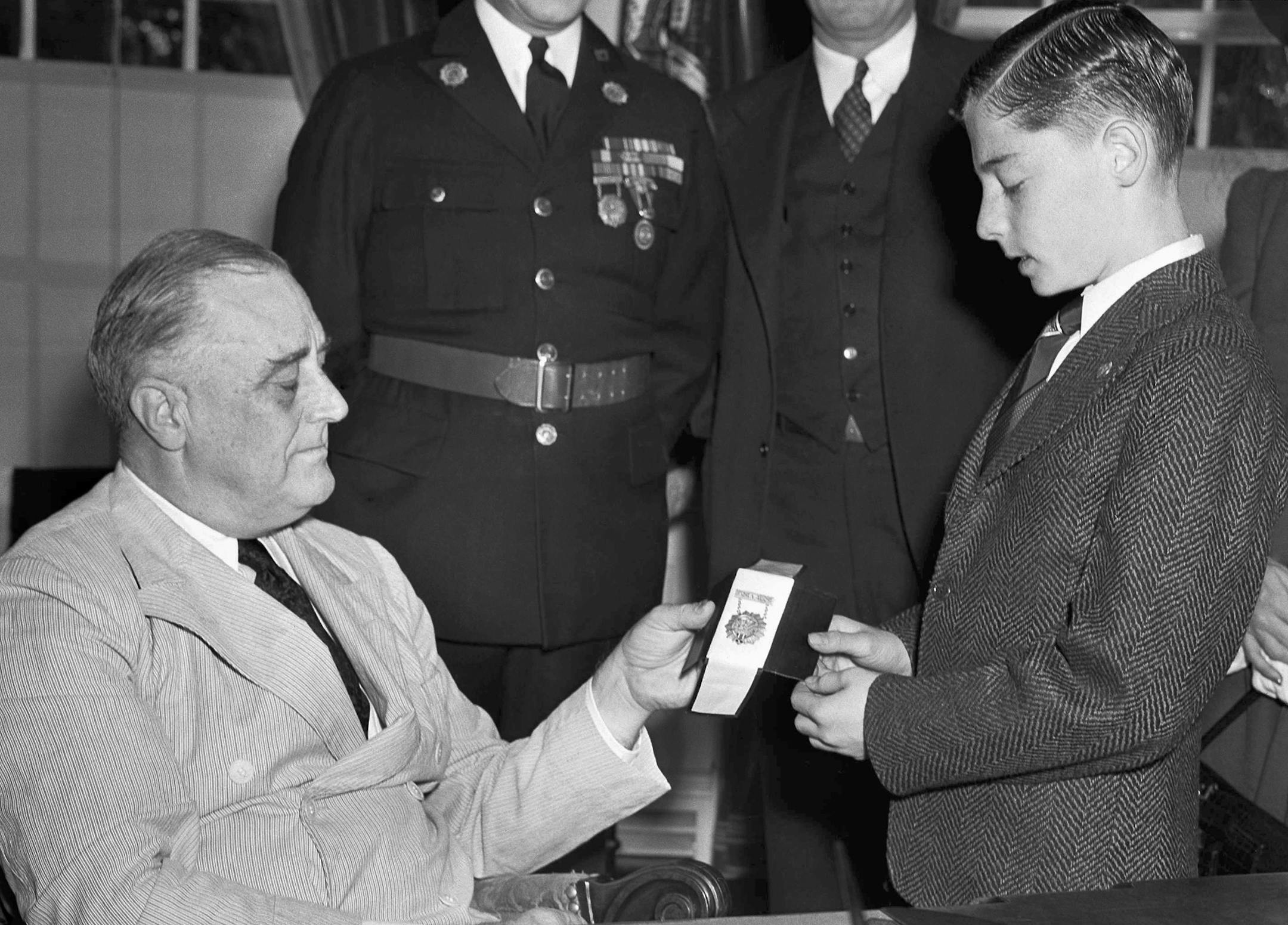
FILE - In this Oct. 15, 1940 file photo, Boy Scout Donn Fendler, of Rye, N.Y., is honored by President Franklin Roosevelt with a gold medal for valor at the White House in Washington. Fendler, who at age 12 survived nine days alone on Maine’s tallest mountain in 1939 and later collaborated on a book about the ordeal, died Monday, Oct 10, 2016, in Bangor, Maine. He was 90. (AP Photo, File)
On Oct. 15, 1940, President Roosevelt honored Boy Scout Donn Fendler, of Rye, N.Y., with a gold medal for valor. (The Minnesota Star Tribune)

Donn Fendler, 90, a Boy Scout who lost his way during a mountain trek in Maine in 1939, embarking on a nine-day survival story that transfixed the nation and inspired generations with its themes of self-reliance and intrepidity, died Monday at a hospital in Bangor, Maine.

Fendler was a month shy of his 13th birthday when he became a national hero. His ordeal landed him in newspapers across the country and, it was said, in the prayers of mothers everywhere.

In the summer of 1939, Fendler became lost while hiking with his father, his twin brother, another brother and two friends on Mount Katahdin — at roughly a mile high, the tallest peak in Maine.

"I had a feeling I was right on the edge of a great cliff," he recalled in an as-told-to memoir, "Lost on a Mountain in Maine" (1939), co-authored with Joseph Egan. "The way the clouds swirled scared me. The rocks about me looked more like ghosts than rocks, until I tried to climb over them."

Sleet followed the fog, and cold began to set in. A search party was formed, including hundreds of police and fire officials, forestry authorities, game wardens, the National Guard, and concerned ­citizens.

Fendler survived on what he described as his faith in God and his will to live — along with pointers from the Scouts, including if lost in the wild, follow a stream to civilization.

Finally, on July 25, the owner of a sporting camp spotted a half-clothed, exhausted boy crying on the banks of the Penobscot River, 35 miles from where his family had last seen him.

Fendler was down from 74 to 58 pounds. After a joyful reunion with his parents, he received a hero's welcome home, including a parade, a feature in Life magazine and a medal from the governor of Maine declaring him "the most courageous boy in America." Later, Fendler received a medal of valor from President Franklin D. Roosevelt.

When Fendler was honored by Roosevelt, he declared that "if I were old enough, I would enlist in the Army today." Five years to the day after he went missing, he joined the Navy, serving in the Pacific during World War II.

Dario Fo, 90, an Italian comic actor, playwright, satirist and self-described jester whose satirical works earned the Nobel Prize for literature, died Tuesday at a Milan ­hospital.

When Fo received the Nobel in 1997, some literary experts were aghast and admitted they had never heard of him. And he became one of the most unlikely Nobel ­laureates in literature — until the very day he died, when the prize was awarded to Bob Dylan. At various times, Fo was arrested, banned from Italian TV and prevented from entering the U.S. because of suspected support of terrorist groups.

In awarding the Nobel to Fo, the Swedish Academy noted that he "emulates the jesters of the Middle Ages in scourging authority and upholding the dignity of the downtrodden."

He was the author of more than 40 plays, most with overtly political and satirical themes. He acted in most of them, often with his wife and collaborator, Franca Rame.

Some of Fo's earliest works from the 1950s, such as "A Madhouse for the Sane," were bold satires of Italy's political life, in which fascist sympathizers from World War II were still active. A 1959 farce, "Archangels Don't Play Pinball," was an absurdist sendup of governmental bureaucracy.

In 1962, after writing and appearing in a satirical sketch — in which an obese woman visiting a meatpacking plant falls into a grinder and winds up as 150 cans of meat — Fo and his wife were effectively banned from Italian television for more than a decade.

They later founded a theater cooperative called Nuova Scena with ties to the Communist Party. The group toured Italy with satirical plays and pantomimes.

In 1969, Fo premiered one of his best-known works, "Mistero buffo" ("Comic Mystery"), in which he lampooned the Catholic Church and the Italian government with outrageous retellings of the gospels — often delivered in a comical form of gibberish. When he finally returned to Italian TV to perform the play in 1977, the Vatican denounced it as "the most blasphemous show in the history of television."

Benjamin F. Payton, 83, a civil rights advocate who was instrumental in transforming the historically black Tuskegee Institute in Alabama into the more broadly encompassing Tuskegee University over nearly three decades as its president, died on Sept. 28 in Estero, Fla.

The university was founded in a shanty in Tuskegee, Ala., in 1881 by Booker T. Washington.

Nearly 100 years later, overcoming alumni objections and hoping to broaden its appeal, Payton enlarged the scope and the very identity of Tuskegee by pushing to give it university status.

His plan was adopted in 1985, and soon afterward he established Tuskegee's first doctoral program, created a College of Business and Information Science, the Gen. Daniel "Chappie" James Center for Aerospace Science and Health Education, and the Continuing Education Program. He oversaw fundraising campaigns that generated about $240 ­million.

He also won an apology from the United States, delivered by President Bill Clinton in 1997, for the federal government's infamous four-decade "Tuskegee Study of Untreated Syphilis in the Negro Male." In the study, beginning in 1932, penicillin and other available treatments were deliberately withheld from more than 600 research subjects with venereal disease: poor black men from Macon County, whose county seat is Tuskegee.

news services

about the writer

about the writer

More from Minnesota Star Tribune

See More
card image
J. SCOTT APPLEWHITE, ASSOCIATED PRESS/The Minnesota Star Tribune

The "winners" have all been Turkeys, no matter the honor's name.

In this photo taken Monday, March 6, 2017, in San Francisco, released confidential files by The University of California of a sexual misconduct case, like this one against UC Santa Cruz Latin Studies professor Hector Perla is shown. Perla was accused of raping a student during a wine-tasting outing in June 2015. Some of the files are so heavily redacted that on many pages no words are visible. Perla is one of 113 UC employees found to have violated the system's sexual misconduct policies in rece