
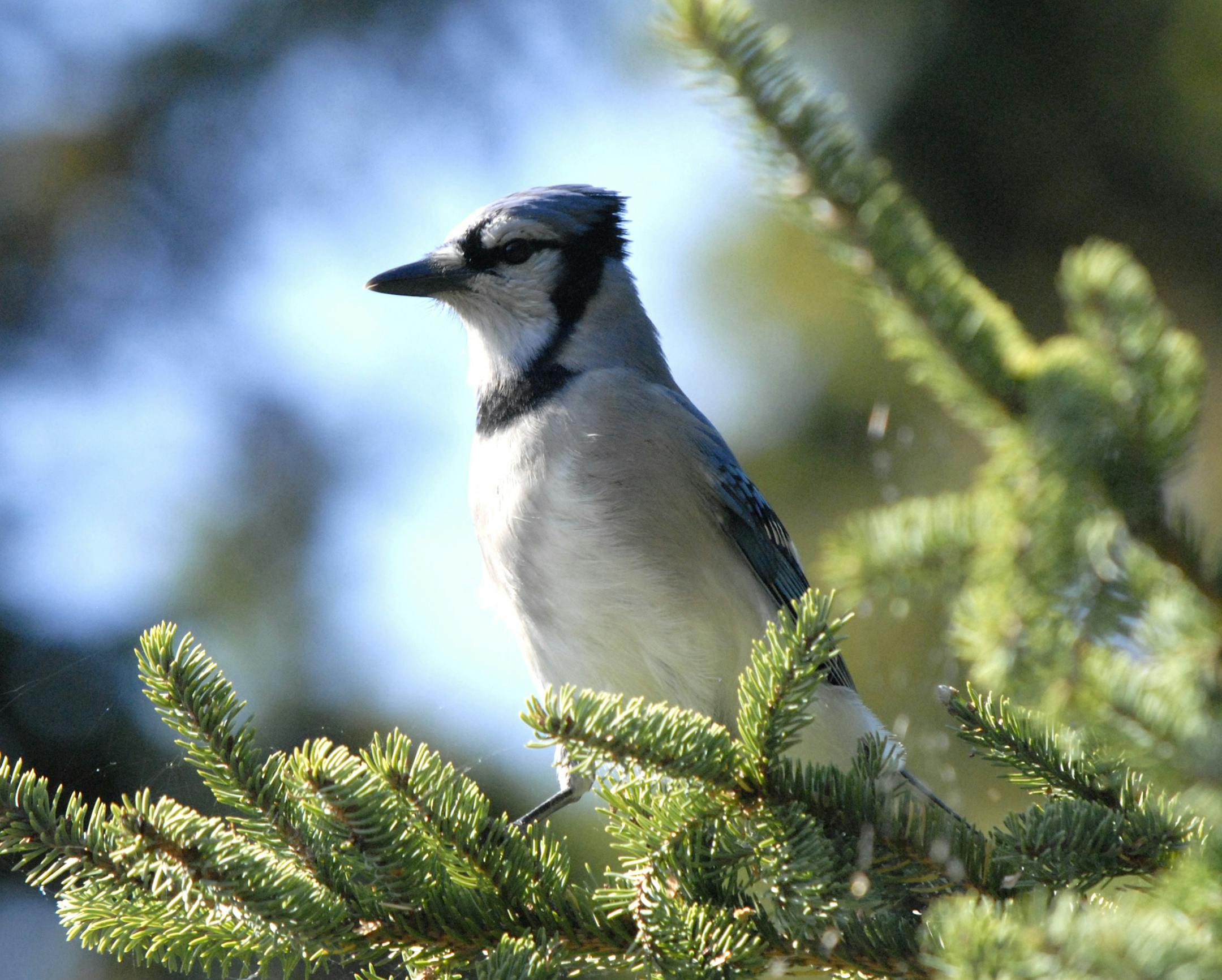
Blue jays spread forest spires

A unique relationship between the mighty oak and the bullying blue jay holds a surprise.

August 19, 2008 at 7:12PM
Blue jays can carry acorns as far as a mile from parent trees.
Blue jays can carry acorns as far as a mile from parent trees. (Special To The Star/The Minnesota Star Tribune)

Blue jays aren't the most popular birds on the block.

Many people are put off by their loud screeches and their bullying ways at the feeder. But jays perform a little-known public service: They are Mother Nature's foresters.

Think of how many times you've seen a lone oak standing in the middle of a field. Because that oak grew from an acorn, you might wonder how that acorn got so far from its parent tree. The answer often is a blue jay -- a bird with a taste for tree nuts and a habit of stashing food for leaner times.

In fact, some experts think the bird and the tree are so closely linked that oak forests might not exist without jays.

Here's why: In fall, blue jays take acorns and bury them in the forest leaf litter or in open spaces under a mat of vegetation. Because jays don't remember where they hide every acorn, many remain to sprout the next spring. Their instinctual need to build a larder means thousands of acorns are dispersed over a wide area.

Without jays, acorns fall from oaks and lie in piles, where most gradually break up or become infested by insects. The few that do sprout often have little chance of becoming saplings because they are doomed by the shade of the parent oak.

Squirrels usually get the credit for burying acorns, but they just grab any old acorn and tap it into the earth, often too deep for successful germination and too close to the parent tree to sprout. Blue jays, on the other hand, boost the chances for an oak to sprout by carefully selecting the seeds and carrying them to better habitat.

Birds move trees

A single blue jay uses its stout beak to move as many as 5,000 acorns in a season. And research indicates they may have a unique ability to select the best ones. Only about 10 percent of the acorns on any oak tree have been pollinated and are fertile. In several studies, jays have been able to pluck the viable nuts about 90 percent of the time.

And because blue jays can carry an acorn up to a mile from its parent tree, the birds help push the slow progress of a forest outward. Some experts even give blue jays credit for the rapid spread of oak forests in the temperate zone after the last Ice Age.

While they do have a very close relationship, the birds aren't totally dependent upon the trees. Blue jays are omnivorous. In addition to acorns, they also eat fruits, insects and feeder foods such as sunflower seeds and corn. But they seem to have a fondness for acorns, which help them survive the winter.

Come spring, their handiwork is evident throughout the state as millions of oak seedlings show up in back yards, meadows and along the edges of forests.

Val Cunningham, a St. Paul nature writer, can be reached at valwrites@comcast.net.

about the writer

about the writer

VAL CUNNINGHAM, Contributing Writer

More from Minnesota Star Tribune

See More
card image
J. SCOTT APPLEWHITE, ASSOCIATED PRESS/The Minnesota Star Tribune

The "winners" have all been Turkeys, no matter the honor's name.

In this photo taken Monday, March 6, 2017, in San Francisco, released confidential files by The University of California of a sexual misconduct case, like this one against UC Santa Cruz Latin Studies professor Hector Perla is shown. Perla was accused of raping a student during a wine-tasting outing in June 2015. Some of the files are so heavily redacted that on many pages no words are visible. Perla is one of 113 UC employees found to have violated the system's sexual misconduct policies in rece