For a certain bandwidth of the population, public discourse on particular topics is often taboo, whether it be sex, money or religion. If the issue is overpopulation, that bandwidth is exceedingly wide. Or so believes John Schuerman, a visual artist who is curator of the inquisitive exhibition "Fruitful and Multiplying: The Overpopulation Exhibit."
Schuerman and the other Minnesota artists he features — Mayumi Amada, Michael Kareken and Jim Proctor — address this slippery topic from various stylistic modes and points of view. The topic is given greater depth through a "salon show" of 12 artists who answered an open call.
Through this panoply of media, styles and perspective, "Fruitful and Multiplying" teases out certain consequences and outcomes of overpopulation. Some works illustrate the topic quickly and clearly, while others are more circuitous in their approach.
"With art we can have this discourse on overpopulation," Schuerman reasoned in an interview last week. "The visual arts are not as constrained as other areas where discussion occurs."
He uses his own family tree to underscore the point. In "My Living Relatives," a stylized pencil and ink-stamped work that is 46 feet long, he identifies his living male and female, blood and non-blood relatives using symbols of mouths in red and yellow. A graphic map of sorts, Schuerman's visual plotting begins with his parents' generation through their great-grandchildren — 10 families totaling 215 people.
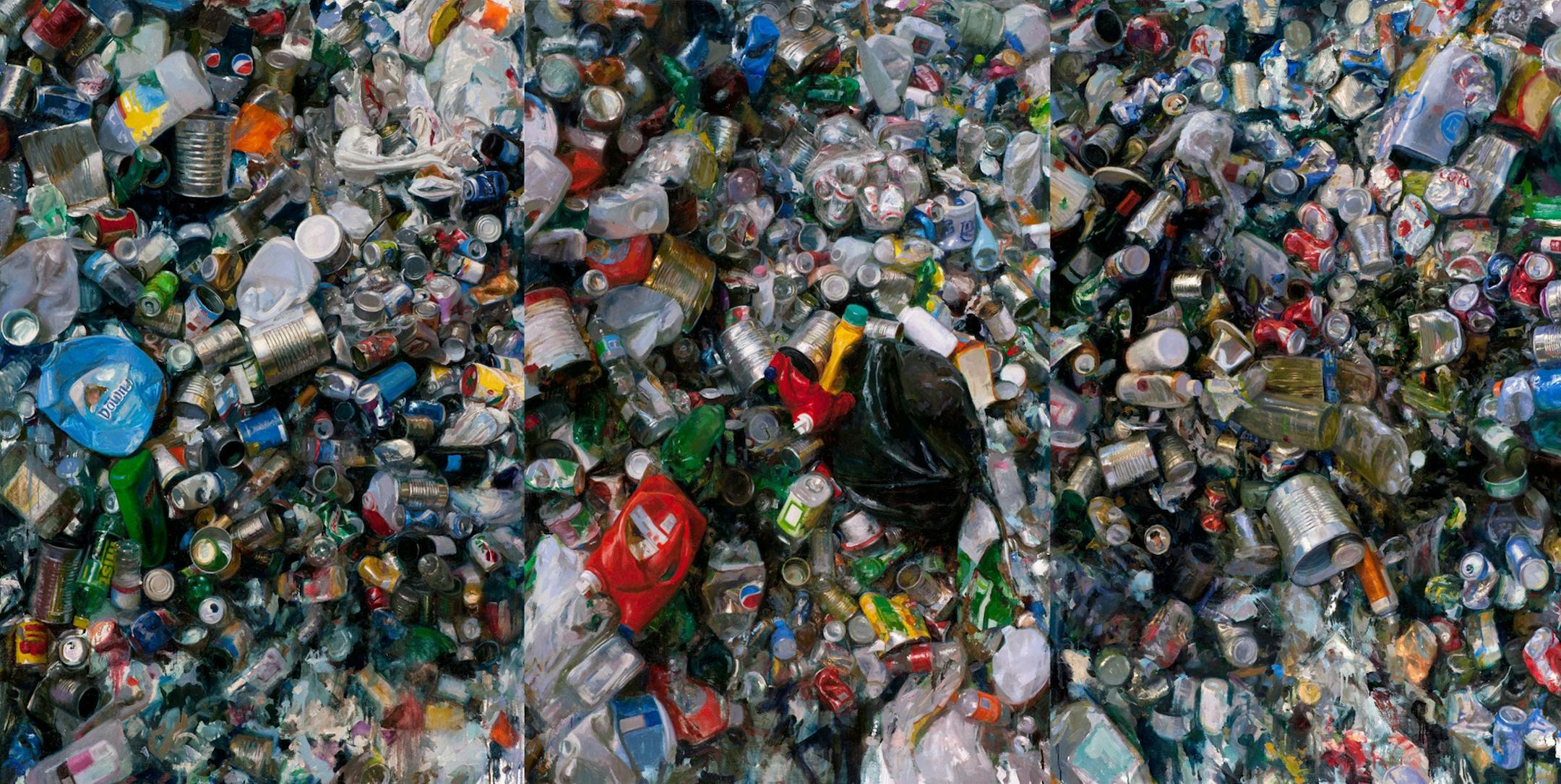
Less immediate are Kareken's striking oil-on-canvas paintings of recycled refuse, the discarded aftermath of human consumption. His monumentally scaled "Tip Floor" (the title signifies the recycling plant floors where material is dumped and sorted) depicts thousands of discarded plastic and glass bottles and metal cans. Executed in a realistic style and a richly hued palette, Kareken's perspective puts us floundering in the sea of refuse that runs edge to edge like an abstract expressionist painting. Kareken seems to ask which product is ours: a blue Downy detergent container, a green soda pop plastic bottle (pick your brand), a red and yellow tin of Italian tomatoes or that ubiquitous Budweiser can?
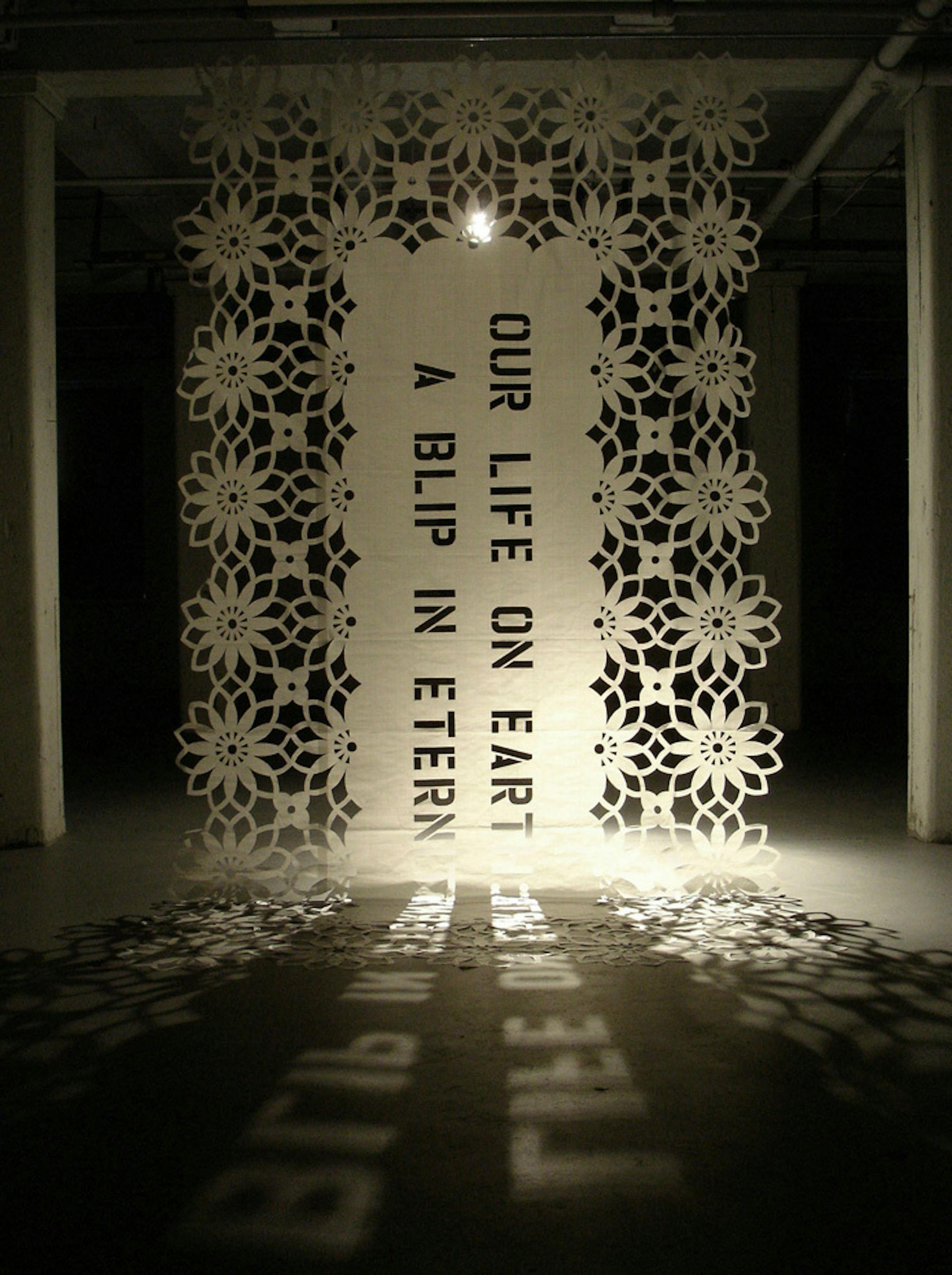
In contrast to the visual cacophony of Kareken's work, Amada's two installations are minimalist and silent. For "A Blip in Eternity," the Japanese native hand-cut a pale vinyl tarp with a wide floral border around the words "Our life on earth a blip in eternity." Dramatically illuminated and suspended from the ceiling, the work is a meditative response to overpopulation and implies that no matter what happens or how good it may be, human life is temporary, just a blip in the universe. Equally poetic is "Floating Garden," a bed of flowers fashioned from water bottle bottoms, each suspended on a line of monofilament.
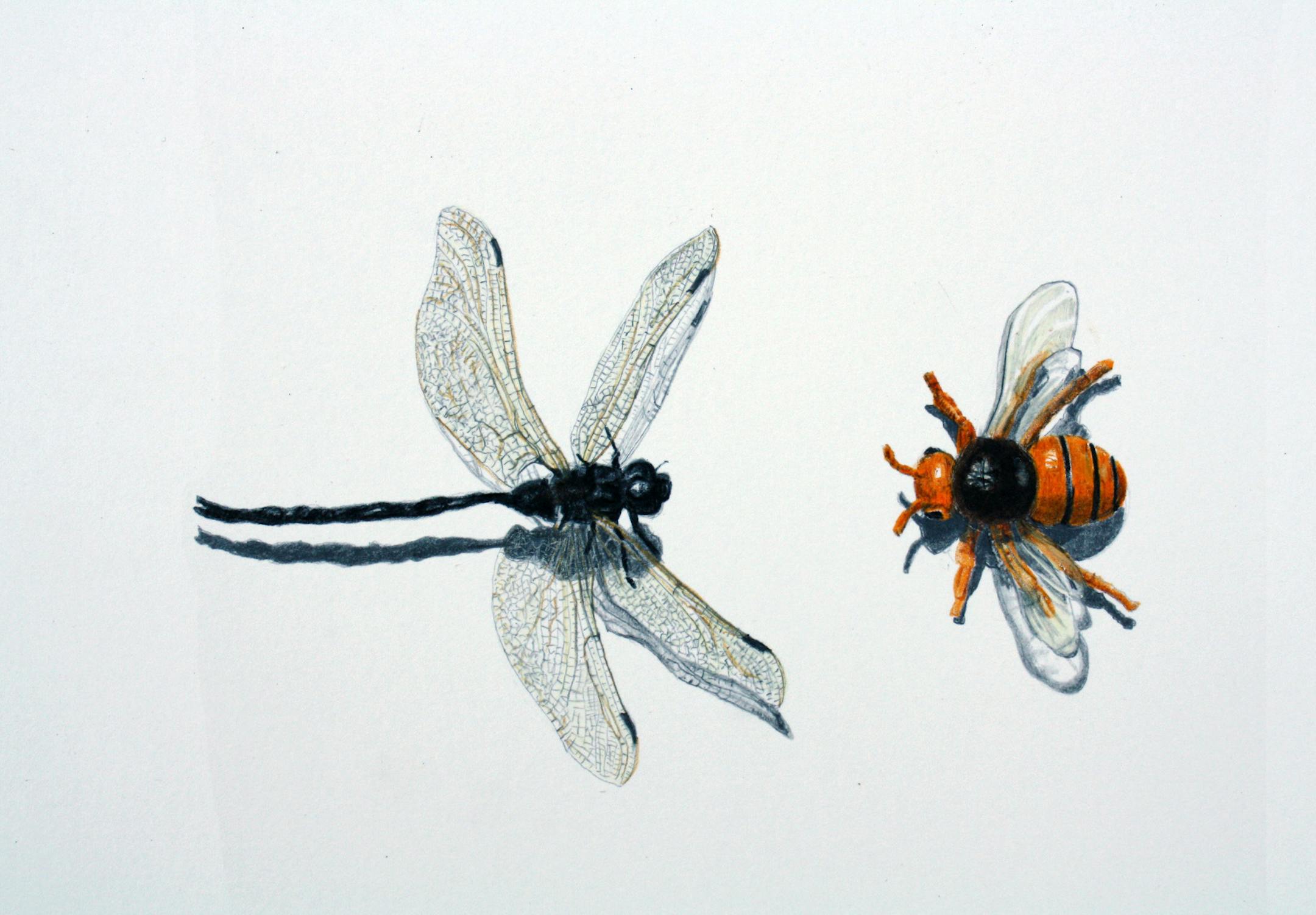
In "Dystopian Thicket," Proctor has manipulated actual plant material to create aberrant forms and appendages, often embellished with thorns, pincers or sharp edges. Subtle but alarming, the idiosyncratic work seems to ask if these perceived abnormalities represent a natural evolutionary path or if they are the species' protective measure against environmental change.