

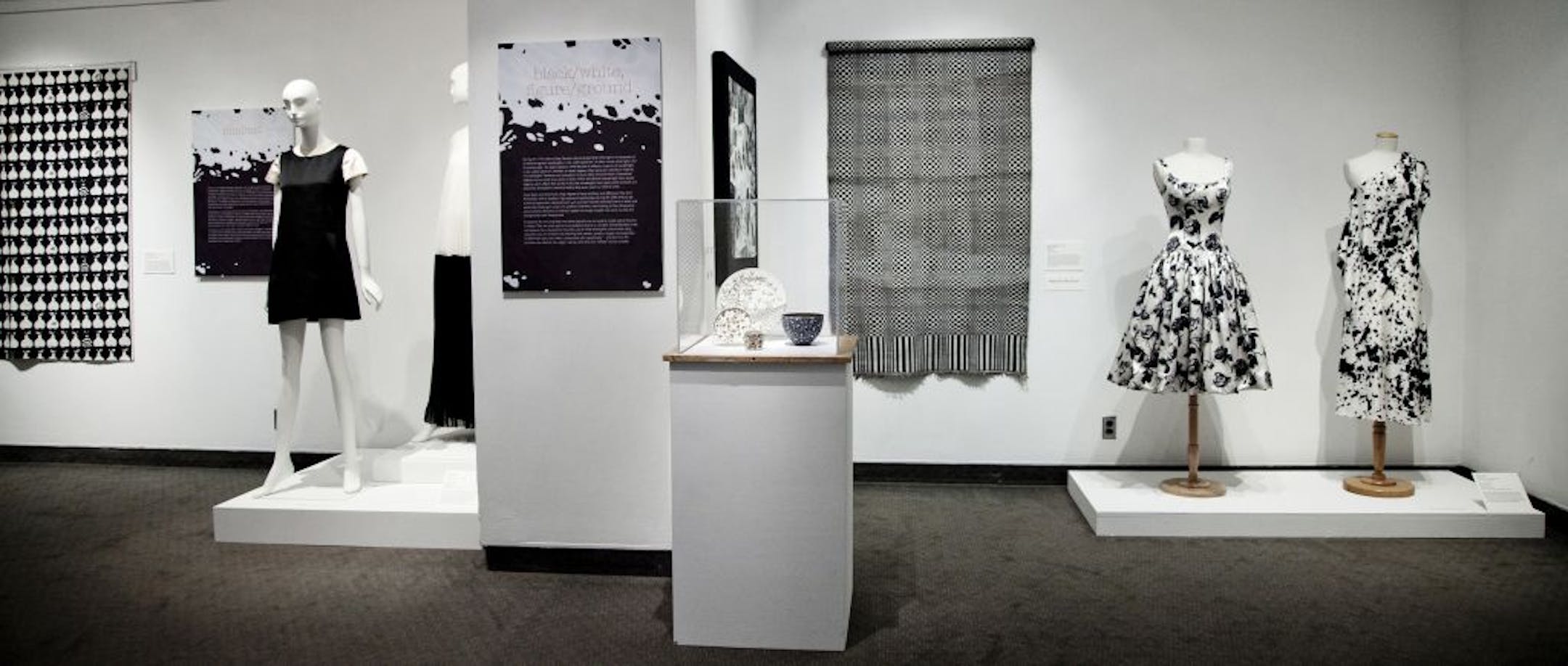
There's nothing so obvious as a wedding dress in the chic little exhibit "Polarities: Black and White in Design" at the Goldstein Museum of Design on the University of Minnesota's St. Paul campus. But there is a footnote reference to Johnny Cash, whose tough-hombre style earned him the label "The Man in Black."
Focusing on monochrome designs for everything from clothing to furniture, tableware, textiles and magazines, the one-gallery show is a superficially simple display of familiar things in minimalist hues. Stripped of color, their lines and patterns are exposed and their bones as bare as a leafless garden in winter.
That clarity throws unexpected details into sharp relief and calls attention to minutiae that might otherwise go unnoticed. Add in the dualities often associated with white-and-black in Euro-American culture -- good/bad, life/death, hope/despair, provocative/pure -- and you have a potent opportunity for social analysis.
Take the prickles and thorns on rose stems, for instance.
Near the show's entrance is a pretty 1950s party dress decorated with photographic images of black roses printed on creamy white silk. It seems a vision of innocence with its modestly scooped neckline, fluffy skirt and English garden flowers.
But there's something unsettling and a little risqué about those black blossoms. Rather than virginal purity, they flirt with danger and invite despoilation. Their stems curl and bristle with the rough, natural stubble of wild roses, not the polished, waxen sheen of hothouse blooms. Look closely and suddenly the princess purity of that sweet frock simmers with the subliminal sexuality of an Alfred Hitchcock vixen.
"Black and white is a choice," said curator Jean McElvain, who organized the show with Caitlin Cohn, a University of Minnesota graduate student in design. "It isn't just the absence of color, it involves a conscious decision to use an economy of means. Black is associated with outlaws while white is considered more pure and is associated with modernism, especially in architecture. But it's all so much richer than that."
The theme practically demanded a wedding dress, especially since the Goldstein has an extensive collection of marital finery. But the curators resisted because "we're trying to shy away from those cultural presuppositions," said McElvain.


