

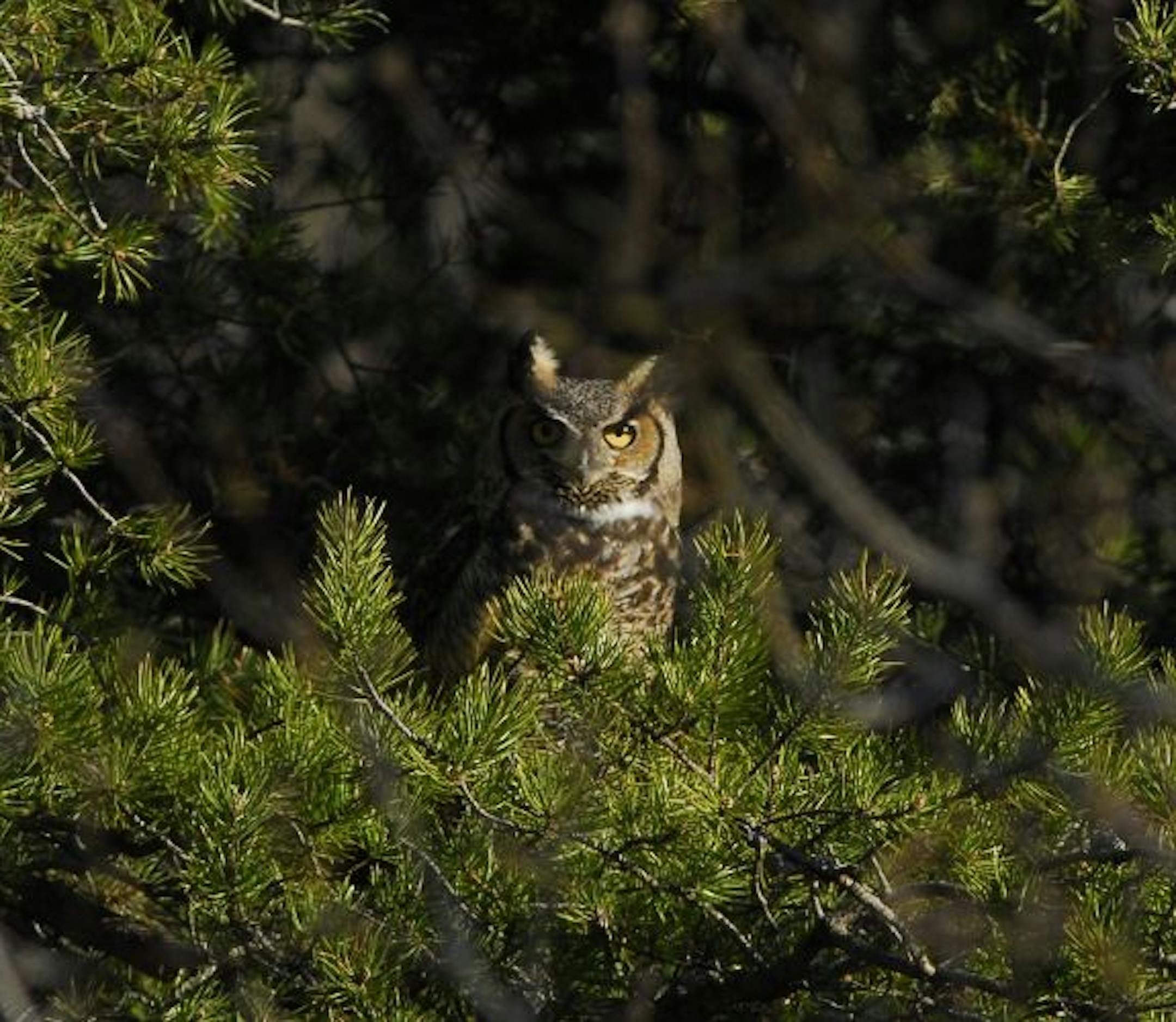
A great horned owl is calling out behind our house. If it's where it often is, in a neighbor's cottonwood, it's 100 yards away. The deep, slow sound of the owl's courtship comes clearly through the glass of the patio door beside me.
Me, who's always asking for the television remote so I can boost the volume. Me, who can't hear certain warbler species sing from 30 feet away. Why I can and can't hear these birds has something to do with me, but most to do with the birds.
My ears are doing what many male ears do at this time of our lives: I'm losing the ability to hear high-register sounds (and sometimes the mid-range sound of my wife's voice).
The birds are doing what they have evolved to do: singing at a sound frequency that varies with topography and ground cover. You sing at one frequency if you live deep in the woods, and another if you spend your time in tree canopies. Grassland birds such as bobolinks deliver songs in yet other pitches.
In research terms, the wood where the owl lives is a complex vegetative structure. This complexity poses a barrier for efficient passage of higher-frequency sounds. Lower frequencies work in that situation. So, the owl goes low.
The higher frequency songs sung by, for instance, orange-crowned, blackpoll and Cape May warblers, escape my ears. Those thin songs are perfect, however, for passage through the canopy habitat that these birds use.
Various species sharing the same habitat deliver songs at varying frequencies. You, as a bird, want your song to stand out from the crowd. You have your own frequency.
You've heard of the dawn chorus, that time just before sunrise when every bird in the neighborhood is singing one frequency or another. Why at dawn?


