

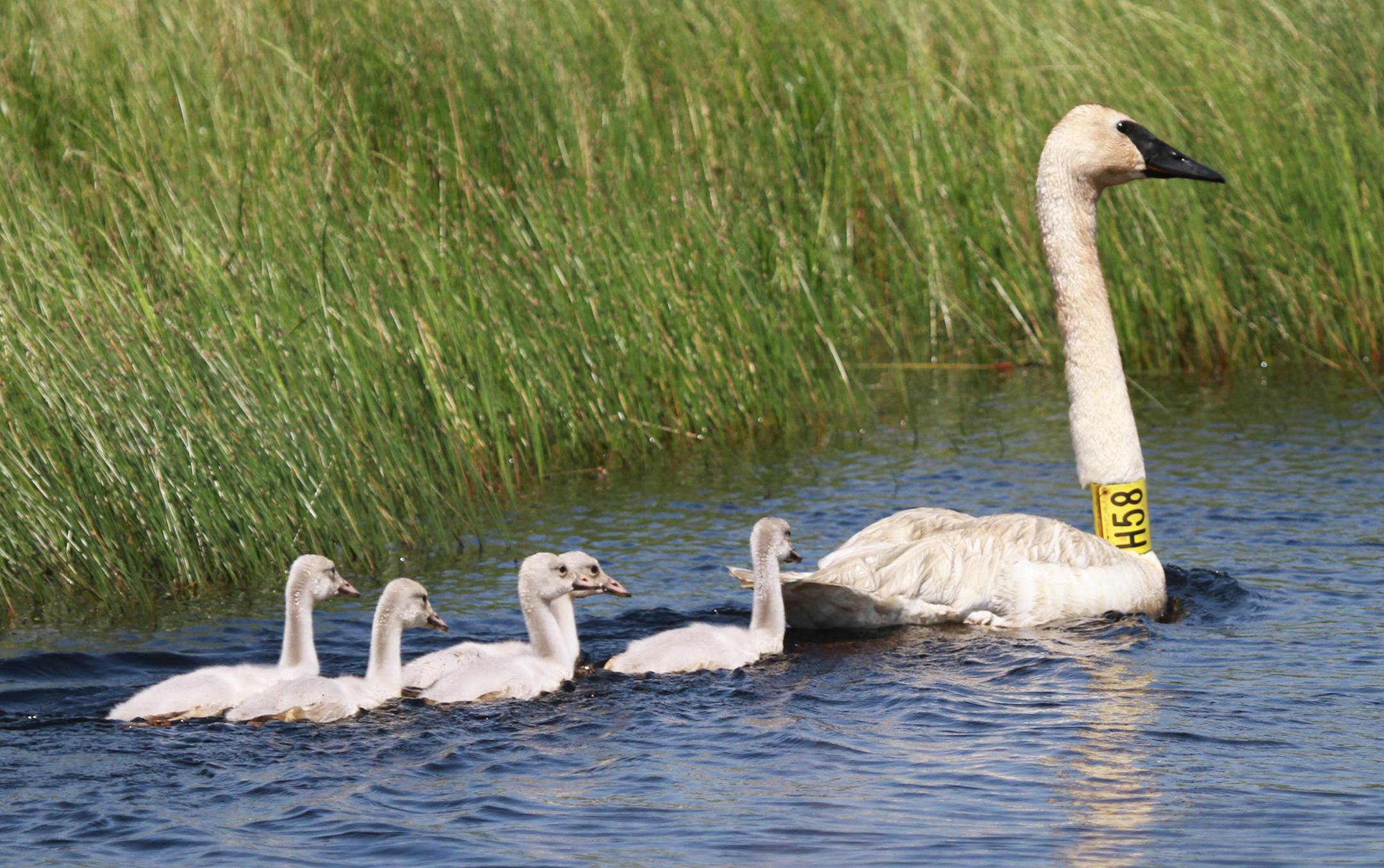
Q: A pair of trumpeter swans nested on the pond behind our house and hatched four cygnets this spring. Within a few days, two of the cygnets had disappeared and the family moved to the other side of the pond. We're wondering if the parents will come back to nest next year and what predator might have taken the young swans.
A: I discussed your questions with Madeleine Linck, who works to help restore this beautiful swan to our area for Three Rivers Park District and the Trumpeter Swan Society. She notes that trumpeter pairs are usually very faithful to their nesting sites and often return year after year. There are many predators on the lookout for young swans, including coyotes, mink, owls and snapping turtles, and it's not unusual for a few cygnets to be lost this way, especially if parents are young and inexperienced. Swans generally move away from the nest site once their young have hatched and may rest and preen on muskrat houses and beaver lodges, both of which offer some protection from coyotes. You're very lucky to have this window into the family life of these spectacular birds.
Lovely in lavender
Q: I was watching two hairy woodpeckers at our feeders (one was feeding the other) and noticed that they had lovely, pale lavender feathers on their upper chests. Is this unusual for this type of bird?
A: I'm seeing the same lavender ascots on a mother and daughter pair of hairy woodpeckers at my feeders, too. Your sharp eyes picked up on a side effect of woodpeckers adding variety to their diet at this time of year: Fruit and berries are abundant and are prized by many species. As the older woodpecker passes a berry via her beak to her offspring, some juice invariably spurts out, dyeing the throat and chest feathers on both birds.
Too young to fly
Q: There's been a cardinal nest in the shrubbery out back, and one day one of the youngsters was on the ground, where the parents seemed to be bringing it food. I thought young birds didn't leave the nest until they could fly.
A: As stressful as it is for humans to observe, and for parent birds to cope with, young birds frequently tumble to the ground some days before they are able to fly. In your case, the parent birds are feeding their youngster and if there are no cats or dogs in the area, the young bird is safe and should be flying within the week. Why do birds leave their nest too soon? It gets crowded in there as nestlings grow, and young robins, blue jays, cardinals and others sometimes find there's just not enough room to flap their wings to develop flight muscles.
The exception to the "leave-it-alone" approach: If a young bird on the ground appears injured, it should go to the Wildlife Rehabilitation Center in Roseville (www.wrcmn.org).
Sparrow foiler update
Q: Just wanted to report that I've been using a Magic Halo device on my feeders for some time and it not only keeps sparrows out of the feeders, but they don't even feed on the ground under the feeders. It frustrates the sparrows but our other birds are fine with it.


