

A group of bird watchers walked the trails at Tamarack Nature Center recently, on the lookout for late migrants as well as birds that will be around all winter. We'd come to this large park in White Bear Township because it often produces some pleasant surprises.
Motion and commotion up ahead soon caught our eyes, compelling us to stop and watch a fascinating display of avian foraging in a stand of spruce trees.
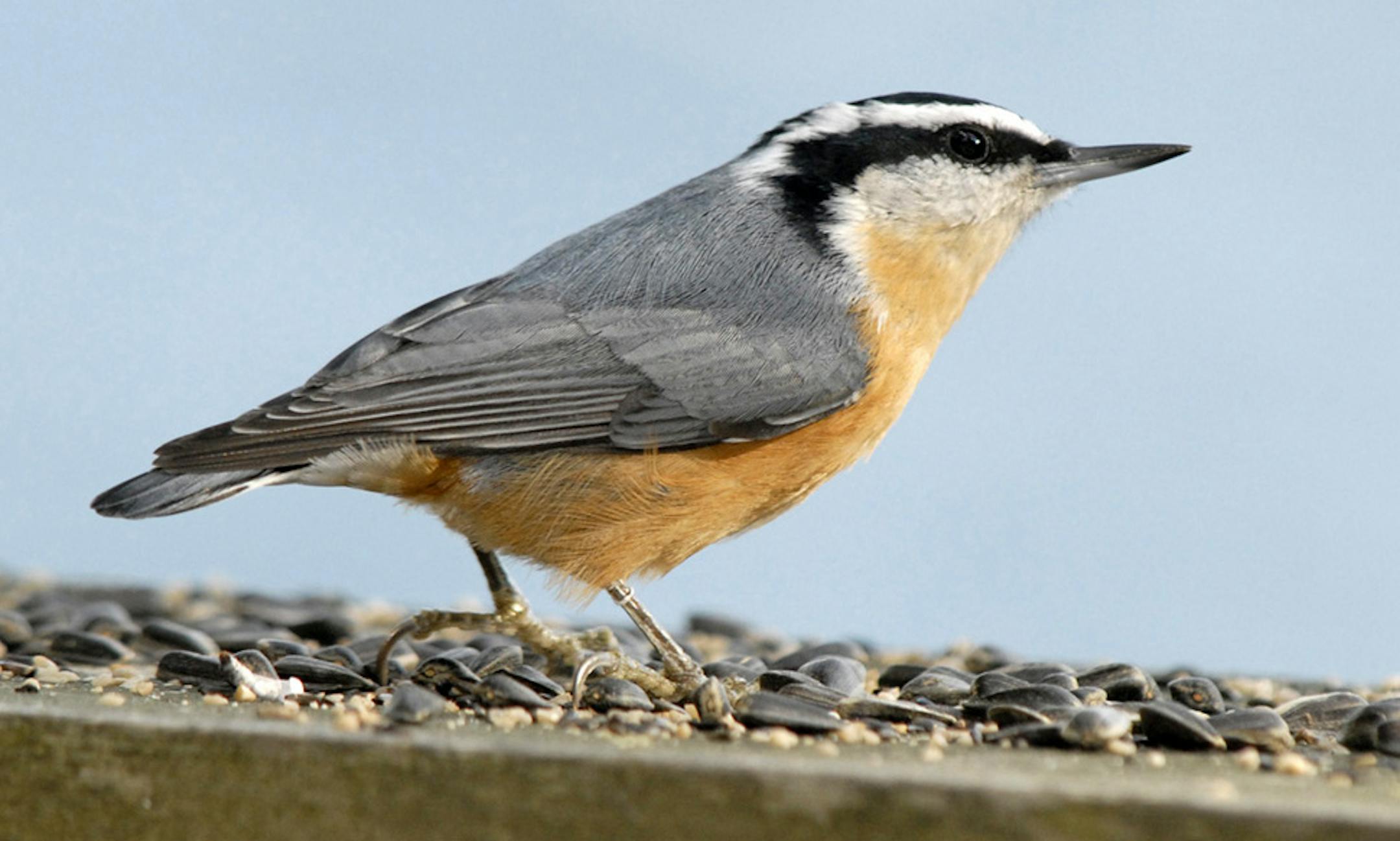
Small birds flitted in and out of the branches, and a constant "buh-Dee, buh-Dee" call quickly identified many as black-capped chickadees. But a few even smaller birds were mixed in with the 'dees, birds with lovely blue-gray backs and dramatically striped faces.
These small birds were communicating with each other, too, and it was their calls, almost more than their plumage pattern, that pinpointed their identification. Yes, these were red-breasted nuthatches, the short-tailed smaller cousins of the familiar white-breasted bird, a fine reward in the middle of a long bird-watching tromp.
They sound a bit like the larger nuthatches, although their call is higher pitched and more nasal. Hear the red-breasted variety here: www.allaboutbirds.org/guide/red-breasted_nuthatch/sounds. Now compare their call to the white-breasted nuthatch's, here: www.allaboutbirds.org/guide/White-breasted_nuthatch/sounds.
Seed whackers
We stood and watched for many minutes, transfixed by the sight of the chickadees exploring needles and branches for small insects and nuthatches landing on spruce cones, jabbing their long beaks inside to extract a plump seed. With a spruce seed clamped in their bill, they'd flit to a nearby oak tree to either eat the meat or tap the seed into the bark for later consumption.
Both kinds of nuthatches are named for the way they approach seed consumption. Unlike chickadees, which hold a food item with both feet and hammer it with their beaks, nuthatches wedge a seed into bark and hack it into manageable pieces. The "hatch" in their names suggests that hacking activity.
The red-breasted kind are more lively than their cousins, moving rapidly up, down and across a branch or tree trunk, zigzagging and issuing frequent squeaky calls to keep in touch with their companions. (White-breasteds are known for their slower, head-down spiral down tree trunks, and for a lower-pitched "yank, yank" call). The red-breasteds are also bolder, seeming almost tame around feeding stations, allowing humans to approach closely before flying off. Some people even train them to eat out of their hands.


