

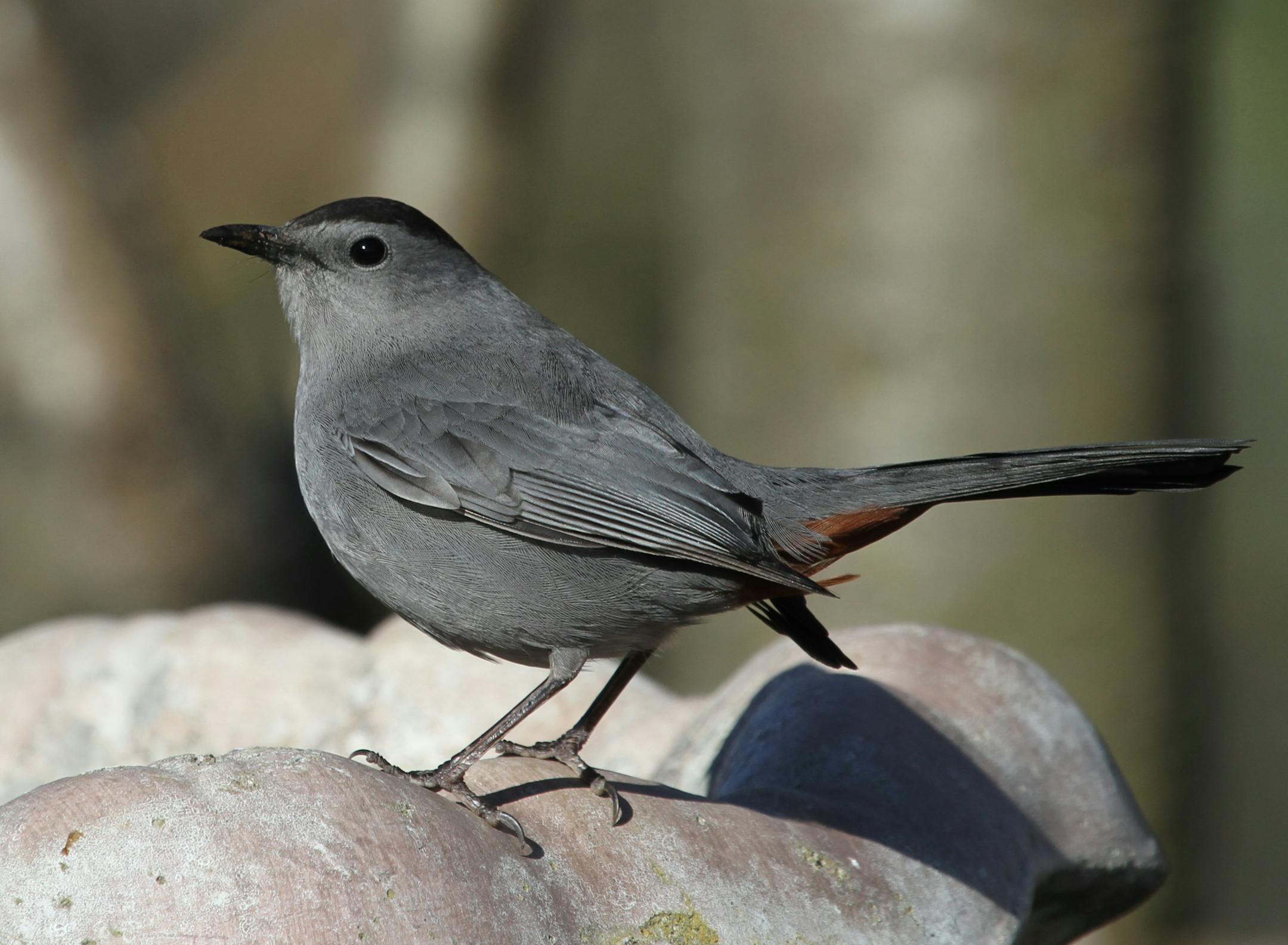
Q: Where does my gray catbird go for the winter?
A: These perky songbirds are gone from our back-yard thickets and tangles and are heading toward winter homes along the Gulf Coast, on Caribbean islands, Central America and especially Mexico, where nearly a quarter of them end up. Catbirds are much more likely to be found in forests on their winter grounds than during nesting season.
Hummer searchers
Q: Watching my hummingbird visitors this summer, I wondered why they came looking for me when I was sitting inside, behind the patio door, but ignored me when I'd be sitting outside? They were very tame and friendly.
A: I'm intrigued by the idea that your hummingbirds seemed to come searching for you when you were indoors. I've heard of hummingbirds doing this kind of thing when feeders are empty, but it doesn't sound as if that's the case here. It's possible that they were seeing a reflection of your feeders in the patio door. I don't mean to intrude on your perception that hummingbirds are tame little birds. But everything I've read about the little dynamos indicates that their dominant characteristics are fearlessness and fierceness. There are so many variables in the world of birds, however, that just about anything is possible.
Who's clucking?
Q: In late afternoon or early evening I sometimes hear a bird that makes a sound like a dull cluck, repeated over and over. Any idea what that might be?
A: My first thought when I read your description was a chipmunk. They're known to make a sound that some describe as a "chuck," others hear as "chip," over and over again. Just to be sure, I asked several birding friends and they had the same thought. The little rodents will be heading down into their burrows soon, so you won't hear them again until next spring.
Cooper's cough
Q: We observed a young Cooper's hawk bathing one day in the birdbath, then it landed on our fence to dry and preen its feathers. Oddly, the hawk kept opening its mouth as if to yawn as it looked around. Can you tell us why it did this?
A: There are two possibilities here, either the hawk was calling to unseen siblings or parents, but you would probably have heard its "cak-cak-cak" call. More likely the hawk had just finished eating a bird or rodent and something (a feather or bone) was caught in its throat or it was working on coughing up a pellet of the indigestible parts.


