

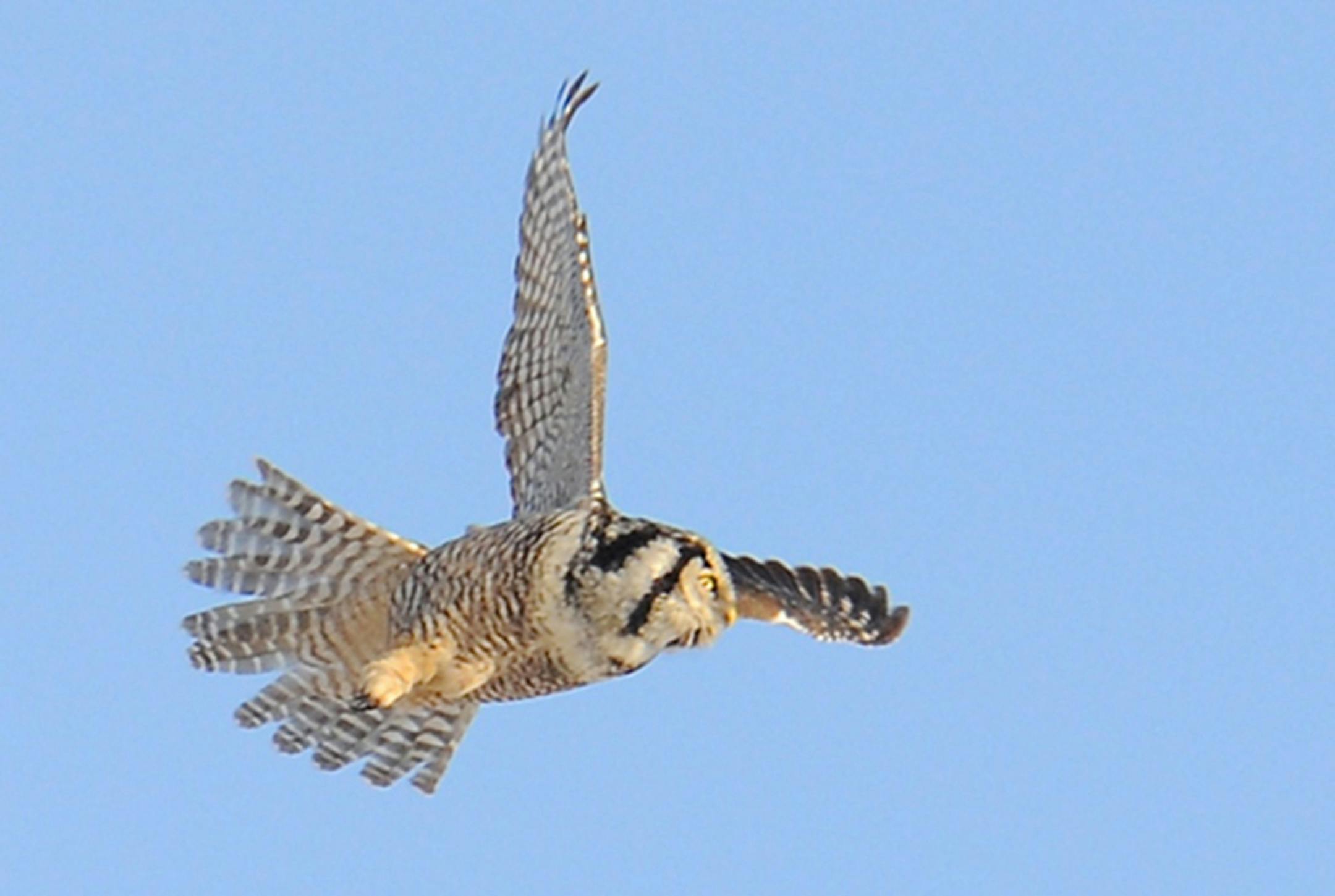
The Northern hawk-owl is an owl, but doesn't exactly fit the owl mold.
One of these little understood creatures has been seen just north of Hutchinson, Minn. This is a noteworthy southerly visit for this resident of boreal forest. A rare nester in northern Minnesota, this species occasionally moves south, most likely in search of food. Almost no winter hawk-owl ever chooses a location as convenient for birders as Hutchinson, a quick drive west from the Twin Cities.
Hawk-owls have the hyphenated name because of the way they look and act. This is a small owl, about crow size. Most owls are nocturnal. This one hunts both day and night.
It has the pointed wings and tail of an accipiter, the falcon-like hawks. The hawk-owl has direct and fast flight, swooping to attack, like its namesake.
These birds lack the asymmetrical ear placement that characterizes owls. Your ears match left to right, or should. Owl ears are slightly offset. This facilitates the audio triangulation that owls use to locate unseen prey.
While hawk-owls can hunt by ear, they depend more on eyesight. Manitoba ornithologist James Duncan wrote that they can see prey up to 900 yards away. That's 2,600 feet, half a mile. We'll assume what they are seeing at that distance are the rabbits and game birds they occasionally eat.
More common in their diet are smaller mammals — voles mostly, and mice and shrews. I'm impressed with their vision. I'd be even more impressed if it was a six-inch vole being watched at half a mile. And maybe it is.
My wife and I drove to Hutchinson to see that hawk-owl. We were on Tagus Avenue in McLeod County when we saw what every birder on the chase hopes to see. Not the bird. We saw a man standing along side the road watching what we were looking for.


