

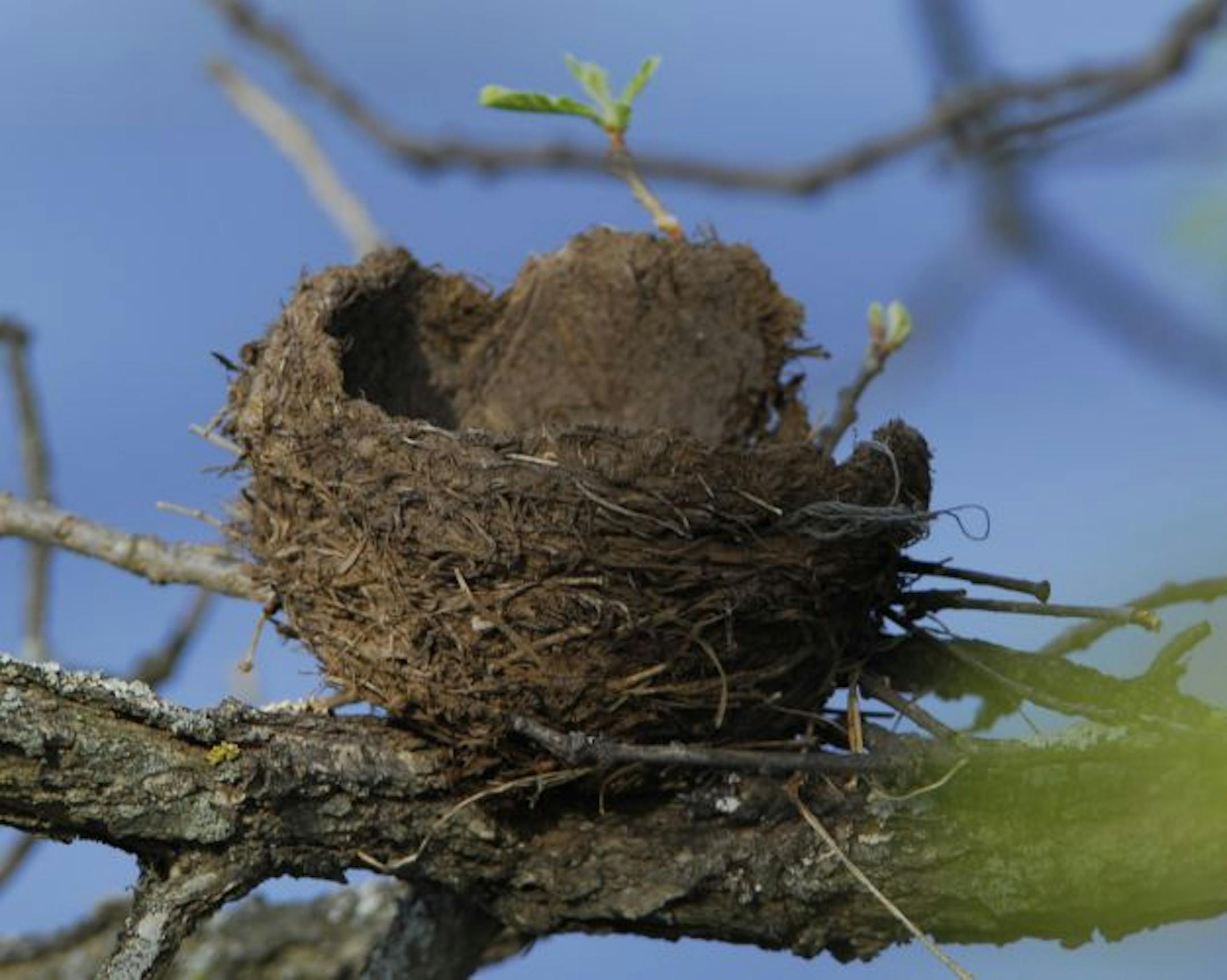
In spring, birds turn into busy builders. They gather grass blades, bark strips, twigs, feathers, string, even mud, which they use to create structures to hold their eggs. Their nests, ranging from the dried mud cups of the barn swallow to the intricately knotted baskets fashioned by orioles, are built to last -- think of the many bird nests that become visible in winter, still holding fast to tree forks and branches.
Each bird builds a nest particular to its species, and the blueprint seems to be hard-wired into birds' brains, since in most species, youngsters don't watch their parents at work. A female robin assembles a bowl of twigs and grasses, and then makes innumerable trips, carrying mud balls in her beak. She packs mud around the bowl's inside and smooths it as she turns her body inside. Mother Robin finishes her nest by pushing soft plant material into the still-damp mud. No robin showed her how to do this -- the basic design is built into her genes.
Mother birds build around themselves; as they build, they drop down into the nest bowl frequently and wiggle around to make sure it's a good fit, both for themselves and for the hatchlings to come.
Once the nest is finished, the female bird begins laying her eggs, an energy-intensive process. A great deal of calcium goes into the eggs, creating a temporary calcium deficiency for the mother bird. To store up more of this important mineral, female birds search for land snails, or consume soil rich in calcium deposits. It must be easier for songbirds, whose nests typically hold four to six eggs, to replenish their calcium, than for ducks and turkeys, which lay 10 or even 15 eggs.
One a day
Because it takes many hours to form an egg, nearly all birds produce only one every 24 hours, usually at daybreak, until the batch -- the clutch -- is complete. A bluebird that lays her first egg on Monday might be ready to start incubating four blue eggs by Thursday afternoon. The same holds true for other songbirds, such as robins, goldfinches and orioles.
In nearly all species, it's the mother bird that tends the eggs, incubating them with her body heat. She takes short breaks to eat, stretch and bathe, then returns to nest duty, turning the eggs each time to ensure even development. Male robins and bluebirds, among others, bring food to the female as she sits on her nest.
Starting several days before the eggs hatch, many mother birds begin to sing soft songs to their chicks, described by some as lullabies. She also may be sending messages about what to expect in the big, wide world. For example, British researchers studying canaries found that the females seemed to be informing almost-hatchlings about the food supply. Consequently, chicks whose parents were having trouble finding enough food to eat were less demanding in the nest than their more well fed counterparts.


