

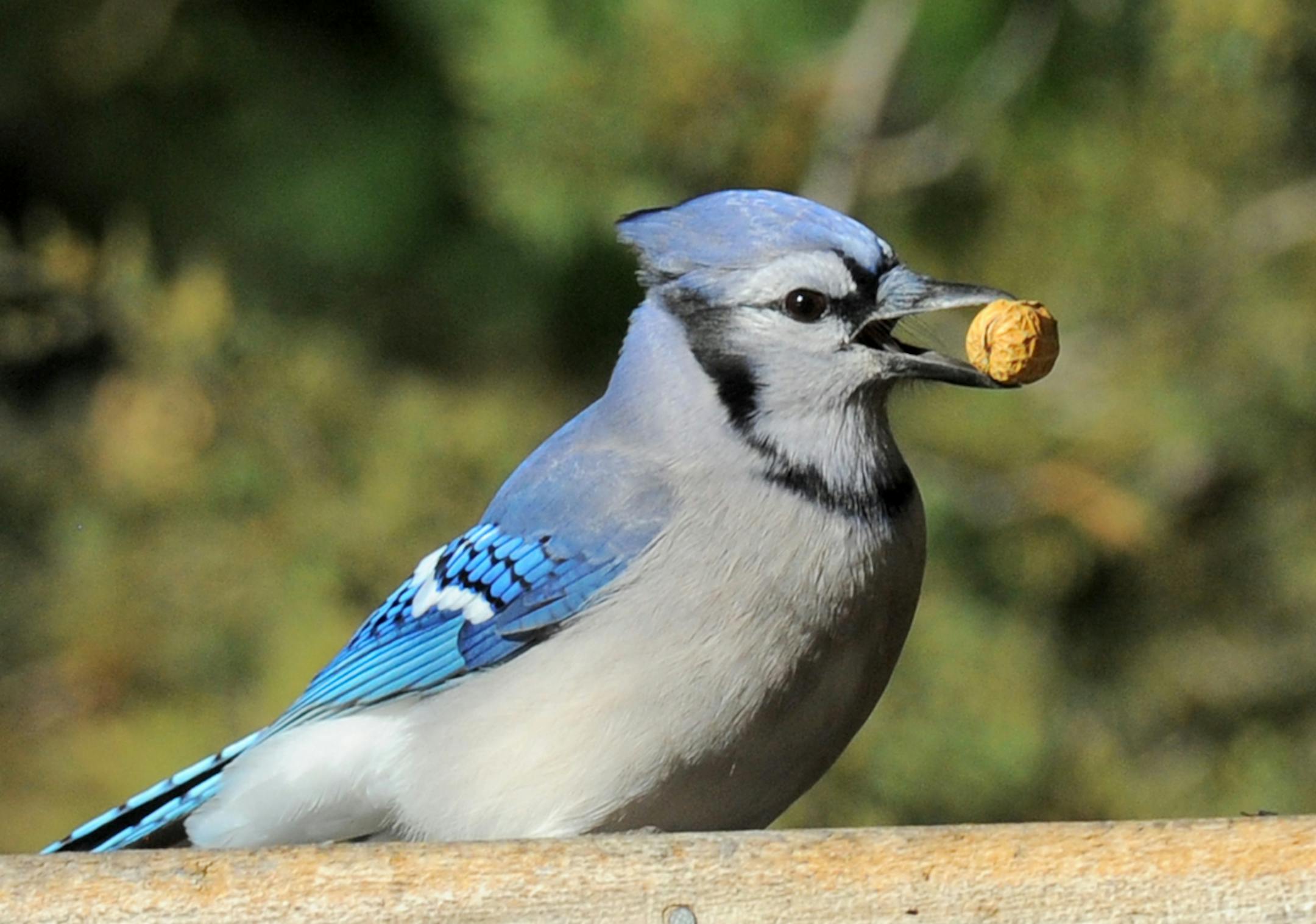
Q: I watch the blue jays around the peanuts I put out for them and it seems that a jay will pick up a nut, then put it down and try another before flying off to hide it. It seems they are comparing weights, is this true?
A: Yes, that's exactly what they're doing. Researchers have found that jays, when faced with a pile of peanuts, will test several nuts until they find the heaviest one. When they return after hiding the first nut under leaves or under tree bark, they go through the ritual again, taking the next heaviest, and so on until all the nuts are gone. They must feel that they want the nut with the largest reward first, in case there's an interruption, which there often is in the bird world.
You can create your own back-yard blue jay show by putting out unsalted peanuts-in-the-shell when you know jays are in the area. Kids and cats, especially, love to watch the tumult that ensues in the blue jay world. In my back yard, a group of four blue jays makes short shrift of the peanuts I place on a bench each morning. They're not the earliest risers in the bird world so I wait until the sun is well up and no squirrels are around before setting out about 30 peanuts. One by one the big birds glide in, picking up first one nut, after another, then flying off with the larger nuts first. One gluttonous bird often stuffs two into his expandable throat patch and holds a third in his beak before departing. They're so noisy that a curious cardinal sometimes comes in to observe and grabs a small peanut himself.
House finch variations
Q: A very different-looking house finch appeared at my feeders a few days ago. He was orange-hued where a normal finch would be red. Is this unusual?
A: Most of the male house finches we see have a great deal of red in the head, chest and rump, but this species is known to exhibit wide color variation. House finch feather color comes primarily from pigments in the food they eat, and if a house finch doesn't consume enough pigment-producing foods, such as fruit and berries, it may molt feathers that are orange, gold or even yellow. An all-yellow house finch showed up at our birdbath a couple of years ago. Some research indicates that the paler birds could be young males who may produce redder feathers as they age.
Sweet-toothed bird timing
Q: What's the best time to put out my hummingbird and oriole feeders? And should I keep them up all summer?
A: These are good questions and very timely. You could put out the oriole and hummingbird feeder during the first week in May, which is when the early birds begin to migrate in. (A few hummingbirds show up in late April, so you might want to hang nectar feeders a bit earlier.)
I'd recommend leaving the hummingbird feeders up all summer and fall, replenishing the nectar every couple of days. Most of us host these little birds only during spring and fall migration periods, but there's a chance a female will nest nearby and appreciate an easy source of nectar. Here's a good website for tracking hummingbird migration: www.hummingbirds.net/map.html, which records where the first birds were sighted.


