
Birding: Blackpoll warblers perform an amazing flying feat

Migration is a hazardous time, but one small warbler ratchets it up several notches, and then triumphs over almost insurmountable odds.

May 20, 2015 at 4:45AM
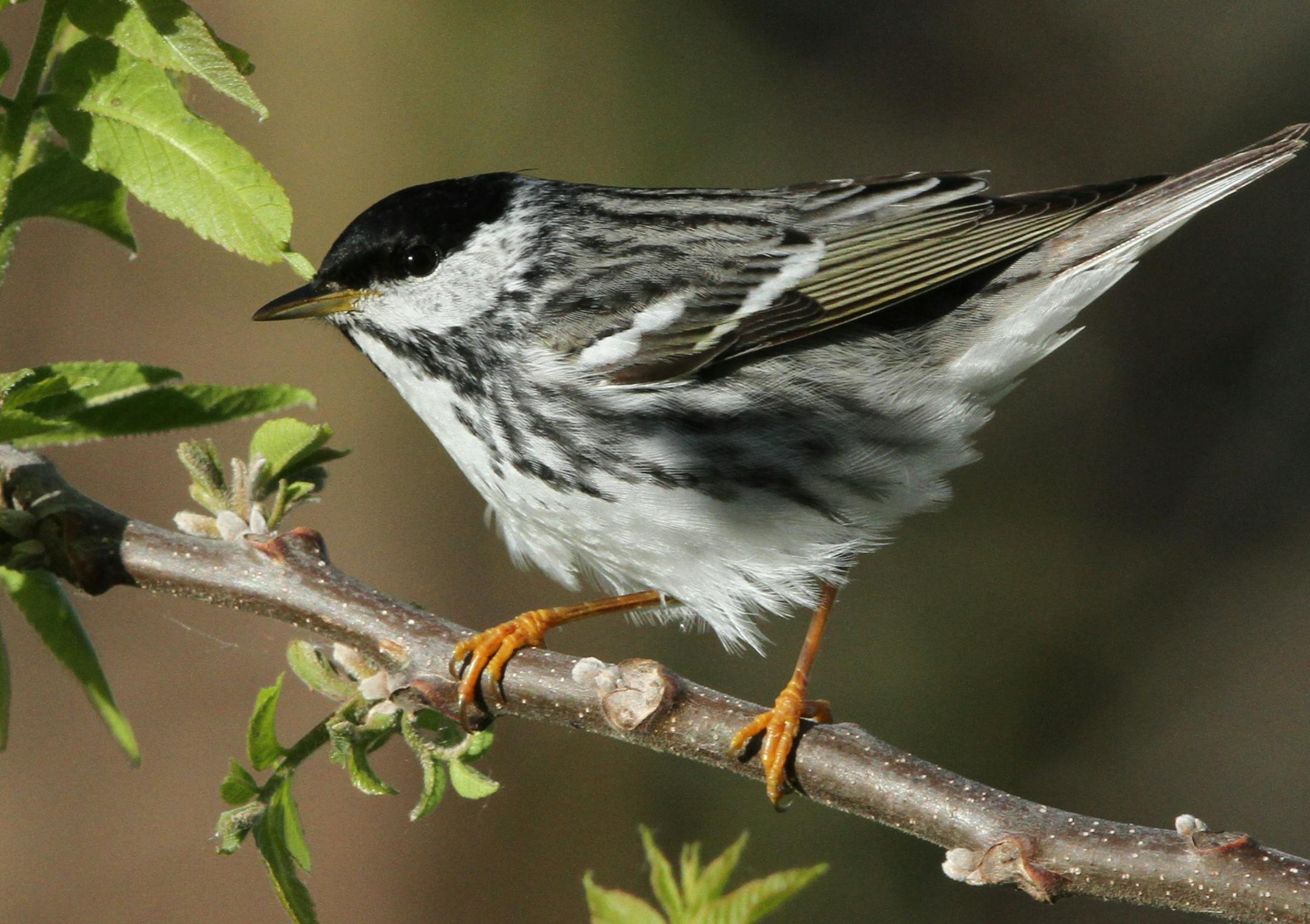
Caption: Photo by Don Severson A quick glance might mistake this black and white bird for a chickadee, but instead itís a blackpoll warbler, traveling faster and farther than almost all other migratory birds.
A quick glance might mistake this black and white bird for a chickadee, but instead it’s a blackpoll warbler, traveling faster and farther than almost all other migratory birds. To hear a recording of its song, dial 612-573-5697. (The Minnesota Star Tribune)

A small black and white bird is passing through local back yards, parks and woodlands on its way to breeding grounds in Canada. If you notice him at all you may see him poking around tree leaves or twigs, searching intently for insects. There's nothing to alert you to the fact that this is an Olympian among migratory birds, traveling one of the longest and most dangerous routes in our hemisphere.

Blackpoll warblers, weighing about half an ounce, are migration champions, a fact long suspected by those who study birds, and now they have proof.

Tiny tracking devices attached to their backs showed that blackpolls take off in autumn and fly — without a rest stop — to their winter grounds, which can be as far away as South America, a journey of 1,500 or more miles. Even more amazing is the fact that they depart from staging areas in the northeastern United States and fly far out over the Atlantic Ocean to catch prevailing winds. This gives them a big southward boost but also presents a death-defying challenge, since their route is over open water. They must fly for up to three days and nights without anywhere to land.

Researchers recently published a description of their blackpoll work, "Transoceanic migration by a 12 g. songbird," a prosaic title for a study that's creating quite a buzz.

Real numbers 'amazing'

"The results may not be entirely surprising, since people had been guessing for some time that this is what blackpolls did, but it is amazing to have real numbers," says Bill DeLuca, lead researcher based at the University of Massachusetts, Amherst. His American team trapped about 20 blackpolls and attached geolocators to them.

Ryan Norris, who led a team in Nova Scotia, noted that this means that blackpolls have the longest over-water flight for a bird of its body size. If driven down by exhaustion or severe weather, the birds will perish in the ocean, all but the few who happen upon a passing ship or remote island.

The birds we see in the springtime accomplished this amazing over-water journey last fall. In spring, because the winds have shifted, the returning warblers fly over land to reach their breeding grounds.

Scientists have been attaching various kinds of devices to birds for decades to help unravel the secrets of their travels. The devices until recently were too heavy for small birds, but now geolocators have been reduced to the size of a dime and weigh only about half a gram.

The tracking devices record sunlight levels at regular intervals, which indicate a bird's position in the world. Since they're not transmitters, researchers must retrieve the devices by recapturing the birds in order to have access to a wealth of information about where and how far a bird has traveled.

Recapturing the same tiny birds half a year later sounds like an impossibility, but DeLuca says this wasn't hugely difficult in the case of the highly territorial blackpoll. The teams had placed distinctive leg bands on "their" birds, to tell them apart from others in the spring.

"The birds are very site-faithful," says DeLuca, "and often return to the same exact breeding territory each spring." The two teams regrouped in the areas where they'd banded the blackpolls the previous year. When they spied the distinctive leg bands they unfurled their nets to trap the birds and remove the geolocators.

Fat balls with wings

Since they won't be stopping to refuel, they bulk up, "basically becoming little fat balls with wings," as DeLuca put it.

Why do they do it? No one really knows. Researchers speculate that the over-water route may be a remnant of an ancient migratory path. Or it could be safer than a route over land, filled with dangers like glass buildings, cats and cars. Or perhaps compressing the migratory period is safer, in the long run.

Migration is an extremely hazardous time for birds, with only about half of them surviving its gantlet of dangers. One small bird follows a unique path as it heads southward each year, a journey that's now one for the record books.

St. Paul resident Val Cunningham, who volunteers with the St. Paul Audubon Society and writes about nature for local, regional and national newspapers and magazines, can be reached at valwrites@comcast.net

On the decline

The Cornell Lab of Ornithology calls the blackpoll warbler "one of the most common birds of the boreal forest," which is where most of them breed. However, last year's State of the Birds report, assembled by a consortium of agencies and conservation groups, lists the blackpoll as one of 33 bird species in steep decline. Habitat loss is the main issue for all of these birds.

about the writer

about the writer

VAL CUNNINGHAM, Contributing Writer

More from Minnesota Star Tribune

See More
card image
J. SCOTT APPLEWHITE, ASSOCIATED PRESS/The Minnesota Star Tribune

The "winners" have all been Turkeys, no matter the honor's name.

In this photo taken Monday, March 6, 2017, in San Francisco, released confidential files by The University of California of a sexual misconduct case, like this one against UC Santa Cruz Latin Studies professor Hector Perla is shown. Perla was accused of raping a student during a wine-tasting outing in June 2015. Some of the files are so heavily redacted that on many pages no words are visible. Perla is one of 113 UC employees found to have violated the system's sexual misconduct policies in rece