

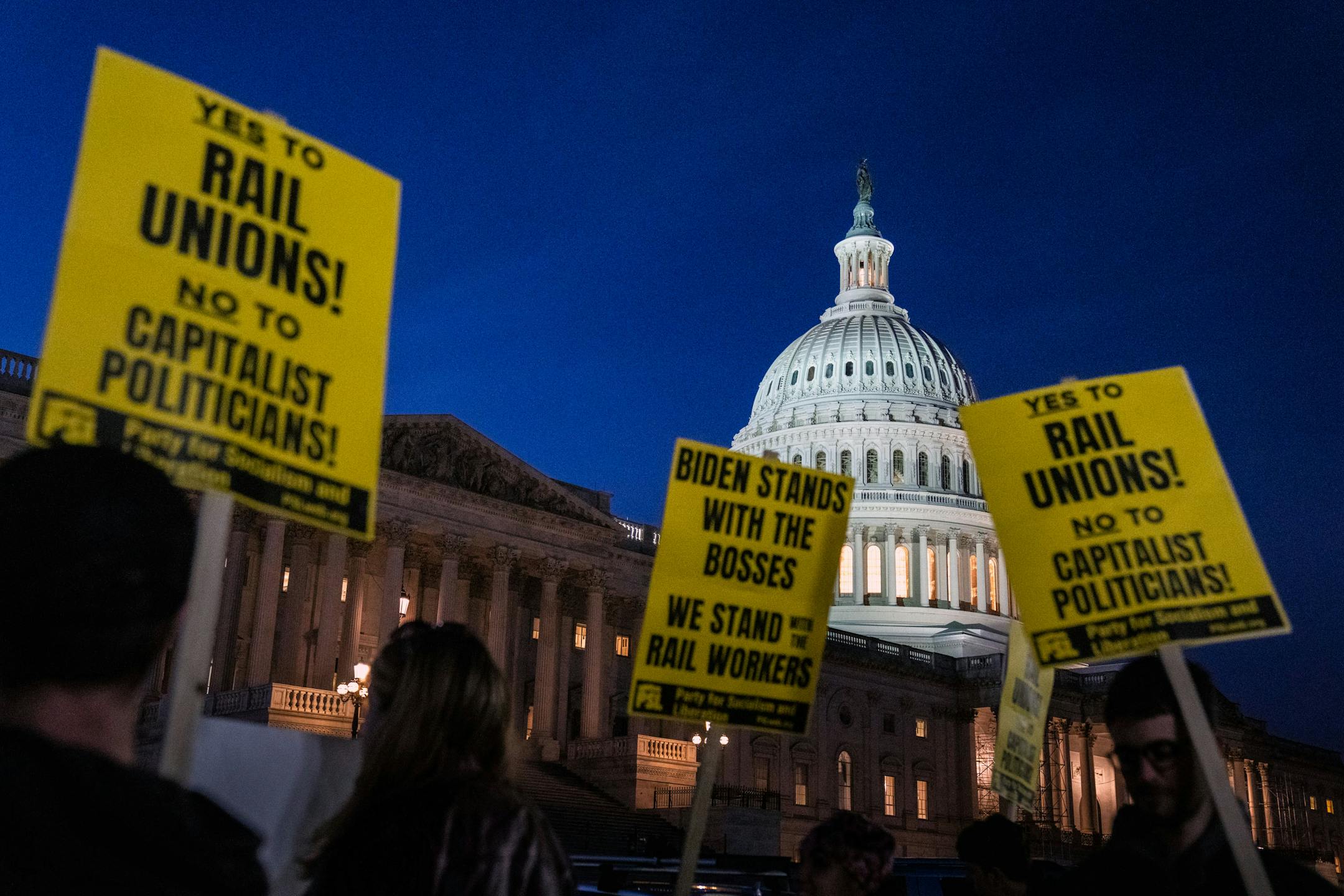
The stories of America's rail workers are often told anonymously - no need to further antagonize their bosses, who set their schedules and who can, and do, make their lives miserable - and yet the details are painfully familiar to millions in a U.S. labor force in which the term "essential worker" isn't really an honorific.
That's why one rail worker didn't give his name when he told The New York Times how he had to cancel an important medical scan when his employer called him back to work on his week off. Or why Justin Schaaf, a conductor on the BNSF line, lost a tooth recently - months after he chose to attend his son's seventh birthday instead of keeping a dental appointment on a prized day off.
It's those kinds of everyday horror stories from the American workplace that unionized rail workers hoped to write an ending to this fall as they fought to negotiate a new labor contract with the nation's profit-drenched rail systems. Seeking paid sick days was a simple humane demand - one that was crushed last week when a labor deal lacking them, crafted by the Biden administration and endorsed by a bipartisan coalition in Congress, was imposed on 12 key rail unions.
To say that thousands of blue-collar Americans feel betrayed by a Democrat who famously promised to be "the most pro-union president you've ever seen" would be an understatement. Rail union leaders say they've been inundated with calls and texts from rank-and-file members angry that they were badgered in 2020 to vote for Joe Biden, and who in no way would support him in 2024.
"Joe relied on us to get him home to his family," Reece Murtagh, a roadway mechanic based in Richmond, Virginia, told NPR, referring to Biden's nightly commute on Amtrak when he was a Delaware senator. Now Murtagh is furious that the president and Congress imposed a settlement that blocked workers from exercising their right to strike. "But when it was his turn to help us out ... to better our life, he turned his back on us."
In the 20th century, blue-collar workers like Murtagh and Schaaf weren't only the backbone of a thriving U.S. economy, but their votes were cherished politically. But in the 21st century, working-class men and women - especially the dwindling numbers enrolled in labor unions - have practically no one in Washington fighting for their interests.
The sick leave sellout marked an aha moment for anyone who thought that Biden - child of Scranton and the last days of the Industrial Revolution - would be radically different. The president, in signing the emergency bill that averted a national rail strike that would have slowed the flow of goods right before Christmas, made a weak-tea promise to keep fighting for mandatory sick leave for all American workers - after inexplicably not using the leverage he had to make it happen here.
Meanwhile, in one of her final acts as a legislative wizard on Capitol Hill, outgoing House Speaker Nancy Pelosi greenlighted the scheme that allowed members to ram through the deal that Team Biden crafted back in September while allowing Democrats to cast a just-for-show vote on a separate bill for seven paid sick days that she knew would never succeed in the Senate.


