

Migratory birds soon will flood into our region, eager to begin their annual ritual of selecting territory and finding mates. Many will stop only briefly on their way farther north. These short-term guests include most of the tiny warblers that flit quickly over bark and leaves in their hunt for energy-rich insect larvae.
Several kinds of flycatchers, most of them small and dressed in taupe or olive-colored plumage, hunt from tree perches for flying insects, hoping to catch a quick meal. Other spring migrants include the sweet-singing (but drab) thrushes and fast-flying swallows.
But I have to admit a fondness for the return of big, flashy birds, the visible ones that couldn't blend in with the foliage if they tried.
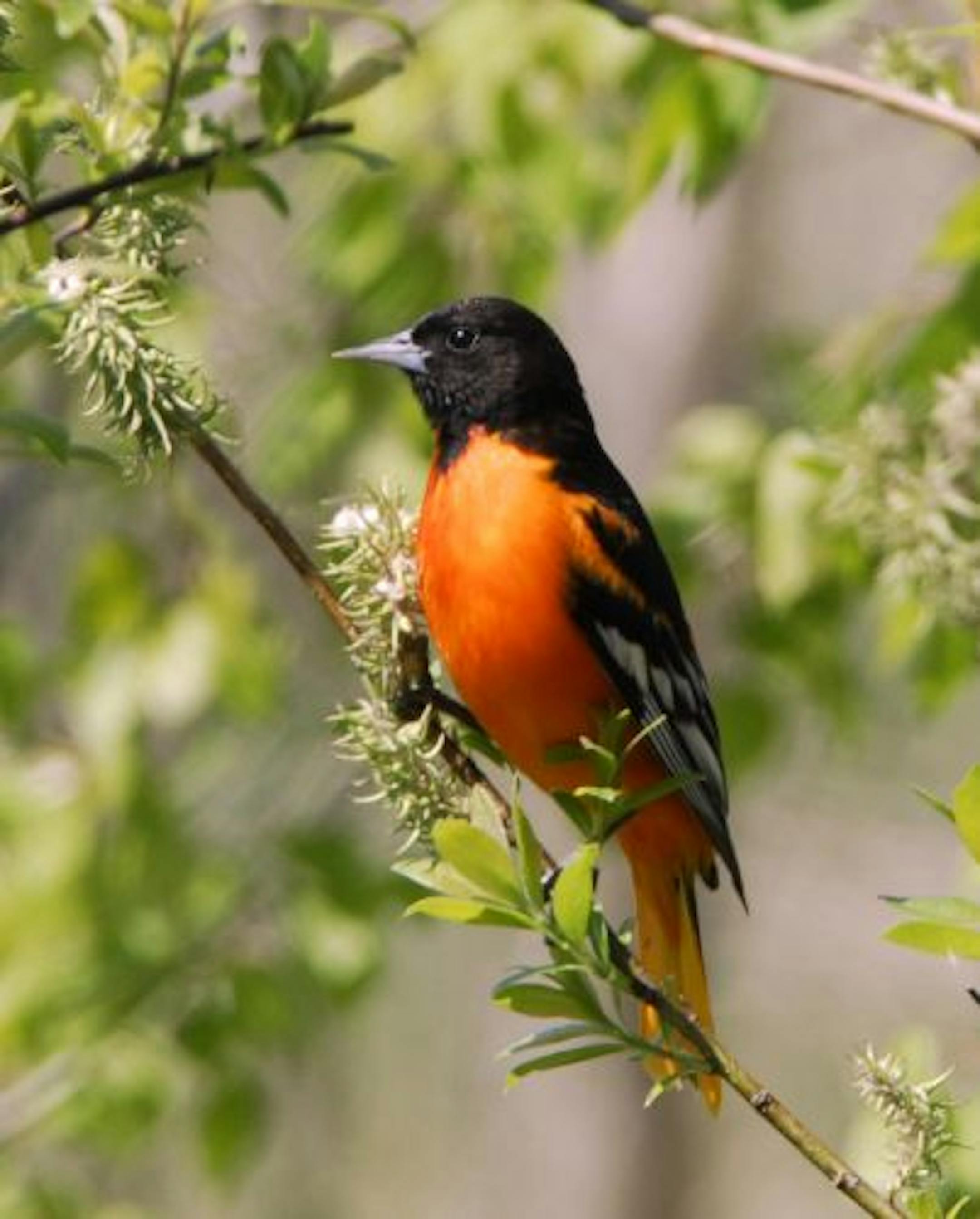
The bright orange-and-black Baltimore oriole, about the size of a cardinal, settles on the top of a tree, frequently near water to whistle his beautiful song. Males often engage in territorial disputes, chasing each other to and fro, making themselves even more conspicuous. These handsome birds are among the migrants that stop and raise their young in the metro area, and are known for their intricately woven nests hanging at the ends of branches.
Sweet-singing grosbeaks
Another good-sized bird shows up suddenly at feeders in mid-May. The handsome rose-breasted grosbeak, one of the sweetest singers on the block, sports a black back, white front and a rose-red bandana around its neck. You'll have to look closely for these cardinal-sized birds, however; even with such a high-contrast coat, they can be strangely difficult to spot.
A burry song from a tall tree signals the scarlet tanager's return. About the size of a cedar waxwing, the tanager is an almost unbelievably neon-red bird. You won't confuse it with a cardinal because tanagers lack a crest, and their red is so much more intense. The tanager's all-black wings are another distinguishing mark that says, "I am so not a cardinal."
Spring is such a noisy season, filled with exuberant bird sounds, that it's sometimes a challenge to single out one particular song -- especially when the singer knows up to 2,000 sounds, as the brown thrasher does, and links them together in always-varying melodic phrases. You'll often find this large (blue-jay size) long-tailed, cinnamon-colored bird at the top of a tree, running through his repertoire, or hunting insects on the ground.


