
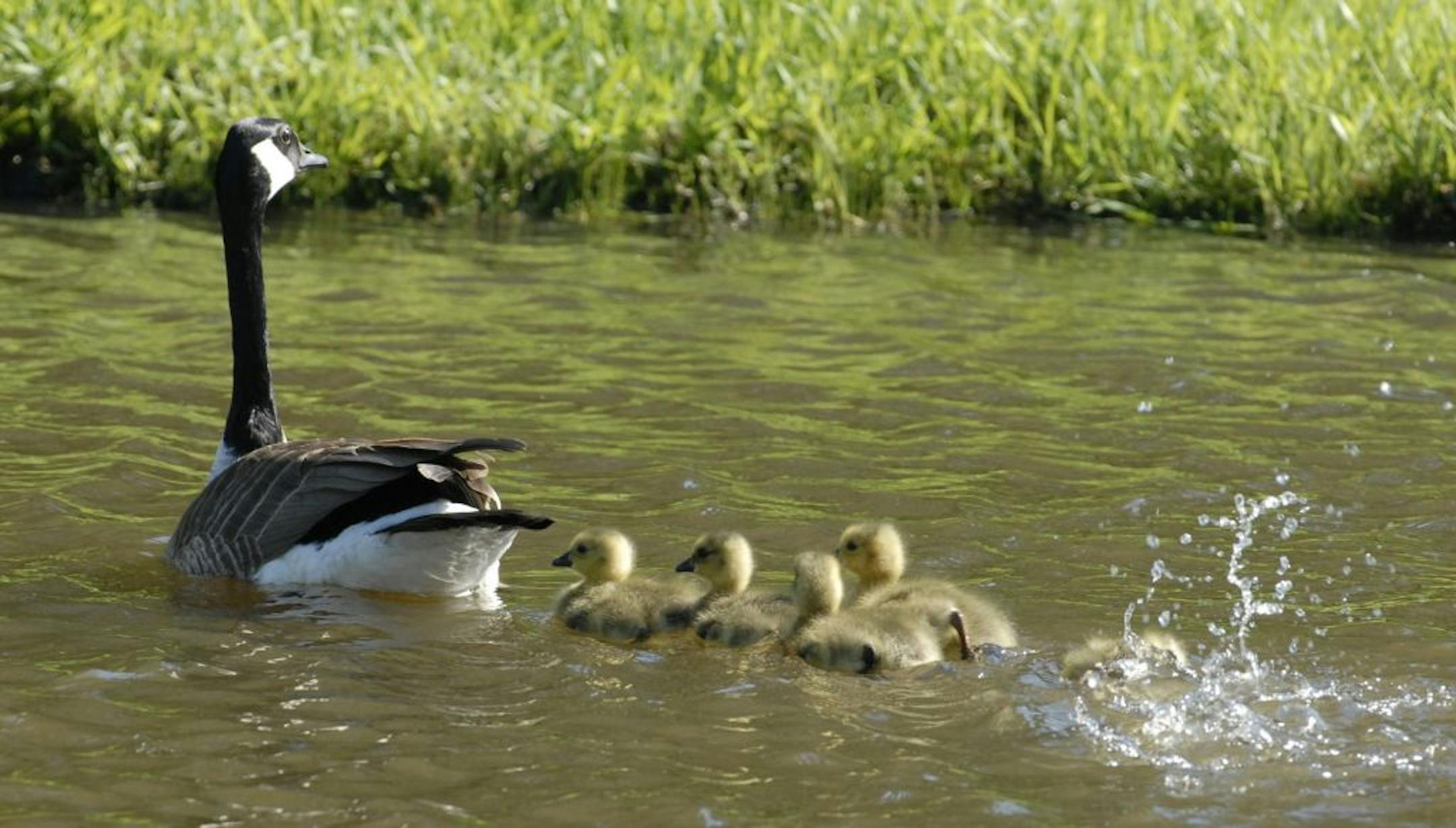
Big batch of goslings is goose day care

Youngsters from several different nests may join up and follow the closest adults.

July 10, 2012 at 7:13PM
Canada goose with goslings
credit: Jim Williams
Canada goose with goslings (Star Tribune/The Minnesota Star Tribune)

Q I counted 25 young geese swimming along with two adult birds on our local lake. This just boggles my mind. Any thoughts?

A You observed a mixed brood of Canada geese, an aggregation called a "super brood" or a crèche by researchers. A Canada goose nest contains an average of five eggs, while the largest nests might hold eight eggs.

Where there are large concentrations of Canada geese living side by side, such as in our metro area, youngsters from several different nests may join up and follow the closest adults. There's little cost to the adult geese, since there's not much real care required to raise young waterfowl. The grown-up geese primarily watch for danger, maintaining vigilance against predators.

If you look closely at these goose gangs, you'll notice that some goslings are larger and more fully feathered, and some are small and covered in yellow down, indicating a range of ages.

Nest eviction Q Cardinals have nested in a shrub near our front door for years, but this May, after their nest was nearly complete, two robins took it over. They evicted the cardinals and enlarged the nest, and then the female laid her eggs. Is this behavior unusual?

A I'd never heard of robins being so assertive as to take over another species' nest. But robins are smart and opportunistic, and may not have had many options for their own nest site. They may have lost their own nest to a predator or to the weather, and decided to cut some corners so they could start another brood more quickly. I'm hoping the cardinals soon found a new location for their own nest.

Guide gaps Q I have a problem with bird field guides: They only seem to help those who already know a lot about birds. But to look up a mystery bird they don't help at all -- I have to look at every page to find a new bird's name. Is there a Web page for looking up unknown birds?

A You're right, field guides to birds can be a challenge to use if you don't even know which family a bird belongs to. If you don't know where to start, you'll probably find this Web page helpful: www.allaboutbirds.org. The Cornell Lab of Ornithology maintains this site, which allows you to type in a general feature, such as "black bird" or "small bird" and it will come up with options. It's an excellent site, loaded with information and recordings of bird songs.

Sparrow solution Q I've spent a lot of time trying to figure out how to keep sparrows out of my feeders. One thing that I'd recommend is the "Magic Halo." It really does work. You might want to share this with readers.

A Thanks for the excellent and timely tip, with local sparrow populations getting a big boost as young birds just out of the nest join the flock. This device, with hanging wires, was developed by a researcher at the University of Nebraska. It does seem to work well at keeping sparrows out of feeders and is based on their relative lack of maneuverability in flight. The halo is available at wild bird supply stores or you could make one yourself. Find out more at www.sialis.org/halo.htm.

Birdbath problems Q We've recently added a birdbath to our back-yard feeding system and have had some gruesome discoveries in the past few days. Twice we've found small dead birds in the water, with most of the feathers stripped off. We have a lot of crows in the neighborhood -- could they have anything to do with this?

A As much as I'm a fan of crows I'll have to say I'll bet they are the culprits here. Crows tend to bring food items in to birdbaths, and sometimes they just leave them there. The birds you've found might not have been stripped of their feathers: Crows are notorious nest raiders, so these could have been nestlings who hadn't yet produced their first feathers.

Grackle grief Q I've had problems with grackles at my feeders for years, but there are so many more this year, and they're eating me out of house and home and scaring off the other birds. Any advice would be appreciated.

A This does seem to be a banner year for grackles, a species that nests early and is eager to feed its young from any and all sources. My best advice is to take down the feeders for a week, which should discourage these big, black birds. This seems to be the only effective way to deal with bird hogs. Once the grackles move on you can put the feeders back outside and your regular birds should soon return.

Val Cunningham, a St. Paul nature writer, bird surveyor and field trip leader, can be reached at valwrites@comcast.net.

about the writer

about the writer

VAL CUNNINGHAM, Contributing Writer

More from Minnesota Star Tribune

See More
card image
J. SCOTT APPLEWHITE, ASSOCIATED PRESS/The Minnesota Star Tribune

The "winners" have all been Turkeys, no matter the honor's name.

In this photo taken Monday, March 6, 2017, in San Francisco, released confidential files by The University of California of a sexual misconduct case, like this one against UC Santa Cruz Latin Studies professor Hector Perla is shown. Perla was accused of raping a student during a wine-tasting outing in June 2015. Some of the files are so heavily redacted that on many pages no words are visible. Perla is one of 113 UC employees found to have violated the system's sexual misconduct policies in rece